

Last updated: October 2021
The restructuring of the main road Gran Via Fernando el Catolico has seen a rehabilitation of its green areas in two distinct plots: one occurring at its intersection with Calle Lagasca, and one at its intersection with Corona de Aragon. The intervention is connected to relieving the heat island effect that occurs in the city center, increase greenery with the planting of 114 new trees and making the main traffic artery more accessible and pleasant to pedestrians. (Ref. 1-5)
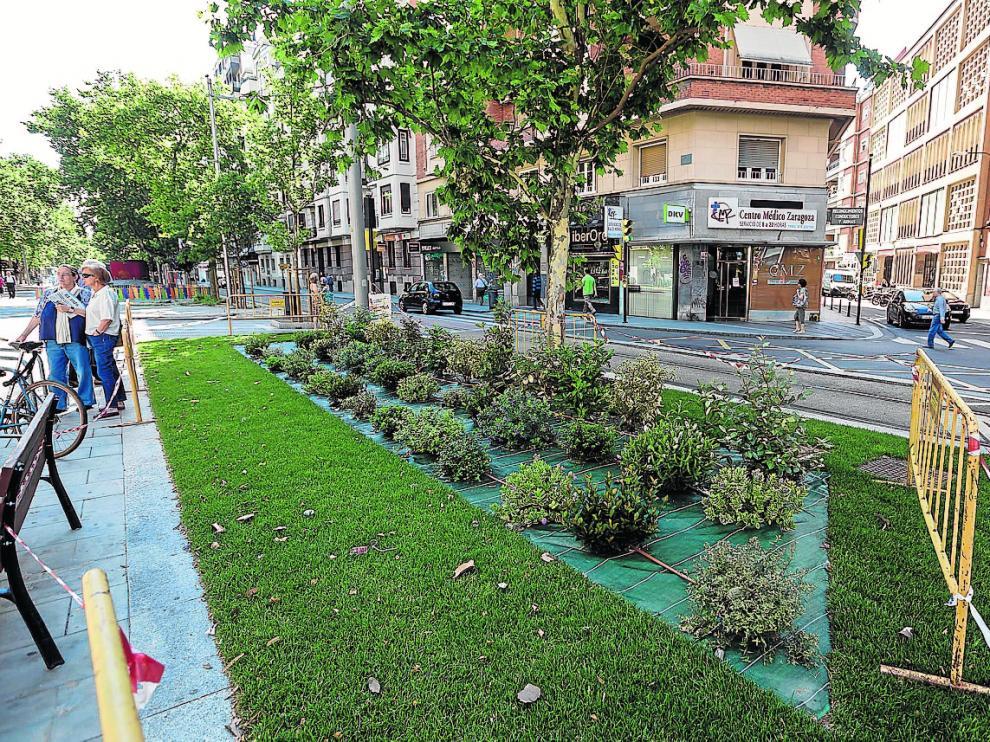
Bushes and flowers in pilot garden of Gran Via
Source: Ref. 4, Oliver Duch
Overview
Nature-based solution
- Grey infrastructure featuring greens
- Alley or street trees and other street vegetation
Key challenges
- Climate action for adaptation, resilience and mitigation (SDG 13)
- Climate change adaptation
- Green space, habitats and biodiversity (SDG 15)
- Green space creation and/or management
- Regeneration, land-use and urban development
- Regulation of built environment
- Inclusive and effective governance (SDG 16)
- Inclusive governance
Focus
Creation of new green areas, Maintenance and management of urban nature, Improved governance of green or blue areas
Project objectives
- Rehabilitation of pedestrian space and trees, due to the consequences the tram line installation construction works had on the trees and pedestrian space. (Ref. 1,4,5)
- Three-phase redevelopment of the Gran Via (Ref. 1-4)
- Ensure citizen participation through consultation of pilot gardens (Ref. 1-4)
- See which of the 2 pilot gardens better adjusts to the area's conditions and climate (Ref. 1-4)
Implementation activities
The first phase of the project had 114 new trees were planted (Ref. 1,2)
The second phase was the replacement of benches along the green areas of the road (Ref. 2)
The last and ongoing phase is the improvement of the garden areas. (Ref. 1, 2)
Involvement of local citizens in consultation of pilot gardens (Ref. 1-4)
Documents mention that the selection of greenery is innovative in that it avoids the planting of allergens. (Ref 1)
Climate-focused activities
Climate change adaptation:
- Increase or improve urban vegetation cover to help reduce outdoor temperature
Main beneficiaries
- Local government/Municipality
- Citizens or community groups
Governance
Management set-up
- Government-led
Type of initiating organisation
- Local government/municipality
Participatory approaches/ community involvement
- Consultation (e.g. workshop, surveys, community meetings, town halls)
- Citizen monitoring and review
Details on the roles of the organisations involved in the project
Ayuntamiento (City Council of Zaragoza) leading the project for the road's restructuring (Ref. 1-4)
Although costs for the specific intervention are not yet finalized, only two pilot installations are in place, the City Government is the one funding the consultation installations. (ref 1)
Project implemented in response to ...
... an EU policy or strategy?
Unknown
... a national policy or strategy?
Unknown
... a local policy or strategy?
Yes
(Urban Organizational Plan 2000 (Plan de Ordenacion Urbana) included the plans to install a tram-line along the Gran Via. The current intervention comes as a follow-up to the tram line installation due to the consequences the construction works had on the trees and the need to rehabilitate the pedestrian space. (Ref. 5))
Financing
Total cost
Unknown
Source(s) of funding
- Public local authority budget
Type of funding
- Earmarked public budget
- Unknown
Non-financial contribution
Unknown
Impacts and Monitoring
Environmental impacts
- Climate change
- Lowered local temperature
- Green space and habitat
- Increased green space area
Economic impacts
- Unknown
Socio-cultural impacts
- Social justice and cohesion
- Increased involvement of locals in the management of green spaces
- Other
Type of reported impacts
Achieved impacts
Presence of formal monitoring system
Unknown
Presence of indicators used in reporting
No evidence in public records
Presence of monitoring/ evaluation reports
No evidence in public records
Availability of a web-based monitoring tool
No evidence in public records
References
1. Ayuntamiento de Zaragoza. (2017). Noticias. Los vecinos del eje Gran Vía – Fernando el Católico deciden el tipo de ajardinamiento de los parterres del bulevar. Available at: Source link. [Accessed: 31 August 2020].
2. El Periódico de Aragón. (n.d.). El eje de Gran Vía estrena la renovación de sus jardineras. Available at: Source link. [Accessed 31 August 2020].
3. Aragon Digital. (2017) Gran Vía prueba un segundo tipo de ajardinamiento para elegir el definitivo en septiembre. Available at: Source link. [Accessed 31 August 2020].
4. Lisbona, J. (2017). Gran Vía prueba ya la nueva vegetación que culminará las mejoras del bulevar. Available at: Source link. [Accessed 31 August 2020].
5. Diario Aragones. (2015). Catorce árboles del eje Gran Vía-Fernando el Católico se talarán en agosto. [Not available in 2020].
2. El Periódico de Aragón. (n.d.). El eje de Gran Vía estrena la renovación de sus jardineras. Available at: Source link. [Accessed 31 August 2020].
3. Aragon Digital. (2017) Gran Vía prueba un segundo tipo de ajardinamiento para elegir el definitivo en septiembre. Available at: Source link. [Accessed 31 August 2020].
4. Lisbona, J. (2017). Gran Vía prueba ya la nueva vegetación que culminará las mejoras del bulevar. Available at: Source link. [Accessed 31 August 2020].
5. Diario Aragones. (2015). Catorce árboles del eje Gran Vía-Fernando el Católico se talarán en agosto. [Not available in 2020].