

Last updated: October 2021
The scheme of the single storey extension building ‘the Irene Kennedy Centre’ (Wirral Churches’ Ark Project, known as, Wirral Ark; a registered charity) includes a sedum roof which provides a more pleasant outlook from the existing upper floor bedrooms, whilst also maximizing environmental potential. (Ref. 1)
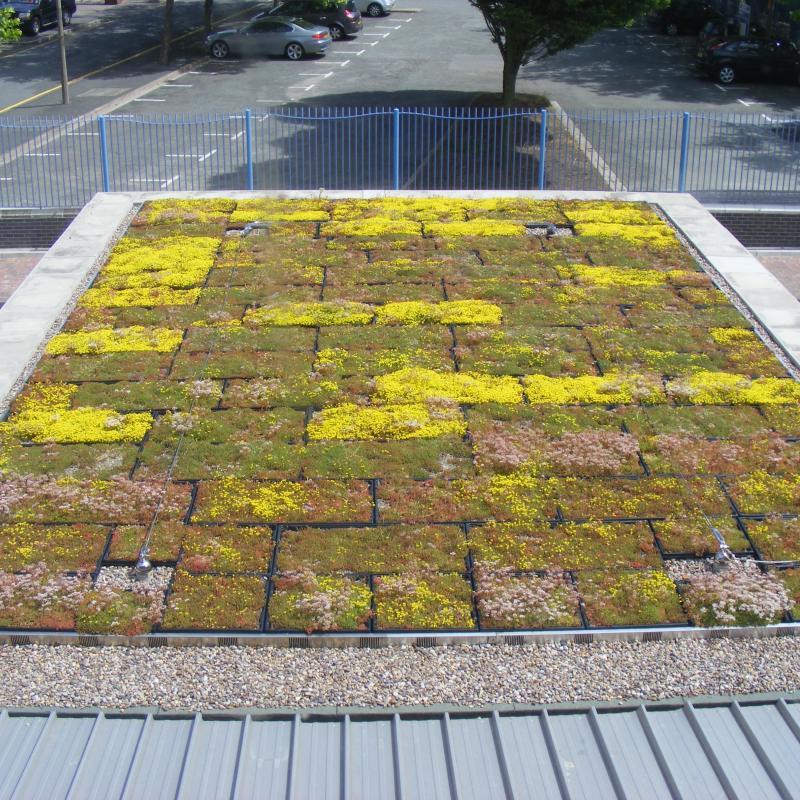
Irene K Centre Wirral Ark (Ref. 1)
Irene K Centre Wirral Ark (Ref. 1)
Overview
Nature-based solution
- Nature on buildings (external)
- Green roofs
Key challenges
- Water management (SDG 6)
- Stormwater and rainfall management and storage
- Green space, habitats and biodiversity (SDG 15)
- Green space creation and/or management
- Health and well-being (SDG 3)
- Improving physical health
- Creation of opportunities for recreation
Focus
Creation of new green areas
Project objectives
Aim of the roof scheme: maximizing environmental potential by: “reducing storm water run-off into existing drains, providing additional thermal insulation, providing a habitat for birds and insects. The whole project was designed to be as environmentally friendly as possible – both to reduce energy and water costs, and to provide a more healthy and inspirational environment”. (Ref. 1)
-The Irene Kennedy Centre, a new single storey, multi-purpose extension to existing Hostel for the Homeless, part of an ongoing phased development at the Wirral Ark, which incorporates the green roof. (Ref. 2) Also, the CEO of Wirral Ark said "As an organisation we are keen to protect our planet and recycle, reuse and turn off as much as we can. This roof is a continuation of this policy." (Ref. 2, 3)
Implementation activities
“The Irene Kennedy Centre, a single storey, multi-purpose extension to existing Hostel for the Homeless, part of an ongoing phased development at the Wirral Ark”. The scheme “maximises use of environmental products to minimise running costs and conserve resources. Incorporates a modular green sedum roof to allow for relocation of the trays in the event of future extension upwards. The green roof as well as providing a pleasing outlook from the first and second floors, also helps to moderate room temperature, whilst also helping to reduce water surges into the drainage system”. The Irene Kennedy Centre is winner of “the Green Apple Environmental Best Practice Award 2010 and Built Environment Award 2011”. (Ref. 2)
Main beneficiaries
- Non-government organisation/Civil Society
- Marginalized groups: Socio-economically disadvantaged populations (e.g. low-income households, unemployed), Other
- Other
Governance
Management set-up
- Led by non-government actors
Type of initiating organisation
- Non-government organisation/civil society
- Citizens or community group
- Other
Participatory approaches/ community involvement
- Co-planning (e.g. stakeholder workshops, focus groups, participatory mapping)
- Taskforce groups
- Citizen oversight (e.g. boards, advisory)
Details on the roles of the organisations involved in the project
“The Irene Kennedy Centre, a single storey, multi-purpose extension to existing Hostel for the Homeless, part of an ongoing phased development at the Wirral Ark”. Part of Wirral Ark's policy (Wirral Ark i.e. Wirral Churches’ Ark Project is a registered charity). (Ref. 2) Designed by Denovo Design Architects and built by Wirral Construction Company, JFW Construction. (Ref. 3) . Funded through National Lottery Charity funding and donations from local businesses. (Ref. 4)
Project implemented in response to ...
... an EU policy or strategy?
Unknown
... a national policy or strategy?
Unknown
... a local policy or strategy?
No
(Part of Wirral Ark’s policy. The CEO of Wirral Ark said "As an organisation we are keen to protect our planet and recycle, reuse and turn off as much as we can. This roof is a continuation of this policy." (Ref. 2, 3) )
Financing
Total cost
Unknown
Source(s) of funding
- Other
Type of funding
- Direct funding (grants, subsidies, or self-financed projects by private entities)
- Donations
Non-financial contribution
Unknown
Impacts and Monitoring
Environmental impacts
- Climate change
- Lowered local temperature
- Environmental quality
- Improved waste management
- Reduced noise exposure
- Water management and blue areas
- Improved stormwater management
- Green space and habitat
- Increased green space area
- Increased number of species present
Economic impacts
- Unknown
Socio-cultural impacts
- Social justice and cohesion
- Increased visibility and opportunity for marginalised groups or indigenous peoples
- Other
Type of reported impacts
No impacts reported
Presence of formal monitoring system
Unknown
Presence of indicators used in reporting
No evidence in public records
Presence of monitoring/ evaluation reports
No evidence in public records
Availability of a web-based monitoring tool
No
References
Ref. 1. Riba Architecture (2010) The Wirral Ark Sheltered Housing. Denovo Design Ldt Projects. Information obtained: 2017-07-25. [Website not available in 2020]
Ref. 2. Denovo Design (2012) Wirral Ark. Information obtained: 2017-07-25. [Website not available in 2020]
Ref. 3. RBKC Gov UK (n.d.) Greengrid Modular Green Roof System. SealEco Ltd. Source: Source link [Accessed on 27 August 2020]
Ref. 4. Wirral Ark (n.d.) Our History. About us. Wirral Churches’ Ark Project, Wirral. Information obtained: 2017-07-25. Source: Source link [Accessed on 27 August 2020]
Ref. 5. Wirral Council (2014) Wirral climate change strategy 2014-2019. Cool Wirral climate change action. Source: Source link [Accessed on 27 August 2020]
Ref. 2. Denovo Design (2012) Wirral Ark. Information obtained: 2017-07-25. [Website not available in 2020]
Ref. 3. RBKC Gov UK (n.d.) Greengrid Modular Green Roof System. SealEco Ltd. Source: Source link [Accessed on 27 August 2020]
Ref. 4. Wirral Ark (n.d.) Our History. About us. Wirral Churches’ Ark Project, Wirral. Information obtained: 2017-07-25. Source: Source link [Accessed on 27 August 2020]
Ref. 5. Wirral Council (2014) Wirral climate change strategy 2014-2019. Cool Wirral climate change action. Source: Source link [Accessed on 27 August 2020]