

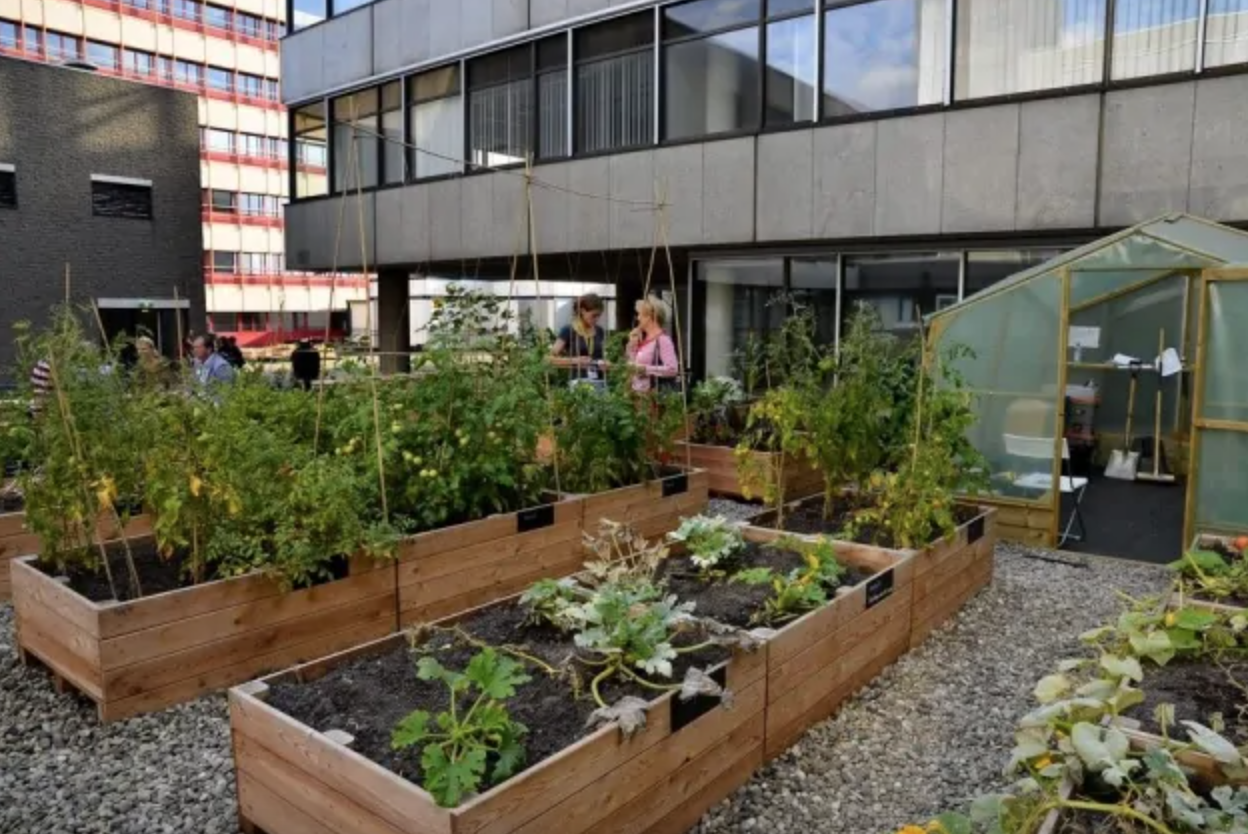
The Garden Factory ('Tuinfabriek') is an exceptional urban agriculture project on a roof of the central station that aims at becoming the largest food-producing roof of the Netherlands. The project is a self-sustaining vegetable garden located on the roof of a busy mall in the centre of Utrecht (ref. 5). On the roof, citizens, students, company employees and schools work together to grow vegetables and keep bees and chicken. The Garden Factory reflects an ecological 'self-sustaining factory' as the chickens, worms and bees 'work' in the garden as being part of the decomposing system and pollination and a system is built for rainwater retention that allows for irrigation (ref. 1). Eating, composting, sowing, growing, harvesting, cooking form the production process of this Garden Factory (ref. 4). The main elements of the roof garden are in place, such as the crop bins, the chicken coop and the decomposing machine are completed. However, it is an ongoing developing project as some elements are still in development stage such as some elements of the Soup Kitchen and the aim is to integrate the Garden Factory more with the central station shopping mall in multiple ways (ref. 1).
Overview
Nature-based solution
- Nature on buildings (external)
- Green roofs
- Community gardens and allotments
- Community gardens
- Green areas for water management
- Sustainable urban drainage systems
Key challenges
- Water management (SDG 6)
- Stormwater and rainfall management and storage
- Green space, habitats and biodiversity (SDG 15)
- Habitat and biodiversity conservation
- Green space creation and/or management
- Environmental quality
- Soil quality improvement
- Regeneration, land-use and urban development
- Promote natural styles of landscape design for urban development
- Social justice, cohesion and equity (SDG 10)
- Social cohesion
- Social interaction
- Sustainable consumption and production (SDG 12)
- Sustainable consumption
- Sustainable production
Focus
Project objectives
Implementation activities
Biodiversity conservation or restoration-focused activities
Biodiversity conservation:
- Protect and enhance urban habitats
- Create new habitats
- Protect species
- Undertake specific measures to protect species
- Undertake specific measures to protect native species
- Undertake specific measures to protect valued species
- Means for conservation governance
- Manage biological resources for conservation and sustainable use
- Raise public awareness
- Public engagement
Main beneficiaries
- Public sector institution (e.g. school or hospital)
- Private sector/Corporate/Company
- Citizens or community groups
Governance
Management set-up
- Led by non-government actors
Type of initiating organisation
- Private sector/corporate actor/company
- Citizens or community group
- Other
Participatory approaches/ community involvement
- Crowd-sourcing/Crowd-funding/Participatory budget
- Taskforce groups
- Dissemination of information and education
- Joint implementation (e.g. tree planting)
- Co-management/Joint management
- Citizen oversight (e.g. boards, advisory)
Details on the roles of the organisations involved in the project
Project implemented in response to ...
Financing
Total cost
Source(s) of funding
- Crowdfunding
Type of funding
- Donations
Non-financial contribution
- Provision of goods
- Provision of labour
- Other
- Public authorities (e.g. land, utility services)
- Citizens (e.g. volunteering)
Impacts and Monitoring
Environmental impacts
- Water management and blue areas
- Improved stormwater management
- Green space and habitat
- Increased green space area
- Increased number of species present
- Enhanced support of pollination
Economic impacts
- Increase in agricultural production (for profit or not)
Socio-cultural impacts
- Social justice and cohesion
- Improved access to urban green space
- Increased opportunities for social interaction
- Increased access to healthy/affordable food
- Increased sustainability of agriculture practices
- Education
- Increased support for education and scientific research
Type of reported impacts
Presence of formal monitoring system
Presence of indicators used in reporting
Presence of monitoring/ evaluation reports
Availability of a web-based monitoring tool
References
2. Mathieu. (2014). De tuinfabriek: moestuinieren op het dak van Hoog Catherijne. [online] Available at: Source link (Accessed 29 July 2020)
3. Dutch Design Awards. (2014). Studio Ester van de Wiel De Tuinfabriek. [online] Available at: Source link (Accessed 29 July 2020)
4. Ester van de Wiel. (n.d.). The Garden Factory (2013 – 2017). Available at: Source link (Accessed 29 July 2020)
5. InsideFlows. (n.d.). The garden factory. Available at: Source link (Accessed 29 July 2020)