

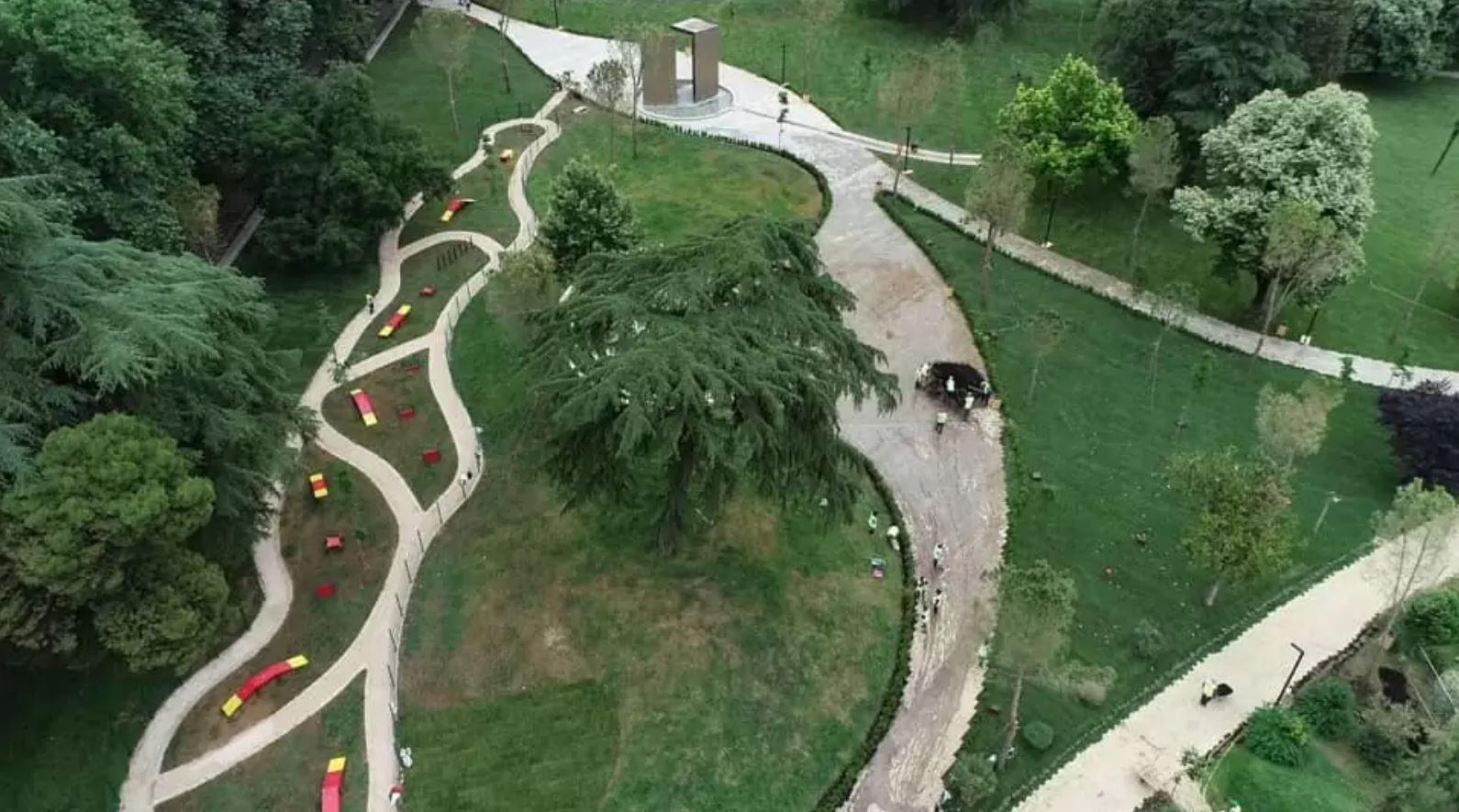
Rinia Park has been a significant social and recreational area in the center of Tirana since the 1950s. Over the years, it has undergone several phases of development and restructuring, each linked to the socio-political regime of the time (Ref. 1). Its most recent rehabilitation was driven by the need to revitalize public spaces and improve the quality and accessibility of urban green areas. In 2019, extensive work on enhancing the park’s infrastructure and amenities began. By June 2020, installations were completed, including new and diverse playgrounds for children, improved lighting and drainage systems, expanded walking paths as well as designated chess and dog areas (Ref. 1,2,6). Both children and the elderly benefit from these new features, which promote social interaction and make the park more inclusive for different age groups (Ref. 2). To protect the Independence Monument from vandalism, a surrounding water feature was added. An additional benefit of the the new lighting installation is the extended access of the park well into the evening (Ref. 1,6). Given the park’s profound history, it stands as a symbol of urban renewal and continues to serve as a central gathering spot for people and cultural events (Ref. 7).
Overview
Nature-based solution
- Parks and urban forests
- Large urban parks or forests
Key challenges
- Green space, habitats and biodiversity (SDG 15)
- Green space creation and/or management
- Water management (SDG 6)
- Stormwater and rainfall management and storage
- Cultural heritage and cultural diversity
- Protection of historic and cultural landscape/infrastructure
- Health and well-being (SDG 3)
- Creation of opportunities for recreation
- Enabling opportunities for physical activity
- Improving physical health
- Social justice, cohesion and equity (SDG 10)
- Social interaction
- Sense of community and community engagement
Principal problems in Functional Urban Area (FUA)
- Land use and Socio-economic change
- Unequal availability and access to public green spaces
- Health, Well-being and Social cohesion
- Inadequate access to recreational opportunities
- Poor community engagement
Key priorities
Focus
Project objectives
Implementation activities
Main beneficiaries
- Citizens or community groups
- Young people and children
- Other
Governance
Management set-up
- Government-led
Type of initiating organisation
- Local government/municipality
Participatory approaches/ community involvement
- The project didn't involve any form of stakeholder participatory activities
Details on the roles of the organisations involved in the project
Project implemented in response to ...
Type of enablers
Financing
Total cost
Source(s) of funding
- Public local authority budget
Type of funding
- Earmarked public budget
Non-financial contribution
Impacts and Monitoring
Environmental impacts
- Environmental quality
- Reduced noise exposure
- Achieved reduced noise exposure
- Green space and habitat
- Increased green space area
- Achieved increased green space area
- Increased number of species present
- Achieved increased number of species present
Economic impacts
- Unknown
Socio-cultural impacts
- Social justice and cohesion
- Improved access to urban green space
- Achieved improved access to urban green space
- Increased opportunities for social interaction
- Achieved increased opportunities for social interaction
- Health and wellbeing
- Gain in activities for recreation and exercise
- Achieved gain in activities for recreation and exercise
- Improved physical health
- Expected improved physical health
- Cultural heritage and sense of place
- Protection of historic and cultural landscape / infrastructure
- Achieved protection of historic and cultural landscape / infrastructure
Type of reported impacts
Presence of formal monitoring system
Presence of indicators used in reporting
Presence of monitoring/ evaluation reports
Availability of a web-based monitoring tool
Potential risks of implementation and trade-offs
References


 Information about this nature-based solution was collected as part of the Naturescapes project funded by the European Union under Grant Agreement No 101084341.