

Thessaloniki has a dense urban structure with limited open and green spaces. As a coastal city severely impacted by climate change, it faces multiple interconnected challenges, including extreme weather events, flooding, and peri-urban forest fires. These issues are further compounded by the city's aging infrastructure and deteriorating buildings, increasing its vulnerability (Ref 1). Kipos 3, a community garden, is part of the "Green Neighborhoods" project proposed in the Thessaloniki 2030 municipal resilience strategy (ibid.). Established in 2015 on a 600-square-meter plot donated by the municipality, the garden is now managed by 30 local families under the continued stewardship of the Municipality (Ref 2, 3). The garden's creation was supported by a team of architects, landscape architects, and agriculturists, and features a variety of herbs and edible plants grown using permaculture methods (Ref 3). The garden hosts a greenhouse along a range of environmental, recreational, and educational activities, providing an opportunity to foster a more cohesive, inclusive, and resilient community. It also serves as a space for synergies and discussions about the future of the city (Ref 3, 4). Recognized as a good practice, the intervention has been showcased in national, European, and international networks (Ref 2, 4).
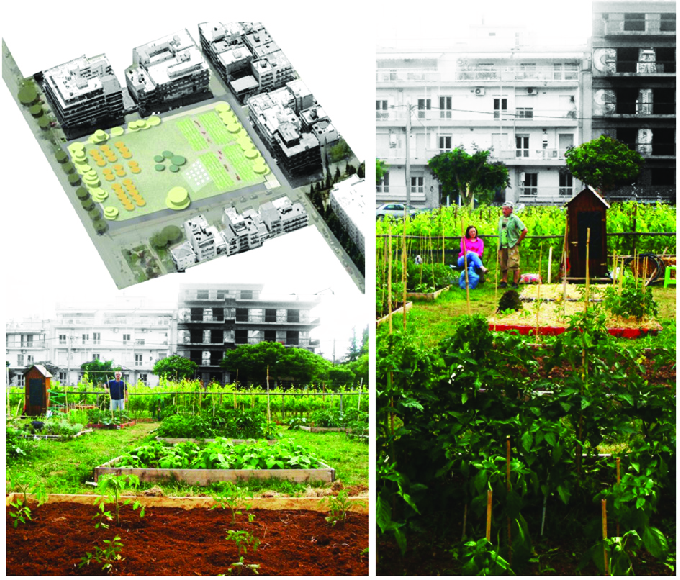
Overview
Nature-based solution
- Community gardens and allotments
- Community gardens
- Other
Key challenges
- Climate action for adaptation, resilience and mitigation (SDG 13)
- Climate change adaptation
- Green space, habitats and biodiversity (SDG 15)
- Green space creation and/or management
- Habitat and biodiversity restoration
- Regeneration, land-use and urban development
- Promote natural styles of landscape design for urban development
- Health and well-being (SDG 3)
- Creation of opportunities for recreation
- Inclusive and effective governance (SDG 16)
- Inclusive governance
- Social justice, cohesion and equity (SDG 10)
- Social cohesion
- Environmental education
- Sense of community and community engagement
- Sustainable consumption and production (SDG 12)
- Sustainable production
Principal problems in Functional Urban Area (FUA)
- Climate-Related Hazards
- Coastal flooding
- Urban flooding (stormwater)
- Coastal hazards (e.g. erosion, flooding)
- Heat stress & Extreme temperatures
- Forest fires and wildfires
- Extreme weather events (e.g. storms, hurricanes)
- Land use and Socio-economic change
- Economic losses due to disasters and environmental degradation
- Unequal availability and access to public green spaces
Key priorities
Focus
Project objectives
Implementation activities
Climate-focused activities
Climate change adaptation:
- Increase urban vegetation cover to reduce urban heat island effect
Biodiversity conservation or restoration-focused activities
Biodiversity restoration:
- Restore native species
- Restore endangered species
Main beneficiaries
- Local government/Municipality
- Public sector institution (e.g. school or hospital)
- Researchers/University
- Citizens or community groups
- Young people and children
- Marginalized groups: Children, young people or youth groups
Governance
Management set-up
- Co-governance with government and non-government actors
Type of initiating organisation
- Local government/municipality
- Researchers/university
Participatory approaches/ community involvement
- Co-planning (e.g. stakeholder workshops, focus groups, participatory mapping)
- Dissemination of information and education
- Consultation (e.g. workshop, surveys, community meetings, town halls)
- Citizen monitoring and review
Details on the roles of the organisations involved in the project
Project implemented in response to ...
Type of enablers
Financing
Total cost
Source(s) of funding
- Multilateral funds/international funding
- Private Foundation/Trust
Type of funding
- Direct funding (grants, subsidies, or self-financed projects by private entities)
Non-financial contribution
- Provision of land
- Provision of labour
- Public authorities (e.g. land, utility services)
- Citizens (e.g. volunteering)
Impacts and Monitoring
Environmental impacts
- Climate change
- Lowered local temperature
- Expected lowered local temperature
- Green space and habitat
- Increased green space area
- Achieved increased green space area
- Increased number of species present
- Expected increased number of species present
Economic impacts
- Generation of other type of work opportunities (e.g. voluntary, work for rehabilitation)
- Achieved generation of other type of work opportunities (e.g. voluntary, work for rehabilitation)
- Increase in agricultural production (for profit or not)
- Achieved increase in agricultural production (for profit or not)
Socio-cultural impacts
- Social justice and cohesion
- Improved access to urban green space
- Achieved improved access to urban green space
- Increased opportunities for social interaction
- Achieved increased opportunities for social interaction
- Increased involvement of locals in the management of green spaces
- Achieved increased involvement of locals in the management of green spaces
- Increased sustainability of agriculture practices
- Achieved increased sustainability of agriculture practices
- Health and wellbeing
- Gain in activities for recreation and exercise
- Expected gain in activities for recreation and exercise
- Education
- Increased support for education and scientific research
- Achieved increased support for education and scientific research
Type of reported impacts
Presence of formal monitoring system
Presence of indicators used in reporting
Presence of monitoring/ evaluation reports
Availability of a web-based monitoring tool
Potential risks of implementation and trade-offs
References
 Information about this nature-based solution was collected as part of the Naturescapes project funded by the European Union under Grant Agreement No 101084341.