

Last updated: October 2021
Greened-over urban railway tracks (grass tracks) is a city-wide program in Stuttgart which assumes the construction of tram lines with grassed-over tracks. This applies not only to planning and construction but also long-term maintenance (ref 1).
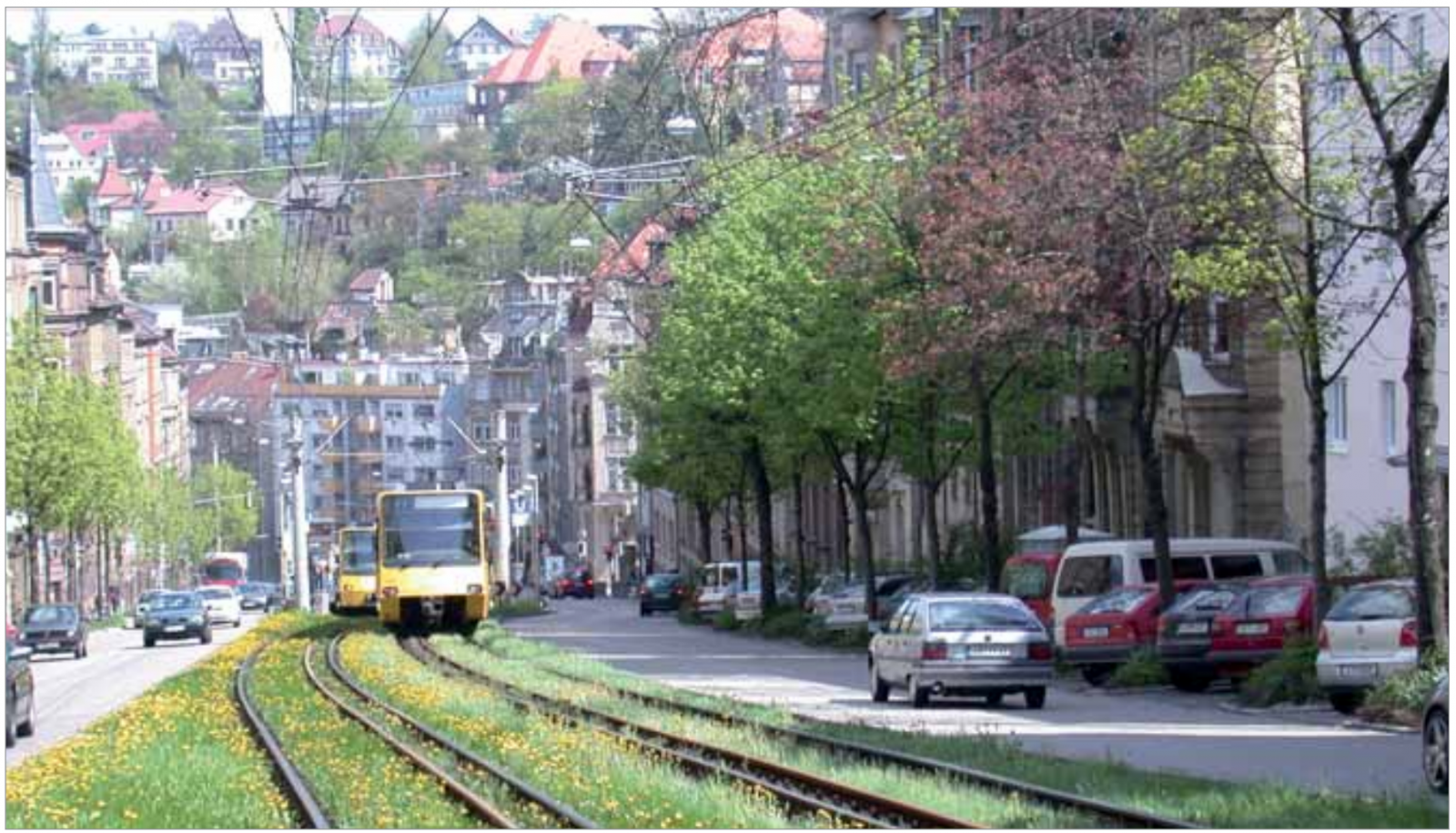
Stadtklima Stuttgart
https://www.stadtklima-stuttgart.de/stadtklima_filestorage/download/AfU-Heft-3-2010-Web.pdf
Overview
Nature-based solution
- Grey infrastructure featuring greens
- Railroad bank and track greens
Key challenges
- Climate action for adaptation, resilience and mitigation (SDG 13)
- Climate change mitigation
- Green space, habitats and biodiversity (SDG 15)
- Green space creation and/or management
- Environmental quality
- Air quality improvement
- Noise reduction
- Regeneration, land-use and urban development
- Regulation of built environment
Focus
Creation of new green areas
Project objectives
1. Decrease in CO2 emissions;
2. Decrease the heat in the city center;
3. Revive the pedestrianism in the city;
4. Increase green space fraction in the roadsides;
5. Make the urban environment more comfortable and liveable for residents;
6. Reduction of noise reflection;
7. Increase in biodiversity (ref 1, 2, 4).
Implementation activities
1. Maintainance and expansion of green spaces along the tram tracks
2. Improving the sidewalks for pedestrians
3. Introduction of high reflection building and road materials, high reflection points for vehicles
4. Planting new trees (ref 1, 2)
Climate-focused activities
Climate change mitigation:
- Install vertical or horizontal artificial surfaces that help with carbon storage and cooling
Main beneficiaries
- Citizens or community groups
Governance
Management set-up
- Government-led
Type of initiating organisation
- Local government/municipality
- Private sector/corporate actor/company
Participatory approaches/ community involvement
- Unknown
Details on the roles of the organisations involved in the project
Tram companies operating in Stuttgart, for example, Stuttgarter Straßenbahnen AG (SSB). (ref 5)
Project implemented in response to ...
... an EU policy or strategy?
Yes
(1. UN Framework Convention on Climate Change (ref 2))
... a national policy or strategy?
Yes
(1. The “Act on the Prevention of Harmful Effects on the Environment Caused by Air Pollution, Noise, Vibration and Similar Phenomena” (or in short BImSchG –Federal Immission Control Act) (1) The BImSchG regulates the admissibility of plants and products using factors such as emission limits, which in the final reckoning does reduce the release of substances damaging to the climate.
2. "Development Planning Act" (Building Code). Within the framework of development planning, landscape and green space plans are used as a way of implementing the objectives of nature and landscape conservation. These encompass an inventory of natural conditions in the relevant area and the claims made for its use (ref 1, 2).)
... a local policy or strategy?
Yes
(1. Stuttgart’s urban climate protection scheme (KLIKS). The State Capital Stuttgart is currently undertaking a whole range of measures aimed at reducing greenhouse gases. These endeavors have been successfully implemented over a period of several years. One significant way in which to approach the adjustment process is by taking the climate into account in local urban planning (ref 1)
)
Financing
Total cost
Unknown
Source(s) of funding
- Public local authority budget
- Corporate investment
Type of funding
- Earmarked public budget
- Direct funding (grants, subsidies, or self-financed projects by private entities)
Non-financial contribution
Unknown
Impacts and Monitoring
Environmental impacts
- Climate change
- Enhanced carbon sequestration
- Environmental quality
- Improved air quality
- Reduced noise exposure
- Water management and blue areas
- Improved stormwater management
- Green space and habitat
- Increased green space area
- Increased number of species present
- Other
Economic impacts
- Generation of income from NBS
Socio-cultural impacts
- Social justice and cohesion
- Improved access to urban green space
- Health and wellbeing
- Improved physical health
- Improved mental health
Type of reported impacts
Expected impacts, Achieved impacts
Presence of formal monitoring system
Unknown
Presence of indicators used in reporting
No evidence in public records
Presence of monitoring/ evaluation reports
No evidence in public records
Availability of a web-based monitoring tool
No evidence in public records
References
1. Office of Urban Planning and the Environment. (2010). Climate change – challenge facing urban climatology. State Capital Stuttgart. Office of Urban Planning and the Environment. Environmental Protection Office. Section of Urban Climatology. In association with the Communication Department.
2. Michael Hebbert, Brian Webb. (2007). Towards a Liveable Urban Climate: Lessons from Stuttgart, Available at: Source link. Accessed on 23rd September, 2020.
3. Tom Moran. (2013). Green Transport: The Grass Tramway of Kagoshima, Available at: Source link. Accessed on 23rd September, 2020.
4. Hendrikje Schreiter (2010). Green Tram Tracks, Available at: Source link. Accessed on 23rd September, 2020.
5. (2010). VerkehrGrüne Gleise gegen Lärm und Feinstaub, Available at: Source link. Accessed on 23rd September, 2020.
6. Wirkung und Funktion Grüner Gleise, Available at: Source link. Accessed on 23rd September, 2020.
2. Michael Hebbert, Brian Webb. (2007). Towards a Liveable Urban Climate: Lessons from Stuttgart, Available at: Source link. Accessed on 23rd September, 2020.
3. Tom Moran. (2013). Green Transport: The Grass Tramway of Kagoshima, Available at: Source link. Accessed on 23rd September, 2020.
4. Hendrikje Schreiter (2010). Green Tram Tracks, Available at: Source link. Accessed on 23rd September, 2020.
5. (2010). VerkehrGrüne Gleise gegen Lärm und Feinstaub, Available at: Source link. Accessed on 23rd September, 2020.
6. Wirkung und Funktion Grüner Gleise, Available at: Source link. Accessed on 23rd September, 2020.