

Last updated: October 2021
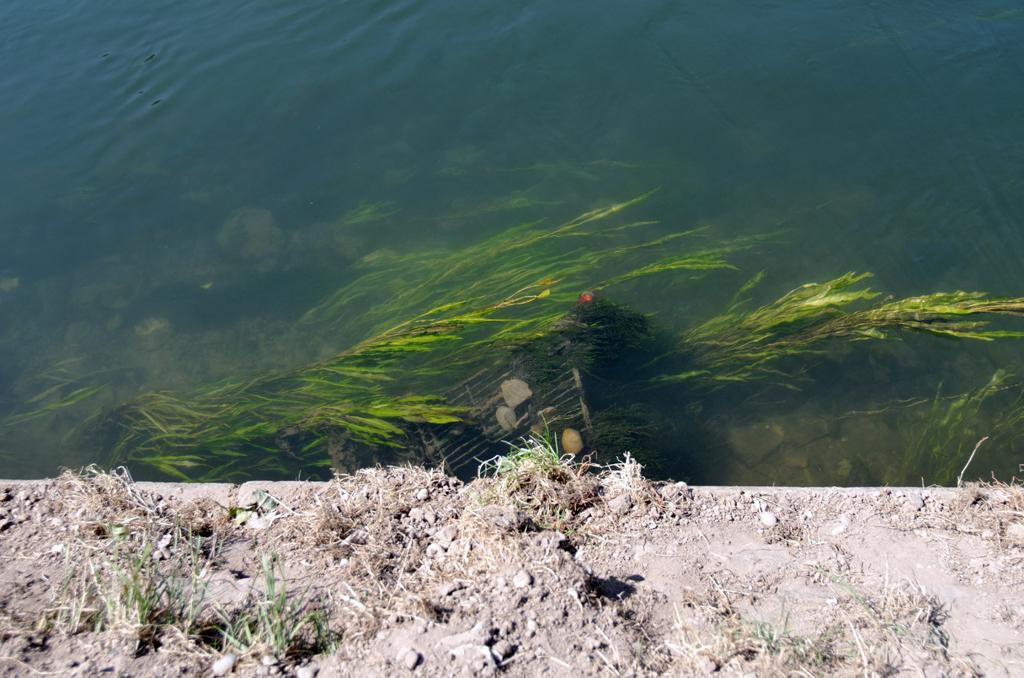
The Development Of The Banks Of The Faux Rempart Ditch is focused on the biological and ecological continuity of the right bank of the Faux Rampart (Ref. 6). The ditch was abandoned, underdeveloped and found to be lacking of the rich biodiversity otherwise seen in the surrounding area. thus, at the request of the local inhabitants, the City of Strasbourg intervened to revitalise the accessibility and greenery located at the area (Ref. 4).

https://www.rue89strasbourg.com/nouvelle-rive-du-fosse-des-faux-remparts-exit-les-joggers-et-les-sdf-15344
Overview
Nature-based solution
- Grey infrastructure featuring greens
- Blue infrastructure
- Riverbank/Lakeside greens
- Rivers/streams/canals/estuaries
Key challenges
- Green space, habitats and biodiversity (SDG 15)
- Habitat and biodiversity restoration
- Habitat and biodiversity conservation
- Green space creation and/or management
- Social justice, cohesion and equity (SDG 10)
- Environmental and climate justice
- Health and well-being (SDG 3)
- Enabling opportunities for physical activity
- Creation of opportunities for recreation
- Cultural heritage and cultural diversity
- Preservation of natural heritage
Focus
Ecological restoration of ecosystems, Management and improved protection of rivers and other blue areas
Project objectives
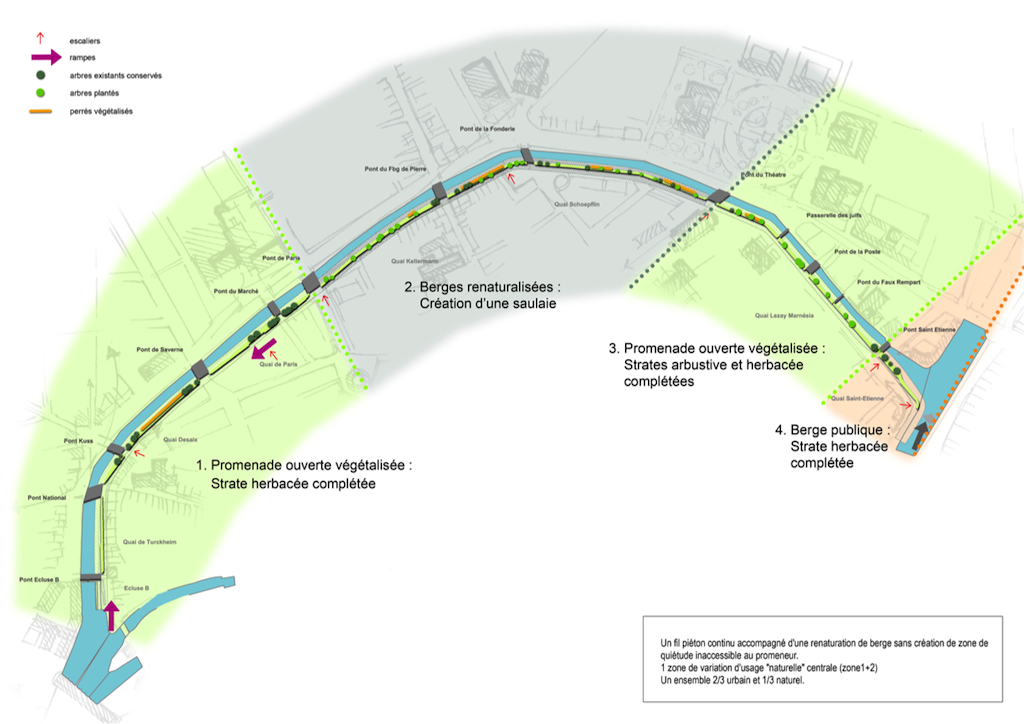
This project aims were to restore the biological and ecological continuity of these flood banks while increasing the comfort of users by:
- Improving the quality of public space
- Preserving, diversifying and developing the existing ecosystem, notably by densifying shrubbery, trees and herbaceous plantations along the right bank
- Creating different atmospheres through the smooth transition of plants
- Recalibrating the paths according to the uses of the site in order to favor a more generous area of vegetation
- Realizing a continuous path of natural stone laid in opus-incertum thus allowing a more easy circulation while preserving the natural appearance (Ref. 1)
Implementation activities
The right bank of the Faux Rempart ditch was abandoned, underdeveloped and found to be lacking of the rich biodiversity otherwise seen in the surrounding area. In 2010 the municipality reached an agreement with national administration's for its development (Ref. 10). Also at the request of the local inhabitants, (Ref. 4) the City of Strasbourg intervened and construction work was undertaken without harming the patrimonial and urban unity of the quays in 2012 (Ref. 3). The first two phases of the work were carried out during 2012 and 2013 and lasted 5 months (Ref. 1). The first phase involved the paving of the quays of Turckheim, Desaix, Paris, Kellerman, and from the beginning of the quay at Schoepflin and the realization of seedlings. The second phase involved paving and planting of 70 trees as well as 1,800 shrubs and other plants that constitute the other two phases of the site. The rehabilitation of the shoreline was completed in the spring of 2013 (Ref. 4). "The promenade will be designed in such a way that the animals living along the banks can continue to evolve while conserving biodiversity" (Ref. 12). "Plants specific to this environment will be planted. We want to create something different from the other banks. Nature will have a preponderant place. We have selected plants that adapt to this type of setting. We will also be concerned about wildlife. When there are nests, we will cut the bank so that the walkers do not disturb this important moment for the animals, as we have already done" (Ref. 4).
Biodiversity conservation or restoration-focused activities
Biodiversity conservation:
- Protect and enhance urban habitats
- Preserve and strengthen existing habitats and ecosystems
- Promote environmentally-sound development in and around protected areas
- Create new habitats
- Preserve and strengthen habitat connectivity
- Reduce negative impacts and avoid the alteration/damage of ecosystem
- Protect species
- Undertake specific measures to protect species
- Undertake specific measures to protect native species
- Undertake specific measures to protect valued species
Biodiversity restoration:
- Restore species (native, endangered, or unspecified)
- Restore native species
- Restore valued species
Main beneficiaries
- Local government/Municipality
- Other
Governance
Management set-up
- Co-governance with government and non-government actors
Type of initiating organisation
- Local government/municipality
Participatory approaches/ community involvement
- Unknown
Details on the roles of the organisations involved in the project
The project was initiated by Strasbourg Eurometropole (Ref. 1). The landscape designer was DIGITALEpaysage, the project director Agnès Daval, and the relevant environmental study office Sinbio (Ref. 5, 6).
Project implemented in response to ...
... an EU policy or strategy?
Unknown
... a national policy or strategy?
Yes
(Work on the banks The Banks Of The Faux Rempart Ditch was first signaled by the French public administrative body "Voies Navigables de France" ("Waterways of France") - in agreement signed with the Mayor of the City Strasbourg, Roland Ries - as part of the body's responsibility for the stability of banks and relevant structural works in France (Ref. 10).)
... a local policy or strategy?
Yes
(The intervention appears under the directory off Strasbourg Eurometropole's Climate Energy Plan (Ref. 9). The intervention is also noted in relation to the Strasbourg's "Projet d’Aménagement et de Développement Durable" (PADD – document d’orientations générales) ("Project Planning and Sustainable Development"), a city document on development guidelines (Ref. 8).)
Financing
Total cost
€100,000 - €500,000
Source(s) of funding
- Public national budget
- Public local authority budget
Type of funding
- Earmarked public budget
- Direct funding (grants, subsidies, or self-financed projects by private entities)
Non-financial contribution
Unknown
Impacts and Monitoring
Environmental impacts
- Water management and blue areas
- Enhanced protection and restoration of freshwater ecosystems
- Green space and habitat
- Increased green space area
- Increased conservation or restoration of ecosystems
- Reduced biodiversity loss
- Increased number of species present
- Restoration of derelict areas
Economic impacts
- Unknown
Socio-cultural impacts
- Health and wellbeing
- Improved physical health
- Gain in activities for recreation and exercise
- Cultural heritage and sense of place
- Protection of natural heritage
Type of reported impacts
Achieved impacts
Presence of formal monitoring system
Unknown
Presence of indicators used in reporting
No evidence in public records
Presence of monitoring/ evaluation reports
No evidence in public records
Availability of a web-based monitoring tool
No evidence in public records
References
(1) Strasbourg Eurometropole. [no date]. AMÉNAGEMENT DES BERGES DU FOSSÉ DU FAUX REMPART (RIVE DROITE). Available at: Source link (Website not available in 2020).
(2) Source link. (2012). STRASBOURG - Actu urbaine & architecturale. Available at: Source link (Accessed: September 24, 2020).
(3) Ministère de l’Écologie. (2015). Aménagement des berges du fossé du faux rempart (rive droite). Available at: Source link (Website not available in 2020).
(4) Rigobert, Jules. (2012). Nouvelle rive du Fossé des faux remparts : exit les joggers et les SDF. Available at:Source link (Accessed: September 24, 2020).
(5) Digital Paysage. (2012). Berges du fossé du faux rempart (rive droite) à Strasbourg - signalétique. Available at:Source link (Website not available in 2020).
(6) Digital Paysage. (2012). Aménagement des berges du fossé du faux rempart (rive droite). Available at:Source link (Website not available in 2020).
(7) Pipart, Beatrice. [no date]. ATELIER DE PROJET: QUELLES ORIENTATIONS POUR LE PNU DE STRASBOURG? Strasbourg Eurometropole. (Document attached).
(8) Voies Navigables de France. (2010) Délibération du Conseil Municipal du lundi 22 mars 20. (Document attached).
(9) Strasbourg Eurometropole. [no date]. POLITIQUE ÉNERGÉTIQUE. Available at: Source link (Accessed: September 24, 2020).
(10) Le Conseil Municipal de Strasbourg. (2011). Communication au Conseil Municipal. (Document attached).
(11) [no author]. (2012). Visite n° 1 : MICRO-JARDINS ET FLEURISSEMENT CITOYEN Visites au centre-ville de jardins et d’espaces verts dans lesquels les habitants s’impliquent. (Document attached).
(12) Arch Wiki (n.d.). "Canal des Faux Remparts (Strasbourg)". Available at: Source link (Accessed: September 24, 2020).
(2) Source link. (2012). STRASBOURG - Actu urbaine & architecturale. Available at: Source link (Accessed: September 24, 2020).
(3) Ministère de l’Écologie. (2015). Aménagement des berges du fossé du faux rempart (rive droite). Available at: Source link (Website not available in 2020).
(4) Rigobert, Jules. (2012). Nouvelle rive du Fossé des faux remparts : exit les joggers et les SDF. Available at:Source link (Accessed: September 24, 2020).
(5) Digital Paysage. (2012). Berges du fossé du faux rempart (rive droite) à Strasbourg - signalétique. Available at:Source link (Website not available in 2020).
(6) Digital Paysage. (2012). Aménagement des berges du fossé du faux rempart (rive droite). Available at:Source link (Website not available in 2020).
(7) Pipart, Beatrice. [no date]. ATELIER DE PROJET: QUELLES ORIENTATIONS POUR LE PNU DE STRASBOURG? Strasbourg Eurometropole. (Document attached).
(8) Voies Navigables de France. (2010) Délibération du Conseil Municipal du lundi 22 mars 20. (Document attached).
(9) Strasbourg Eurometropole. [no date]. POLITIQUE ÉNERGÉTIQUE. Available at: Source link (Accessed: September 24, 2020).
(10) Le Conseil Municipal de Strasbourg. (2011). Communication au Conseil Municipal. (Document attached).
(11) [no author]. (2012). Visite n° 1 : MICRO-JARDINS ET FLEURISSEMENT CITOYEN Visites au centre-ville de jardins et d’espaces verts dans lesquels les habitants s’impliquent. (Document attached).
(12) Arch Wiki (n.d.). "Canal des Faux Remparts (Strasbourg)". Available at: Source link (Accessed: September 24, 2020).
https://www.rue89strasbourg.com/nouvelle-rive-du-fosse-des-faux-remparts-exit-les-joggers-et-les-sdf-15344
https://www.rue89strasbourg.com/nouvelle-rive-du-fosse-des-faux-remparts-exit-les-joggers-et-les-sdf-15344