

Last updated: June 2024
The Danube Eco-District project is Strasbourg's first eco-districy and is based on previous experimental designs in sustainable urban living (Ref. 27, 30). It is situated at the heart of the axis Deux Rives, and is thus a strategic point of the large Franco-German Deux Rives project (Ref. 28). The district will have the capacity for 20,000 residents, and will include green spaces, green roofs, insect hotels (Ref. 1), various water management facilities (ditches, swales... etc.), and composting facilities (Ref. 4). The project aims to improve biodiversity, social equality, ecology, reduce urban heating, and promote sustainable consumption (Ref. 30).
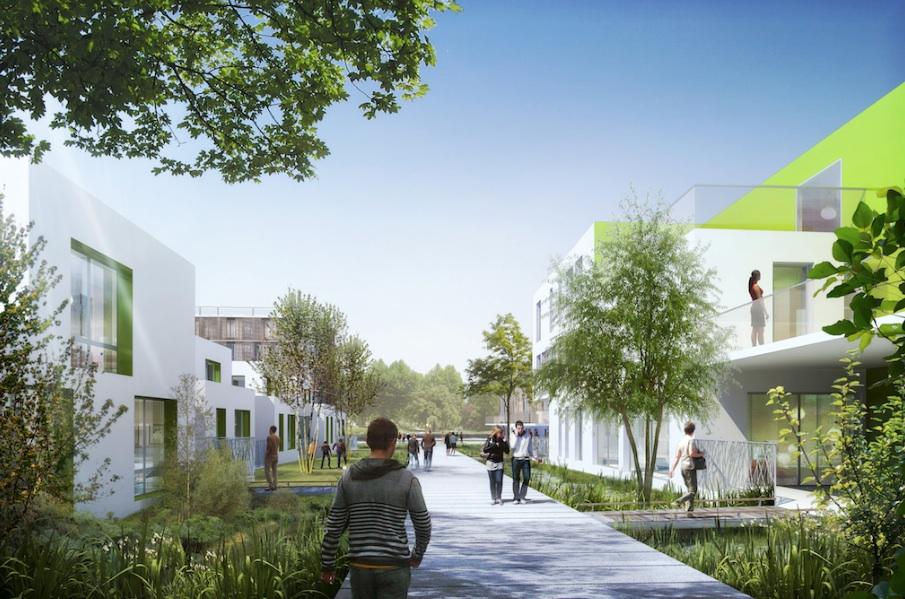
https://www.rue89strasbourg.com/danube-bientot-labellise-ecoquartier-49245
Overview
Nature-based solution
- Blue infrastructure
- Lakes/ponds
- In-land wetlands, peatlands, swamps, and moors
- Community gardens and allotments
- Allotments
- Community gardens
- Green areas for water management
- Swales and filter strips
- Sustainable urban drainage systems
- Grey infrastructure featuring greens
- Alley or street trees and other street vegetation
- Riverbank/Lakeside greens
- House gardens
- Green playgrounds and school grounds
- Nature on buildings (external)
- Green roofs
- Parks and urban forests
- Green corridors and green belts
Key challenges
- Climate action for adaptation, resilience and mitigation (SDG 13)
- Climate change mitigation
- Environmental quality
- Waste management
- Green space, habitats and biodiversity (SDG 15)
- Habitat and biodiversity conservation
- Green space creation and/or management
- Regeneration, land-use and urban development
- Regulation of built environment
- Water management (SDG 6)
- Improvements to water quality
- Health and well-being (SDG 3)
- Enabling opportunities for physical activity
- Creation of opportunities for recreation
- Inclusive and effective governance (SDG 16)
- Inclusive governance
- Social justice, cohesion and equity (SDG 10)
- Social cohesion
- Social interaction
- Economic development and employment (SDG 8)
- Real estate development
- Sustainable consumption and production (SDG 12)
- Sustainable consumption
- Sustainable production
Focus
Creation of new green areas
Project objectives
The project raises concerns of increasing urban living, and subsequent problems of ecology, climate change, urban heating, effects on social equality and biodiversity as its main challenges. The Danube Eco-District, therefore, aims at promoting environmental logic and integrating biodiversity in urban spaces for different social and economic demographics, and hopes to enforce these through a variety of methods including (Ref. 1, 19):
- developing the vegetation of port wastelands for flood and water management,
- installing green roofs on residential buildings for thermal insulation,
- rain and stormwater managing facilities (e.g. ditches, swales, landscaping ponds, green roofs, green attached water gullies),
- encouraging eco-friendly methods of gardening (e.g. stopping the use of pesticides),
- green spaces, involving tree planting,
- insect hotels for biodiversity
- garden plots and shared gardens dedicated to preserving biodiversity, improving air quality, and communal living (Ref. 30)
Implementation activities
Reflections and dialogues in 2008 (e.g. 50 meetings of Project Danube Workshop, while committees and neighborhood associations were set-up) (Ref. 27) highlighted the desire to create a new innovative and sustainable neighborhood leading to the creation of the Project Workshop "Danube". In 2010 SERS was chosen as developer, while Devillers & Associates, and architects Richter, Artelia, LEA and Philippe Oblige were contracted to the project. 2011 saw the completion of the first building and a nursing home. The 1st phase was completed in 2014. The completion of the 2nd phase is due in 2017, while the 3rd and final phase of construction is due in 2020. The project is co-designed and co-built with the inhabitants of the city and (future) residents, for example in charting new pathways urban, architectural, social, environmental (Ref. 30). The project has faced challenges such as soil pollution for example, (Ref. 6) which has meant that only suspended fruit gardens and no fruit trees can be grown (Ref. 17).
"The EcoQuartier Danube is implementing, over 6 hectares, innovative energy systems (BBC buildings, passive or positive energy such as the Elithis tower, the world's 1st positive energy housing tower, alternative mobility solutions (station car-sharing, shared parking), urban mix (650 housing units including 50% social housing or social access, 10% self-promotion), a specific mode of project governance ( project workshops, workshops, etc.)" (Ref. 2). "Everything has been done to favor and preserve the port character of the site. Trees have been planted, vegetation adapted to humid spaces has been reintroduced. Exchange spaces have been installed such as playgrounds, gardens or composting areas. In short, green spaces represent more than 6,000 m² , plus another 4,000 m² of public green spaces. Town planners have made a special effort to preserve and develop biodiversity with Fauna and Flora" (Ref. 10). "To respect the port atmosphere, a river garden will be set up; trees will be planted there, benches and pontoons installed. This garden will also play a hydraulic role because it will constitute a rainwater retention basin" (Ref. 1).
Climate-focused activities
Climate change mitigation:
- Implement solutions to help reducing energy consumption or support the use of sustainable energy resources
Biodiversity conservation or restoration-focused activities
Biodiversity conservation:
- Protect and enhance urban habitats
- Preserve and strengthen existing habitats and ecosystems
- Create new habitats
Main beneficiaries
- Private sector/Corporate/Company
- Researchers/University
- Citizens or community groups
- Marginalized groups: Socio-economically disadvantaged populations (e.g. low-income households, unemployed)
Governance
Management set-up
- Co-governance with government and non-government actors
Type of initiating organisation
- Local government/municipality
Participatory approaches/ community involvement
- Co-planning (e.g. stakeholder workshops, focus groups, participatory mapping)
- Consultation (e.g. workshop, surveys, community meetings, town halls)
- Joint implementation (e.g. tree planting)
- Co-management/Joint management
- Citizen oversight (e.g. boards, advisory)
- Citizen monitoring and review
Details on the roles of the organisations involved in the project
The technical coordination of the project was provided initially by the staff of the City of Strasbourg. Other municipal and community services intervened according to the nature of the project in its duration. SERS then acquired the role of project developer from the City of Strasbourg, and acquired the necessary land. Technical experts in the study of soils, topography, and biodiversity were also solicited. Over 100 members of civil society, associations, self-help groups, social landlords, builders, architects and planners as well as students were also involved in the project (Ref. 27).
Project implemented in response to ...
... an EU policy or strategy?
Unknown
... a national policy or strategy?
Yes
(The project was named as a recipient of the "EcoQuartier initiative" (Ref. 32) call for proposals Eco-Quartier 2009 organized by the French Ministry of Ecology, Energy, Sustainable Development and the Sea. In 2013 it obtained the label "eco-neighborhood" issued by the Ministry of Territory Equality and Housing, and was one of the top 32 French projects to be labeled "eco-district" by the state (Ref. 5, 30, 33).)
... a local policy or strategy?
Yes
(The Danube Eco-District project is implemented as part of the Franco-German Deux Rives post-1990 project (Ref. 26) led by Starsbourg Eurometropole in its partnerships with the German town Kehl and is focused on making a new "piece of city" at the edge of the old harbor basins (Ref. 1, 7, 27, 28).)
Financing
Total cost
More than €4,000,000
Source(s) of funding
- Public local authority budget
Type of funding
- Earmarked public budget
Non-financial contribution
Type of non-financial contribution
- Provision of land
- Provision of labour
Who provided the non-financial contribution?
- Public authorities (e.g. land, utility services)
Impacts and Monitoring
Environmental impacts
- Climate change
- Reduced emissions
- Environmental quality
- Improved waste management
- Water management and blue areas
- Increased protection against flooding
- Improved stormwater management
- Green space and habitat
- Increased green space area
- Reduced biodiversity loss
Economic impacts
- Increase in agricultural production (for profit or not)
Socio-cultural impacts
- Social justice and cohesion
- Improved liveability
- Improved access to urban green space
- Increased opportunities for social interaction
- Health and wellbeing
- Gain in activities for recreation and exercise
Type of reported impacts
Expected impacts
Presence of formal monitoring system
Unknown
Presence of indicators used in reporting
No evidence in public records
Presence of monitoring/ evaluation reports
No evidence in public records
Availability of a web-based monitoring tool
No evidence in public records
References
(1) Strasbourg Eurométropole. [no date]. THE ECO-QUARTIER DANUBE. Available at: Source link (Accessed: October 1, 2020).
(2) Strasbourg Eurométropole. [no date]. DEUX-RIVES : LES GRANDES ÉTAPES DU PROJET. Available at: Source link (Accessed: October 1, 2020).
(3) Eco-Quartier. [no date]. Ecoquartier Danube (Strasbourg). Available at: Source link (Website not available in 2020).
(4) editeurstrasbourg2016. (2016). Les enjeux du projet d’aménagement de l’Eco-Quartier Danube. Available at: Source link (Website not available in 2020).
(5) France, Pierre. (2013). Danube, bientôt labellisé ÉcoQuartier. Available at: Source link (Accessed: October 1, 2020).
(6) Marty, Marie. (2015). Un tiers du quartier Danube sera habitable en 2016. Available at: Source link (Website not available in 2020). (Accessed: October 1, 2020).
(7) Strasbourg Eurométropole. [no date]. DEUX-RIVES / ZWEI UFER : LE GRAND PROJET FRANCO-ALLEMAND. Available at: Source link (Website not available in 2020).
(8) Becker, Denis. (2014). L'éco-quartier Danube ouvert au public ce samedi. Available at: Source link (Accessed: October 1, 2020).
(9) KCAP. [no date]. Ecoquartier Danube Strasbourg [FR]. Available at: Source link (Accessed: October 1, 2020).
(10) LE Source link. (2012). Présentation de l’écoquartier Danube par le maire de Strasbourg et l’architecte-urbaniste Christian Devillers. Available at: Source link (Accessed: October 1, 2020).
(11) GUIDE DU NEUF. [no date]. L'éco quartier du Danube. Available at: Source link (Accessed: October 1, 2020).
(12) Le Point. (2015). Strasbourg fait mieux que Fribourg. Available at: Source link (Accessed: October 1, 2020).
(13) ecohabitat-9. (2014). Strasbourg : à la découverte de l'éco-quartier Danube. Available at: Source link (Accessed: October 1, 2020).
(14) Citymoments. [no date]. En balade dans l’écoquartier du Danube: La ville se met au vert. Available at: Source link (Accessed: October 1, 2020).
(15) info-culture. [no date]. L’Eco-quartier Danube soutenu par la Caisse des Dépôts et Consignations. Available at: Source link (Accessed: October 1, 2020).
(16) Frédéric Rossano. [no date]. Project managed and designed @ KCAP architects and planners. Available at: Source link (Accessed: October 1, 2020).
(17) Jund, Alain. (2011). Les quatre défis des écoquartiers : entretien avec Alain Jund. Available at: Source link (Accessed: October 1, 2020).
(18) PSS. (2010). Strasbourg - Les Deux Rives - Écoquartier Danube. Available at: Source link (Accessed: October 1, 2020).
(19) Palettes de Solutions. (2014). Portes Ouvertes de l'Eco quartier Danube à Strasbourg. Available at: Source link (Accessed: October 1, 2020).
(20) Blog Strasbourg. (2015). The eco-district Danube will welcome its future inhabitants in January 2016. Available at: Source link (Accessed: October 1, 2020).
(21) Boughriet, Rachida. (2009). Un second éco-quartier verra le jour à Strasbourg en 2012. Available at: Source link (Accessed: October 1, 2020).
(22) Places Line. [no date]. Eco-quartier Danube à Strasbourg: Strasbourg Rues, places et quartiers: Eco-quartier Danube. Available at: Source link (Accessed: October 1, 2020).
(23) Zohar, Lea. (2017). The neighborhood of the future: the eco-district Danube. Available at: Source link (Accessed: October 1, 2020).
(24) Petropavlovsky, Volodia. (2016). À Strasbourg, l'air pollué du projet Danube. Available at: Source link (Accessed: October 1, 2020).
(25) e-immobilier. (2015). Strasbourg: zoom on the eco-district Danube. Available at: Source link (Accessed: October 1, 2020).
(26) Strasbourg Eurométropole. [no date]. LA NOUVELLE VILLE SUR LE RHIN. (Document attached).
(27) Zetlaoui-Léger, Jodelle. [no date]. L'Éco-quartier Danube- Strasbourg. (Document attached).
(28) Strasbourg Eurométropole. [no date]. STRASBOURG ECO QUARTIER DANUBE. (Document attached).
(29) ASPA. (2012). ECO-QUARTIER DANUBE: Modélisation de la qualité de l’air sur le futur éco-quartier Danube. (Document attached).
(30) Strasbourg Eurométropole. [no date]. Éco-quartier: DANUBE. (Document attached).
(31) Strasbourg Eurométropole. [no date]. ÉCO-QUARTIERS: POUR QUI ? POURQUOI ? COMMENT ? (Document attached).
(32) MINISTÈRE DE LA COHÉSION DES TERRITOIRES. (2016). Qu’est-ce qu’un ÉcoQuartier ? Available at: Source link (Accessed: October 1, 2020).
(33) Architecture Urbanisme. (2013). Palmarès des 13 quartiers labellisés « EcoQuartier » en France en 2013. Available at: Source link (Accessed: October 1, 2020).
(2) Strasbourg Eurométropole. [no date]. DEUX-RIVES : LES GRANDES ÉTAPES DU PROJET. Available at: Source link (Accessed: October 1, 2020).
(3) Eco-Quartier. [no date]. Ecoquartier Danube (Strasbourg). Available at: Source link (Website not available in 2020).
(4) editeurstrasbourg2016. (2016). Les enjeux du projet d’aménagement de l’Eco-Quartier Danube. Available at: Source link (Website not available in 2020).
(5) France, Pierre. (2013). Danube, bientôt labellisé ÉcoQuartier. Available at: Source link (Accessed: October 1, 2020).
(6) Marty, Marie. (2015). Un tiers du quartier Danube sera habitable en 2016. Available at: Source link (Website not available in 2020). (Accessed: October 1, 2020).
(7) Strasbourg Eurométropole. [no date]. DEUX-RIVES / ZWEI UFER : LE GRAND PROJET FRANCO-ALLEMAND. Available at: Source link (Website not available in 2020).
(8) Becker, Denis. (2014). L'éco-quartier Danube ouvert au public ce samedi. Available at: Source link (Accessed: October 1, 2020).
(9) KCAP. [no date]. Ecoquartier Danube Strasbourg [FR]. Available at: Source link (Accessed: October 1, 2020).
(10) LE Source link. (2012). Présentation de l’écoquartier Danube par le maire de Strasbourg et l’architecte-urbaniste Christian Devillers. Available at: Source link (Accessed: October 1, 2020).
(11) GUIDE DU NEUF. [no date]. L'éco quartier du Danube. Available at: Source link (Accessed: October 1, 2020).
(12) Le Point. (2015). Strasbourg fait mieux que Fribourg. Available at: Source link (Accessed: October 1, 2020).
(13) ecohabitat-9. (2014). Strasbourg : à la découverte de l'éco-quartier Danube. Available at: Source link (Accessed: October 1, 2020).
(14) Citymoments. [no date]. En balade dans l’écoquartier du Danube: La ville se met au vert. Available at: Source link (Accessed: October 1, 2020).
(15) info-culture. [no date]. L’Eco-quartier Danube soutenu par la Caisse des Dépôts et Consignations. Available at: Source link (Accessed: October 1, 2020).
(16) Frédéric Rossano. [no date]. Project managed and designed @ KCAP architects and planners. Available at: Source link (Accessed: October 1, 2020).
(17) Jund, Alain. (2011). Les quatre défis des écoquartiers : entretien avec Alain Jund. Available at: Source link (Accessed: October 1, 2020).
(18) PSS. (2010). Strasbourg - Les Deux Rives - Écoquartier Danube. Available at: Source link (Accessed: October 1, 2020).
(19) Palettes de Solutions. (2014). Portes Ouvertes de l'Eco quartier Danube à Strasbourg. Available at: Source link (Accessed: October 1, 2020).
(20) Blog Strasbourg. (2015). The eco-district Danube will welcome its future inhabitants in January 2016. Available at: Source link (Accessed: October 1, 2020).
(21) Boughriet, Rachida. (2009). Un second éco-quartier verra le jour à Strasbourg en 2012. Available at: Source link (Accessed: October 1, 2020).
(22) Places Line. [no date]. Eco-quartier Danube à Strasbourg: Strasbourg Rues, places et quartiers: Eco-quartier Danube. Available at: Source link (Accessed: October 1, 2020).
(23) Zohar, Lea. (2017). The neighborhood of the future: the eco-district Danube. Available at: Source link (Accessed: October 1, 2020).
(24) Petropavlovsky, Volodia. (2016). À Strasbourg, l'air pollué du projet Danube. Available at: Source link (Accessed: October 1, 2020).
(25) e-immobilier. (2015). Strasbourg: zoom on the eco-district Danube. Available at: Source link (Accessed: October 1, 2020).
(26) Strasbourg Eurométropole. [no date]. LA NOUVELLE VILLE SUR LE RHIN. (Document attached).
(27) Zetlaoui-Léger, Jodelle. [no date]. L'Éco-quartier Danube- Strasbourg. (Document attached).
(28) Strasbourg Eurométropole. [no date]. STRASBOURG ECO QUARTIER DANUBE. (Document attached).
(29) ASPA. (2012). ECO-QUARTIER DANUBE: Modélisation de la qualité de l’air sur le futur éco-quartier Danube. (Document attached).
(30) Strasbourg Eurométropole. [no date]. Éco-quartier: DANUBE. (Document attached).
(31) Strasbourg Eurométropole. [no date]. ÉCO-QUARTIERS: POUR QUI ? POURQUOI ? COMMENT ? (Document attached).
(32) MINISTÈRE DE LA COHÉSION DES TERRITOIRES. (2016). Qu’est-ce qu’un ÉcoQuartier ? Available at: Source link (Accessed: October 1, 2020).
(33) Architecture Urbanisme. (2013). Palmarès des 13 quartiers labellisés « EcoQuartier » en France en 2013. Available at: Source link (Accessed: October 1, 2020).