

Last updated: October 2021
An intervention in the parks of Sintra relying on volunteer participation to eradicate invasive species from the green areas. The intervention was carried out on International Volunteer Day and volunteers removed the exotic weed species manually. The manual work with volunteering was carried out in more sensitive places where herbicide can not be applied (water lines, protected habitats, etc ...) (ref.5)
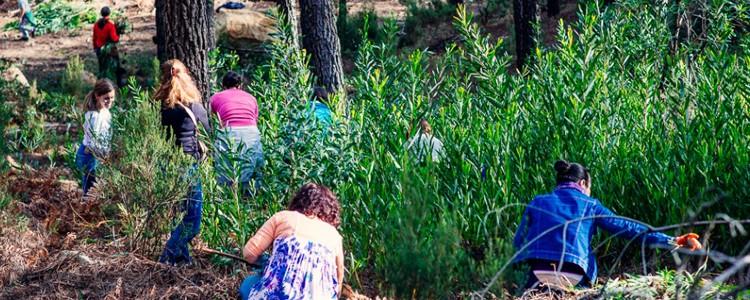
Volunteer action
Source: https://cm-sintra.pt/index.php?option=com_content&Itemid=631&catid=10&id=2922&view=article
Overview
Nature-based solution
- Parks and urban forests
- Large urban parks or forests
Key challenges
- Green space, habitats and biodiversity (SDG 15)
- Habitat and biodiversity conservation
- Green space creation and/or management
- Environmental quality
- Waste management
- Health and well-being (SDG 3)
- Enabling opportunities for physical activity
Focus
Maintenance and management of urban nature, Ecological restoration of ecosystems, Protection of natural ecosystems
Project objectives
Eradication of invasive tree species (acacias, pitosporos and áquias) that present themselves as a strong threat not only for the flora but also for the fauna of the mountain range of Sintra. (ref 2);
Collection of the invasive species from the parks by the staff;
Involvement of citizens in environmental protection. (ref 5)
Implementation activities
One day volunteer coordination for the removal of invasive species in two parks, one meeting at 9:30 am and the second at 12:30pm. (ref 1)
Biodiversity conservation or restoration-focused activities
Biodiversity conservation:
- Protect and enhance urban habitats
- Preserve and strengthen existing habitats and ecosystems
- Protect species
- Undertake specific measures to protect species
- Control and clean invasive alien species
- Means for conservation governance
- Raise public awareness
- Public engagement
Main beneficiaries
- Local government/Municipality
- Citizens or community groups
- Young people and children
Governance
Management set-up
- Government-led
Type of initiating organisation
- Local government/municipality
Participatory approaches/ community involvement
- Crowd-sourcing/Crowd-funding/Participatory budget
- Taskforce groups
- Joint implementation (e.g. tree planting)
Details on the roles of the organisations involved in the project
Sintra Parks, a body of the local government organized the intervention. (ref 1)
Project implemented in response to ...
... an EU policy or strategy?
Yes
(The EU Commission’s Strategy for Biodiversity is mentioned in its 2013 developed with the Regulation of Parliament and the European Council on invasive alien species. (ref 7)
The volunteer interventions started with the LIFE BIO+Sintra Program, this program ended in early 2015 but the volunteer actions continued. “The project "LIFE BIO + Sintra" had as its mission to promote the active participation of the public in the conservation of the main natural values of the Serra de Sintra and to make known the causal relationships between day-to-day activities, carbon emissions, changes Climate change and loss of biodiversity in order to foster the adoption of environmentally friendly behaviors and sustainable visits to Sintra.”
(ref 5 and 6)
)
... a national policy or strategy?
Unknown
... a local policy or strategy?
Yes
(The Cultural Landscape of Sintra has a “Plan for combatting invasive species” since 2008, this plan is financed by AGRO/PRODER and involves the voluntary actions of the weed eradication. (ref 5)
Intervention part of the local actions for World Tree Day and the Parks’ department “Volunteer Program” which have been used for volunteer actions for environmental improvement. (ref 1)
)
Financing
Total cost
Unknown
Source(s) of funding
- Public local authority budget
Type of funding
- Direct funding (grants, subsidies, or self-financed projects by private entities)
Non-financial contribution
Type of non-financial contribution
- Provision of land
- Provision of goods
- Provision of labour
- Provision of expertise
Who provided the non-financial contribution?
- Public authorities (e.g. land, utility services)
- Citizens (e.g. volunteering)
Impacts and Monitoring
Environmental impacts
- Green space and habitat
- Increased conservation or restoration of ecosystems
- Improved prevention or control of invasive alien species
Economic impacts
- Unknown
Socio-cultural impacts
- Education
- Increased knowledge of locals about local nature
- Increased awareness of NBS and their benefits
Type of reported impacts
Achieved impacts
Presence of formal monitoring system
Unknown
Presence of indicators used in reporting
No evidence in public records
Presence of monitoring/ evaluation reports
Yes
Availability of a web-based monitoring tool
No evidence in public records
References
1. Sintra Camara Municipal (2015), Ação de voluntariado para erradicação de infestantes, Available at Source link (Accessed 23-6-2020)
2. Wilder (2015), Voluntariado para erradicar exóticas em Sintra, Available at Source link (Accessed 23-6-2020)
3. Fatima Missionaria (2016), Mãos à obra para melhorar a Serra de Sintra, Available at Source link (Accessed 23-6-2020)
4. Cision News (2016), Programa de Voluntariado da Parques de Sintra com nova ação, Available at Source link (Accessed 23-6-2020)
5. Parques Sintra Monte da Lua (2015). Seminário Técnico do Projeto LIFE Biodiscoveries – Espécies Invasoras, Available at Source link (Accessed 23-6-2020)
6. Parques Sintra Monte da Lua (2015), RESULTADOS DO PROJETO “LIFE BIO+SINTRA” DIVULGADOS. Available at Source link (Accessed 23-6-2020)
7. Quercus (2013), União Europeia toma medidas para tentar evitar que espécies exóticas invasoras cruzem as suas fronteiras, Available at Source link (Accessed 23-6-2020)
2. Wilder (2015), Voluntariado para erradicar exóticas em Sintra, Available at Source link (Accessed 23-6-2020)
3. Fatima Missionaria (2016), Mãos à obra para melhorar a Serra de Sintra, Available at Source link (Accessed 23-6-2020)
4. Cision News (2016), Programa de Voluntariado da Parques de Sintra com nova ação, Available at Source link (Accessed 23-6-2020)
5. Parques Sintra Monte da Lua (2015). Seminário Técnico do Projeto LIFE Biodiscoveries – Espécies Invasoras, Available at Source link (Accessed 23-6-2020)
6. Parques Sintra Monte da Lua (2015), RESULTADOS DO PROJETO “LIFE BIO+SINTRA” DIVULGADOS. Available at Source link (Accessed 23-6-2020)
7. Quercus (2013), União Europeia toma medidas para tentar evitar que espécies exóticas invasoras cruzem as suas fronteiras, Available at Source link (Accessed 23-6-2020)