

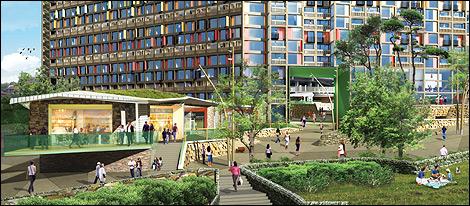
Due to years of under-investment left the Park Hill estate in a state of decline. The challenge for Sheffield Council was to regenerate a neglected estate into a place people wanted to live in. The city council allocated private gardens, a wildflower meadow, a bowling green and a parterre garden as part of the landscaping. Much of the landscaping will be inspired by the Peak District and typical Sheffield landscapes (ref 1). Park Hill is Grade II (special interest buildings and authority put extra effort to preserve them) listed and remains Europe's largest listed structure. The building alone covers an area of 17 acres and currently contains around 1,000 flats. In total the whole site covers 32 acres (ref 2). In the new proposal, a part of Park Hill flats will be converted into student housing (ref 5).
Overview
Nature-based solution
- Grey infrastructure featuring greens
- House gardens
- Green playgrounds and school grounds
- Parks and urban forests
- Pocket parks/neighbourhood green spaces
Key challenges
- Green space, habitats and biodiversity (SDG 15)
- Green space creation and/or management
- Regeneration, land-use and urban development
- Regulation of built environment
- Economic development and employment (SDG 8)
- Real estate development
Focus
Project objectives
Implementation activities
Main beneficiaries
- Local government/Municipality
- Citizens or community groups
Governance
Management set-up
- Co-governance with government and non-government actors
Type of initiating organisation
- Local government/municipality
- Private sector/corporate actor/company
Participatory approaches/ community involvement
- Unknown
Details on the roles of the organisations involved in the project
Project implemented in response to ...
Financing
Total cost
Source(s) of funding
- Corporate investment
- Funds provided by non-governmental organization (NGO)
Type of funding
- Direct funding (grants, subsidies, or self-financed projects by private entities)
- Donations
Non-financial contribution
Impacts and Monitoring
Environmental impacts
- Environmental quality
- Improved air quality
- Green space and habitat
- Increased green space area
- Reduced biodiversity loss
- Restoration of derelict areas
Economic impacts
- Increased property prices
- Stimulate development in deprived areas
- Attraction of business and investment
Socio-cultural impacts
- Social justice and cohesion
- Improved social cohesion
- Improved liveability
- Increased involvement of locals in the management of green spaces
- Cultural heritage and sense of place
- Improvement in people’s connection to nature
Type of reported impacts
Presence of formal monitoring system
Presence of indicators used in reporting
Presence of monitoring/ evaluation reports
Availability of a web-based monitoring tool
References
2. Forged in Sheffield. Park Hill Regeneration. Available at: Source link [Accessed 13 August 2020].
2. Work Starts to Expand Sheffield’s Green Lung | Sheffield News Room. 2017. Work Starts to Expand Sheffield’s Green Lung | Sheffield News Room. [ONLINE] Available at: Source link. [Accessed 16 June 2017]. - No longer available
3. The Star UK. 2014. Autumn finish date for Sheffield’s new green space. [ONLINE] Available at: Source link. [Accessed 16 June 2017]. - No longer available
4. Edward Platt. 2012. Multi-million-pound makeover for Sheffield's notorious Park Hill estate. [ONLINE] Available at: Source link. [Accessed 16 June 2017]. - No longer available
5. Mairs, J., 2018. Park Hill Housing Estate To Be Converted Into Student Housing. [online] Dezeen. Available at: <Source link [Accessed 16 July 2020].