

Last updated: April 2022
A recovered green area next to the Guadaira river, it opened as a park in 2014 (Ref 6). In its planning it reconciles the historical use of the river to power the historic mill and its new use as a green corridor on the Eastern part of the city. Its large dimension allows it to fulfill the quadruple ecological, landscape, leisure, and non-motorized mobility dimensions. (Ref 4,5,6). The park was officially inaugurated but it continues to face challenges. In 2007 the economic crisis led to construction being stopped and the budget of the park cut from 23.8 million euro. Construction was started and the budget re-established at 17.2 million in 2011. (Ref 5)

Guadaira Park
Antonio Fajardo de la Fuente (2017), retrieved 07/18/2018 from https://plataformaparqueguadaira.wordpress.com/
Overview
Nature-based solution
- Blue infrastructure
- Rivers/streams/canals/estuaries
- Community gardens and allotments
- Horticulture
- Green areas for water management
- Other
- Grey infrastructure featuring greens
- Riverbank/Lakeside greens
- Parks and urban forests
- Large urban parks or forests
- Green corridors and green belts
Key challenges
- Green space, habitats and biodiversity (SDG 15)
- Habitat and biodiversity restoration
- Green space creation and/or management
- Regeneration, land-use and urban development
- Promote natural styles of landscape design for urban development
- Water management (SDG 6)
- Flood protection
- Cultural heritage and cultural diversity
- Protection of historic and cultural landscape/infrastructure
- Health and well-being (SDG 3)
- Creation of opportunities for recreation
- Inclusive and effective governance (SDG 16)
- Inclusive governance
- Social justice, cohesion and equity (SDG 10)
- Social justice and equity
- Social interaction
Focus
Creation of new green areas, Maintenance and management of urban nature, Transformation of previously derelict areas
Project objectives
To rehabilitate the green space around the neglected Guadaira stream; (Ref 4)
To create an area of non-motorized urban mobility; (Ref 4)
To create a space of leisure for the residents of adjacent neighborhoods; (Ref 4)
To be a space of social integration and meeting place to combat stigmas. (Ref 4,6)
plans were created with specific urban mobility concerns through the inclusion of a pedestrian walkway, a bike lane, and the inclusion of leisurely spaces and orchards. (8)
Implementation activities
The first works in the park were the rehabilitation as a green space of the Parque Riberas del Guadaira (the area that used to border the river) from 2007 to 2010. (Ref 5)
In 2007 the economic crisis led to construction being stopped and the budget of the park cut from 23.8 million euro. (Ref 5)
Construction was started and the budget re-established at 17.2 million in 2011, with the first phase of lighting (for nocturnal use) only having been installed in January 2016. (Ref 5)
In March 2016, a follow-up citizen committee was created for the development of the park. (Ref 5)
Design:
Space unites different urban areas (Ref 3)
Space for practice of sports and leisure (Ref 3)
Space for dogs to play (Ref 3)
Playground area (Ref 3)
Biodiversity conservation or restoration-focused activities
Biodiversity restoration:
- Rehabilitate and restore damaged or destroyed ecosystems
- Restore species (native, endangered, or unspecified)
- Restore ecological connectivity
- Other
Main beneficiaries
- Local government/Municipality
- Citizens or community groups
- Other
Governance
Management set-up
- Government-led
Type of initiating organisation
- Local government/municipality
Participatory approaches/ community involvement
- Dissemination of information and education
- Citizen oversight (e.g. boards, advisory)
Details on the roles of the organisations involved in the project
La Confederación Hidrográfica del Guadalquivir (CHG) (regional body), in charge of the planning work. (Ref 5,6)
The city of Sevilla, funds and planning. (Ref 4,7)
European Union, funding (FEDER Funds). (Ref 4)
Neighborhood councils, planning and communication with city. (Ref 5,6)
Asociacion Parque Vivo del Guadaira (citizen group), (Ref 5)
Various companies (Trauxia SA, Arpo) awarded different work streams (e.g. fixing landfill plot, lengthening bike lane, conditioning plot adjacent to park) (Ref 6)
Project implemented in response to ...
... an EU policy or strategy?
Unknown
... a national policy or strategy?
Unknown
... a local policy or strategy?
Yes
(General Urban Organization Plan of Sevilla (2005), this is the city's plan for future projects and strategies to improve the urban fabric (ref 2))
Financing
Total cost
More than €4,000,000
Source(s) of funding
- Public local authority budget
- EU funds
Type of funding
- Earmarked public budget
- Direct funding (grants, subsidies, or self-financed projects by private entities)
Non-financial contribution
Unknown
Impacts and Monitoring
Environmental impacts
- Water management and blue areas
- Increased protection against flooding
- Green space and habitat
- Increased green space area
- Restoration of derelict areas
Economic impacts
- Unknown
Socio-cultural impacts
- Social justice and cohesion
- Improved social cohesion
- Improved access to urban green space
- Increased opportunities for social interaction
- Increased involvement of locals in the management of green spaces
- Health and wellbeing
- Gain in activities for recreation and exercise
- Other
Type of reported impacts
Expected impacts, Achieved impacts
Presence of formal monitoring system
Unknown
Presence of indicators used in reporting
No evidence in public records
Presence of monitoring/ evaluation reports
Yes
Availability of a web-based monitoring tool
No evidence in public records
References
1. Asociacion Parque Vivo Del Gudaira. (2014, February 11). Cartografía del parque. Available at: Source link [Accessed: 28 September 2020].
2. Ayuntamiento de Sevilla. (2005, July 14). Nuevo Plan General de ordenacion Urbanistica. Ayuntamiento de Sevilla. [Not available in 2020].
3. Baron, R. (2015). Parque antiguo cauce río Guadaíra. Sevilla. Análisis crítico. RBB. 2015-2016. Available at: Source link [Accessed: 28 September 2020].
4. Confederacion Hydrografica del Guadalquivir. (n.d.). Parque Rio Guadaira: El Parque que nos une. Confederacion Hydrografica del Guadalquivir. [Document provided].
5. Fajardo de la Fuente, A. (2017, March 22). Parque del Guadaira: de espacio abandonado a corredor verde. Incidencia del empoderamiento ciudadano en su proceso de construccion. Ciclo Agua, Paisaje y Ciudadania. [Document provided].
6. Diario de Sevilla (2014). El Parque Guadaíra se abre al público con flecos. Available at: Source link [Accessed: 28 September 2020].
7. Confederacion Hidrográfica del Guadalquivir. (2006). PROYECTO DE EJECUCIÓN DEL PARQUE SOBRE EL ANTIGUO CAUCE DEL RÍO GUADAÍRA. T.M. DE SEVILLA. [Document provided].
8. Ayuntamiento de Sevilla. (n.d.) Parque Rio Guadaira: El Parque que nos une. [Document provided].
9. Ayuntamiento de Sevilla. (2004). Analisis Ambiental del Parque Guadaira. [Document provided].
2. Ayuntamiento de Sevilla. (2005, July 14). Nuevo Plan General de ordenacion Urbanistica. Ayuntamiento de Sevilla. [Not available in 2020].
3. Baron, R. (2015). Parque antiguo cauce río Guadaíra. Sevilla. Análisis crítico. RBB. 2015-2016. Available at: Source link [Accessed: 28 September 2020].
4. Confederacion Hydrografica del Guadalquivir. (n.d.). Parque Rio Guadaira: El Parque que nos une. Confederacion Hydrografica del Guadalquivir. [Document provided].
5. Fajardo de la Fuente, A. (2017, March 22). Parque del Guadaira: de espacio abandonado a corredor verde. Incidencia del empoderamiento ciudadano en su proceso de construccion. Ciclo Agua, Paisaje y Ciudadania. [Document provided].
6. Diario de Sevilla (2014). El Parque Guadaíra se abre al público con flecos. Available at: Source link [Accessed: 28 September 2020].
7. Confederacion Hidrográfica del Guadalquivir. (2006). PROYECTO DE EJECUCIÓN DEL PARQUE SOBRE EL ANTIGUO CAUCE DEL RÍO GUADAÍRA. T.M. DE SEVILLA. [Document provided].
8. Ayuntamiento de Sevilla. (n.d.) Parque Rio Guadaira: El Parque que nos une. [Document provided].
9. Ayuntamiento de Sevilla. (2004). Analisis Ambiental del Parque Guadaira. [Document provided].

Source: Ref. 3

Source: Ref. 6, Juan Carlos Munoz
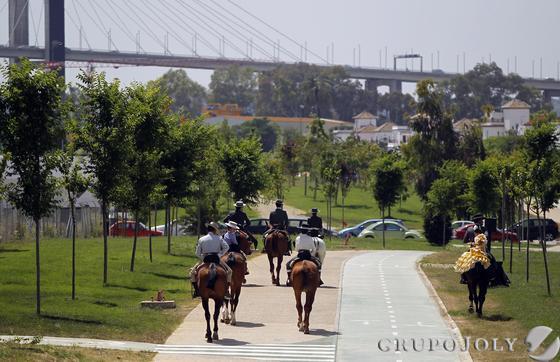
Source: Ref. 6, Juan Carlos Munoz