

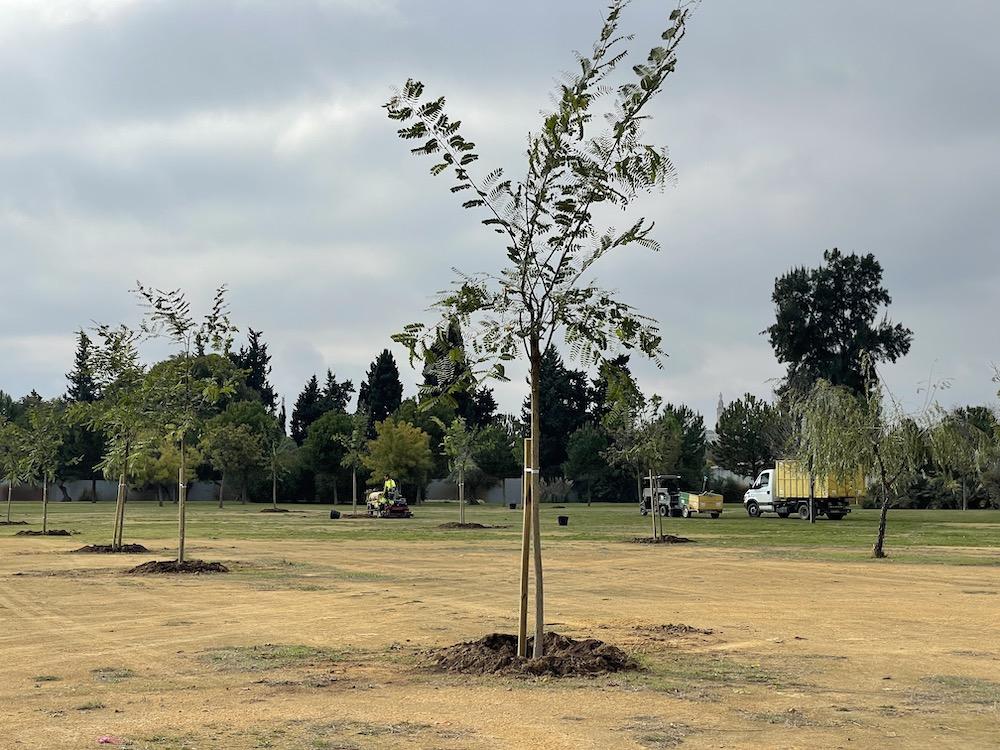
The City of Seville has carried out four tree planting campaigns between 2020 and 2024, aiming to meet the goals of its Urban Tree Management Plan for Seville [Ref. 2-7]. The intervention as described here is based on the planting campaigns to date, but as the Management Plan spans from 2019 to 2039, more campaigns can expected in the future. The tree management plan aims to provide guidelines for the planning of trees in the city to maximise their value and minimize conflicts. As part of the process, the current state of the tree population in Seville has been evaluated. The management plan describes the ecosystem services of trees related to climate adaptation, biodiversity and public health. It also identifies challenges and conflicts that may arise due to urban trees and their management [Ref. 1]. The plan has a goal to increase the tree cover in Seville by 5 % over 20 years, which leads to the ambition of planting 5000 trees yearly and the tree planting campaigns over the last years. Between 2020 and 2024, about 1000-5000 trees have been planted each year [Ref. 1-5].
Overview
Nature-based solution
- Grey infrastructure featuring greens
- Alley or street trees and other street vegetation
- Parks and urban forests
- Large urban parks or forests
- Pocket parks/neighbourhood green spaces
Key challenges
- Climate action for adaptation, resilience and mitigation (SDG 13)
- Climate change adaptation
- Environmental quality
- Air quality improvement
- Noise reduction
- Green space, habitats and biodiversity (SDG 15)
- Green space creation and/or management
- Health and well-being (SDG 3)
- Improving mental health
- Social justice, cohesion and equity (SDG 10)
- Social cohesion
- Sense of community and community engagement
Principal problems in Functional Urban Area (FUA)
- Climate-Related Hazards
- Heat stress & Extreme temperatures
- Environmental Degradation
- Biodiversity loss
- Soil degradation and loss
- Air pollution
Key priorities
Focus
Project objectives
Implementation activities
Climate-focused activities
Climate change adaptation:
- Increase urban vegetation cover to reduce urban heat island effect
- Restore and protect forests to prevent water runoff and assets loss due to flooding
Main beneficiaries
- Citizens or community groups
Governance
Management set-up
- Government-led
Type of initiating organisation
- Local government/municipality
Participatory approaches/ community involvement
- Consultation (e.g. workshop, surveys, community meetings, town halls)
- Joint implementation (e.g. tree planting)
Details on the roles of the organisations involved in the project
Project implemented in response to ...
Type of enablers
Financing
Total cost
Source(s) of funding
- Public local authority budget
Type of funding
- Earmarked public budget
Non-financial contribution
- Provision of expertise
- Other
Impacts and Monitoring
Environmental impacts
- Climate change
- Lowered local temperature
- Expected lowered local temperature
- Enhanced carbon sequestration
- Expected enhanced carbon sequestration
- Green space and habitat
- Increased green space area
- Achieved increased green space area
- Increased number of species present
- Achieved increased number of species present
Economic impacts
- Increased property prices
- Expected increased property prices
Socio-cultural impacts
- Social justice and cohesion
- Improved access to urban green space
- Achieved improved access to urban green space
- Increased involvement of locals in the management of green spaces
- Expected increased involvement of locals in the management of green spaces
- Health and wellbeing
- Improved physical health
- Expected improved physical health
- Improved mental health
- Expected improved mental health
- Education
- Increased awareness of NBS and their benefits
- Expected increased awareness of NBS and their benefits
Type of reported impacts
Presence of formal monitoring system
Presence of indicators used in reporting
Presence of monitoring/ evaluation reports
Availability of a web-based monitoring tool
Potential risks of implementation and trade-offs
References
 Information about this nature-based solution was collected as part of the Naturescapes project funded by the European Union under Grant Agreement No 101084341.