

Last updated: October 2021
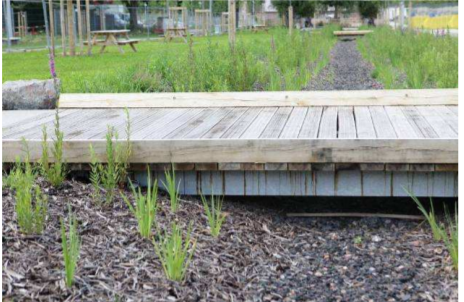
"In order to make this center area attractive and dynamic, the EPASE (Saint-Etienne Public Development Agency) and the town hall of Saint-Etienne have set up an ambitious eco-neighborhood project. This project is based on public spaces that are built on an original urban park model where nature is the driving force behind the site. Nature is at the heart of this "park city" project, realized in record time: in a year and a half, the vast majority of the park's work has been carried out and the neighborhood has begun to change."(Ref. 1)
https://www.orcae-auvergne-rhone-alpes.fr/
Overview
Nature-based solution
- Nature on buildings (external)
- Green roofs
- Grey infrastructure featuring greens
- Alley or street trees and other street vegetation
- Parks and urban forests
- Large urban parks or forests
- Green areas for water management
- Swales and filter strips
- Intentionally unmanaged areas
- Abandoned spaces with growth of wilderness or greens
Key challenges
- Climate action for adaptation, resilience and mitigation (SDG 13)
- Climate change adaptation
- Climate change mitigation
- Water management (SDG 6)
- Flood protection
- Green space, habitats and biodiversity (SDG 15)
- Habitat and biodiversity restoration
- Green space creation and/or management
- Environmental quality
- Soil quality improvement
- Regeneration, land-use and urban development
- Regulation of built environment
- Social justice, cohesion and equity (SDG 10)
- Social cohesion
- Social interaction
- Health and well-being (SDG 3)
- Improving mental health
- Creation of opportunities for recreation
- Economic development and employment (SDG 8)
- Economic development: industry
- Economic development: service sectors
- Real estate development
- Cultural heritage and cultural diversity
- Preservation of natural heritage
- Promotion of cultural diversity
Focus
Creation of new green areas
Project objectives
-Improve nature in the a urban environment (Ref. 2)
-To stimulate and make attractive this district for future inhabitants, companies and research centers (Ref. 1)
-Improved biodiversity, living environment and landscape and enhancing natural heritage (Ref. 1, page 10,11)
Implementation activities
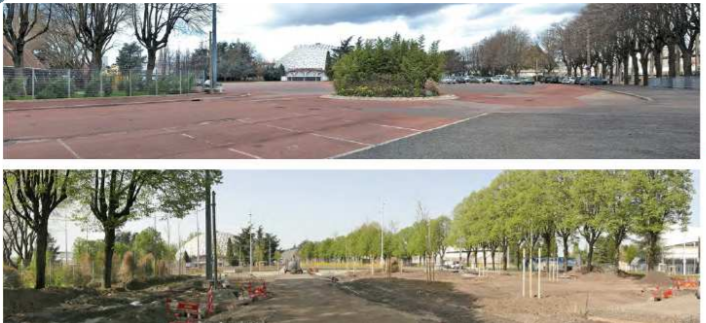
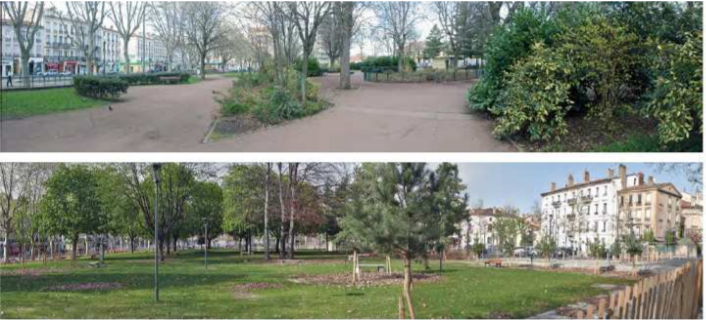
"The public spaces were reorganized and their natural character reinforced: redevelopment of Place Carnot, the parking of the Plaine Achille completely transformed into an urban park, the square Schoelcher more vegetated ... The whole district is redeveloped with green continuities where the movement is done in soft mode (pedestrian, bicycle, etc.) between the different spaces and public facilities. 13 hectares of public space were thus considerably vegetated: cement removed and replaced by a stabilized fertile, swales...
-The interstices between the pavement and the lining of the aisles let grow the grass and favor the possible spontaneous vegetation. 1000 trees were planted on the site in addition to existing ones, highlighting the landscape setting."(Ref. 1, page 4)
-Plants adapted to climate, and "zero irrigation system"(Ref.1 page 5)
"A strong communication, which allowed a significant mobilization and a rapid appropriation of the site by the inhabitants: 3 000 people were present at the inauguration of the park F. Mitterrand. Witnessing the attractiveness of the park, the pedestrian footbridge linking the Manufacture to the Achille Plain is quite used: there are about 4,000 passages per month." (Ref. 1, page 11) "1000 trees were planted on the site in addition to existing ones, highlighting the landscape setting."(Ref. 1, page 4)
-Swales replace cement and "Zero Irrigation System" and use of plants adapted to local climate (Ref.1 page 5)
-Improving biodiversity, living environment and landscape and enhancing natural heritage (Ref. 1, page 10,11).
Related ecosystem services (Ref. 1, page 9):
- Hobbies
- Improvement of the living environment, well-being
- Strengthening of social ties and conviviality
- Climate regulation (cooling through planted and wet ditches during summer,
facade or roof greening to avoid air conditioning the buildings)
- Land fertilization
-Nature's "cultural" services (leisure, improvement of the living environment, social link) are
particularly highlighted in this project.
Climate-focused activities
Climate change adaptation:
- Create or improve outdoor spaces to help people escape from urban heat
- Implement sustainable urban drainage infrastructure (e.g. to make space for water)
- Increase the use of climate-resilient plant species (resistant to drought, fire, and pests)
Climate change mitigation:
- Install vertical or horizontal artificial surfaces that help with carbon storage and cooling
- Invest in public transport/bicycle infrastructure as a means to prevent car use
Biodiversity conservation or restoration-focused activities
Biodiversity restoration:
- Restore species (native, endangered, or unspecified)
- Restore valued species
- Public engagement
- Other
Main beneficiaries
- Local government/Municipality
- Public sector institution (e.g. school or hospital)
- Non-government organisation/Civil Society
- Private sector/Corporate/Company
- Researchers/University
- Citizens or community groups
Governance
Management set-up
- Government-led
Type of initiating organisation
- National government
- Regional government
- Local government/municipality
Participatory approaches/ community involvement
- Dissemination of information and education
- Citizen monitoring and review
Details on the roles of the organisations involved in the project
"The whole project was financed by EPASE (a partnership between the State, the city of Saint Etienne, Saint-Etienne Métropole, the General Council of the Loire and the Rhône-Alpes region)." (Ref.1, page 7)
"In terms of green space management, the whole project is part of the differentiated management carried out by the city of Saint-Etienne. In parallel, a management approach labeled "Zero phyto" has begun with support from FRAPNA (Rhône-Alpes Nature Protection Federation)." (Ref. 1, page 6)
-Universities and real estate developments have been developed in the neighbourhood, including the national centre for dramatic arts and "La Grande Usine Creative", which is a real estate operation dedicated to welcoming creative and innovative companies (Ref. 2).
Project implemented in response to ...
... an EU policy or strategy?
Unknown
... a national policy or strategy?
Yes
("Axes and commitments of the National Plan on Restoring and Valorising nature in the city :
-Axe 2: Developing natural spaces in quality and quantity
Commitment 7: Developing natural spaces of proximity
Commitment 8: Promoting ecological management of nature in the city
-Annex 3: Promoting a culture and shared governance
Commitment 16: Promoting citizens' participation in projects of urban nature spaces" (Ref. 1)
Nature in the City national plan launched in 2010, the implementation of this plan is provided for in Article 7 of the Grenelle 1 law and through the commitment to "restore nature in the city and its multiple functions". (Ref. 4))
... a local policy or strategy?
Yes
(The Nature in the city plan within the framework of the Green Network of Saint Etienne. (Ref. 1 page 6)
)
Financing
Total cost
€500,000 - €2,000,000
Source(s) of funding
- Public national budget
- Public regional budget
- Public local authority budget
Type of funding
- Earmarked public budget
Non-financial contribution
Unknown
Impacts and Monitoring
Environmental impacts
- Climate change
- Lowered local temperature
- Reduced emissions
- Strengthened capacity to address climate hazards/natural disasters
- Environmental quality
- Improved soil quality
- Water management and blue areas
- Increased protection against flooding
- Improved stormwater management
- Green space and habitat
- Increased green space area
- Increased conversion of degraded land or soil
- Reduced biodiversity loss
- Increased number of species present
- Other
Economic impacts
- Attraction of business and investment
- Increased market share for green economies
Socio-cultural impacts
- Social justice and cohesion
- Improved social cohesion
- Improved liveability
- Improved access to urban green space
- Increased opportunities for social interaction
- Health and wellbeing
- Improved mental health
- Gain in activities for recreation and exercise
- Cultural heritage and sense of place
- Promotion of cultural diversity
- Protection of natural heritage
- Protection of historic and cultural landscape / infrastructure
- Education
- Increased knowledge of locals about local nature
Type of reported impacts
Expected impacts, Achieved impacts
Presence of formal monitoring system
Unknown
Presence of indicators used in reporting
No evidence in public records
Presence of monitoring/ evaluation reports
No evidence in public records
Availability of a web-based monitoring tool
No evidence in public records
References
1. DREAL Rhône-Alpes & ASCONIT Consultants (2012). "Projet urbain : « Ville-Parc »Manufacture – Plaine Achille". (See attached document)
2. EPASE (n.d). MANUFACTURE PLAINE-ACHILLE - Chiffres. Available at: Source link (Accessed: September 8, 2020).
3. EPASE (n.d). LES OPÉRATIONS. Available at: Source link (Accessed: September 8, 2020).
4. Nature en Ville (n.d). "Historique du Plan Nature en Ville". Available at: Source link (Website not available in 2020).
5. Saint Etienne (n.d) "Nature en ville". Brochure. Available at: Source link (Accessed: September 8, 2020).
6. Saint Etienne Métropole (n.d). Plan Climat "Tous Acteurs du Climat". Available at: Source link (Accessed: September 8, 2020).
2. EPASE (n.d). MANUFACTURE PLAINE-ACHILLE - Chiffres. Available at: Source link (Accessed: September 8, 2020).
3. EPASE (n.d). LES OPÉRATIONS. Available at: Source link (Accessed: September 8, 2020).
4. Nature en Ville (n.d). "Historique du Plan Nature en Ville". Available at: Source link (Website not available in 2020).
5. Saint Etienne (n.d) "Nature en ville". Brochure. Available at: Source link (Accessed: September 8, 2020).
6. Saint Etienne Métropole (n.d). Plan Climat "Tous Acteurs du Climat". Available at: Source link (Accessed: September 8, 2020).
https://www.orcae-auvergne-rhone-alpes.fr/
https://www.orcae-auvergne-rhone-alpes.fr/