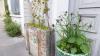
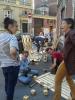
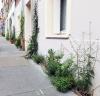
Fil vert aims to help green the streets in Normandy and raise awareness among citizens of the importance of being an actor of their daily life with regard to the occupation of public space. They aim to "embellish our streets, which are often devoid of vegetation, but also to train responsible citizens" (Ref. 7). "Operation "Fil Vert" was launched at Croix de Pierre (District) in Rouen in September 2013 to beautify and revitalize the district by mobilizing residents and tradespeople. It aims of installing planters in front of the inhabitants and the merchants (subject to obtaining the agreement of the owners in case of hiring), along the pavements, provided that it makes at least 1.40 M width to allow strollers and wheelchairs to pass." (Ref. 3)
Overview
Nature-based solution
- Nature on buildings (external)
- Green walls or facades
- Grey infrastructure featuring greens
- Alley or street trees and other street vegetation
Key challenges
- Green space, habitats and biodiversity (SDG 15)
- Habitat and biodiversity conservation
- Green space creation and/or management
- Environmental quality
- Air quality improvement
- Regeneration, land-use and urban development
- Regulation of built environment
- Inclusive and effective governance (SDG 16)
- Inclusive governance
- Social justice, cohesion and equity (SDG 10)
- Environmental education
- Social justice and equity
- Social cohesion
- Social interaction
- Health and well-being (SDG 3)
- Enabling opportunities for physical activity
- Creation of opportunities for recreation
- Economic development and employment (SDG 8)
- Tourism support
- Sustainable consumption and production (SDG 12)
- Sustainable production
Focus
Project objectives
Implementation activities
Biodiversity conservation or restoration-focused activities
Biodiversity conservation:
- Protect and enhance urban habitats
- Create new habitats
- Protect species
- Undertake specific measures to protect species
- Means for conservation governance
- Raise public awareness
- Public engagement
- Create and use scientific knowledge for conservation
- Capacity building
- Other
Main beneficiaries
- Local government/Municipality
- Non-government organisation/Civil Society
- Citizens or community groups
Governance
Management set-up
- Led by non-government actors
Type of initiating organisation
- Citizens or community group
- District/neighbourhood association
Participatory approaches/ community involvement
- Taskforce groups
- Dissemination of information and education
- Consultation (e.g. workshop, surveys, community meetings, town halls)
- Joint implementation (e.g. tree planting)
- Co-management/Joint management
Details on the roles of the organisations involved in the project
Project implemented in response to ...
Financing
Total cost
Source(s) of funding
- Public local authority budget
- Unknown
Type of funding
- Earmarked public budget
- Unknown
Non-financial contribution
- Provision of land
- Provision of goods
- Provision of labour
- Public authorities (e.g. land, utility services)
- Citizens (e.g. volunteering)
Impacts and Monitoring
Environmental impacts
- Environmental quality
- Improved air quality
- Improved waste management
- Improved protection against strong wind
- Green space and habitat
- Increased green space area
- Increased conservation or restoration of ecosystems
- Reduced biodiversity loss
- Increased number of species present
Economic impacts
- More sustainable tourism
Socio-cultural impacts
- Social justice and cohesion
- Improved social cohesion
- Improved liveability
- Increased opportunities for social interaction
- Increased involvement of locals in the management of green spaces
- Health and wellbeing
- Improved mental health
- Cultural heritage and sense of place
- Promotion of cultural diversity
- Protection of historic and cultural landscape / infrastructure
- Increased sense of place identity, memory and belonging
- Education
- Increased support for education and scientific research
- Increased knowledge of locals about local nature
- Increased awareness of NBS and their benefits
- Other
Type of reported impacts
Presence of formal monitoring system
Presence of indicators used in reporting
Presence of monitoring/ evaluation reports
Availability of a web-based monitoring tool
References
2. Association Fil Vert's Facebook Page. Available at: Source link (Accessed: August 26, 2020).
3. Incredible Edible Agglo Rouen (2014). "Les incroyables comestibles rejoignent « le Fil vert » du quartier Croix de Pierre". Available at: Source link (Accessed: August 26, 2020).
4. Anon. (2014). "Compte-Rendu de la Réunion « Fil Vert » du jeudi 16 Janvier 2014". Available at: Source link (Accessed: August 26, 2020).
5. Ville de Rouen (2015). Communiqué de Presse: Soutenir la biodiversité au cœur de Rouen. Available at: Source link (Website not available in 2020).
6. Fil Vert en Normandie (2020). "Fil Vert en Normandie". Available at: Source link (Accessed: August 26, 2020).