

Last updated: October 2021
"The National Park of Circeo, established in 1934, on the Tyrrhenian coast south of Rome, contains ecosystems of invaluable scientific interest. The site is, however, regularly invaded, during the summer season, by thousands of holidaymakers who tend to park their cars on the sand dunes near the beach with a consequent heavy impact on the whole dune system. The LIFE project aimed to complete the preventative and natural restoration measures started under two earlier projects financed by the EU" (1).
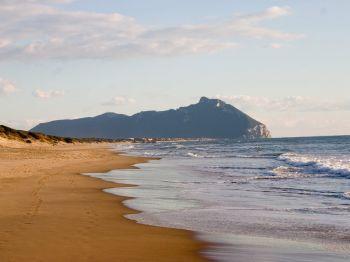
http://www.parcocirceo.it/page.php?id=87
Overview
Nature-based solution
- Blue infrastructure
- Coastlines
Key challenges
- Coastal resilience and marine protection (SDG 14)
- Coastal protection / hazard mitigation
- Green space, habitats and biodiversity (SDG 15)
- Green space creation and/or management
Focus
Protection of natural ecosystems, Knowledge creation and awareness raising, Improved governance of green or blue areas
Project objectives
This project focused its activities on two segments of a road along the dune area.
Its aims were two-fold.
1. In the first segment (a 2 km stretch), in which special walkways had already been built to prevent passages on the dunes, the aim was to close the road
altogether, to private vehicles.
2. In the second segment, which was already closed to traffic, the project aimed
at a series of interventions that would favour the natural recovery of the dune. (1)
Implementation activities
- Facilities were created to prevent swimmers from passing through the dunes (walkways, fences, information boards and pickets to deter parking).
- Removal of asphalt for 3km of coastal road in order to trigger a process of re-naturalisation of the area.
- Modern naturalistic engineering techniques were used for the reconstruction of the dunes.
- Winding systems, of different shape and size.
- Basal barriers in windy windswept and damping of wave motion.
- Containment and consolidation works of sands with viminate associated with coconut fiber bios
- Planting of 40,000 local plants (5).
Main beneficiaries
- Local government/Municipality
- Citizens or community groups
Governance
Management set-up
- Government-led
Type of initiating organisation
- National government
- Local government/municipality
Participatory approaches/ community involvement
- Dissemination of information and education
Details on the roles of the organisations involved in the project
Ente Parco Nazionale del Circeo was coordinating the intervention in cooperation with the Ufficio Amministrazione Gestione
Beni ex ASFD MiPAF (6).
Project implemented in response to ...
... an EU policy or strategy?
Yes
("The National Park of Circeo includes 2000 ha of wetlands that fall within the terms defined by the Ramsar Convention (on wetlands of international importance) and is a special protection area, according to the Birds Directive. Moreover, it includes three natural reserves that form part of the UNESCO nature conservation project known as “MAB-Man and Biosphere”. The sand dunes, which extend for 25 km along the coast, constitute one of the largest nucleus for this type of priority habitat (listed in Annex I of the Habitats Directive) in central-southern Italy".
Nature protection and Biodiversity:
Directive 79/409 - Conservation of wild birds (02.04.1979)
Directive 92/43 - Conservation of natural habitats and of wild fauna and flora- Habitats Directive (1 and 6).)
... a national policy or strategy?
Unknown
... a local policy or strategy?
Unknown
Financing
Total cost
€500,000 - €2,000,000
Source(s) of funding
- EU funds
- Public national budget
- Public local authority budget
Type of funding
- Earmarked public budget
Non-financial contribution
Unknown
Impacts and Monitoring
Environmental impacts
- Environmental quality
- Improved protection against strong wind
- Improved soil quality
- Water management and blue areas
- Increased protection against flooding
- Green space and habitat
- Increased green space area
Economic impacts
- Unknown
Socio-cultural impacts
- Education
- Increased awareness of NBS and their benefits
Type of reported impacts
Achieved impacts
Presence of formal monitoring system
Yes
Presence of indicators used in reporting
Yes
Presence of monitoring/ evaluation reports
Yes
Availability of a web-based monitoring tool
Yes
References
1. Europa Eu (1999), NBS webpage, Available at Source link (Accessed 20-10-2020)
2. EConservation (no date) ,Website of the intervention, Available at Source link (Accessed 20-10-2020)
3. EuropaBook(1998), Circeo - Completion of the main programme for the reestablishment of the coastal dune in Parco Nazionale Circeo, Available at Source link (Accessed 20-10-2020)
4. Parco del Circeo (no date), Park website, Available at Source link (Accessed 20-10-2020)
5. ISPRA (1999) Report of the intervention, Available at Source link (Accessed 20-10-2020)
6. ISPRA (no date), NBS Info, Available at Source link (Accessed 20-10-2020)
2. EConservation (no date) ,Website of the intervention, Available at Source link (Accessed 20-10-2020)
3. EuropaBook(1998), Circeo - Completion of the main programme for the reestablishment of the coastal dune in Parco Nazionale Circeo, Available at Source link (Accessed 20-10-2020)
4. Parco del Circeo (no date), Park website, Available at Source link (Accessed 20-10-2020)
5. ISPRA (1999) Report of the intervention, Available at Source link (Accessed 20-10-2020)
6. ISPRA (no date), NBS Info, Available at Source link (Accessed 20-10-2020)