

Last updated: October 2021
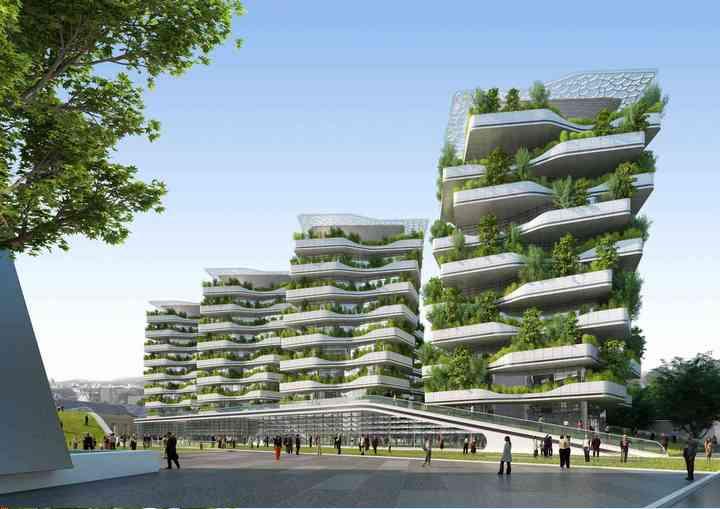
The proposed masterplan for the "Città della Scienza" or the City of Science by Vincent Callebaut Architectures and Studio d'Architettura Briguglio Morales focuses on sustainability with history to propose a self-sufficient urban ecosystem in Italy. More than a spatial work of art, it encourages the promotion of sustainable design, low carbon transportation, renewable energies, automation technologies, and green building materials. Because of these features, the project has many examples of nature-based solutions (e.g.vertical gardens, green roofs/walls, orchards). Operating on the principle of living facades, the Città della Scienza revitalizes Rome's forgotten military district into a vibrant, regenerating living city. [1][3]
http://vincent.callebaut.org/object/150312_cittadellascienza/cittadellascienza/projects/user
Overview
Nature-based solution
- Nature on buildings (external)
- Green roofs
- Green walls or facades
- Balcony greens
- Grey infrastructure featuring greens
- Alley or street trees and other street vegetation
- Institutional green space
- Community gardens and allotments
- Community gardens
- Other
Key challenges
- Water management (SDG 6)
- Stormwater and rainfall management and storage
- Green space, habitats and biodiversity (SDG 15)
- Green space creation and/or management
- Regeneration, land-use and urban development
- Regulation of built environment
- Conversion of former industrial areas
- Economic development and employment (SDG 8)
- Tourism support
- Sustainable consumption and production (SDG 12)
- Sustainable consumption
- Sustainable production
Focus
Creation of new green areas
Project objectives
The 6 fundamental principles of the intervention are as follows [1]:
1. Correlation with the context and industrial history;
2. Connection of various public spaces, building types and architectural spaces;
3. Flexible and multi-functional urban spaces;
4. Cityscape full of trees;
5. Bio-sustainability of urban plants and buildings;
6. Social mix of dwelling units.
Implementation activities
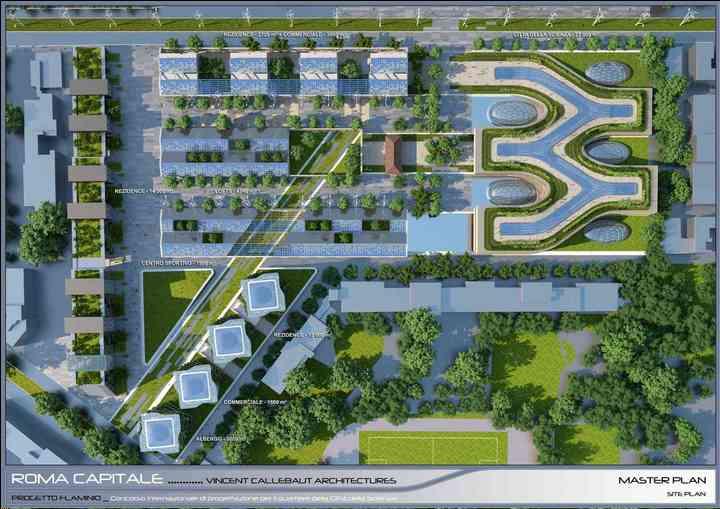
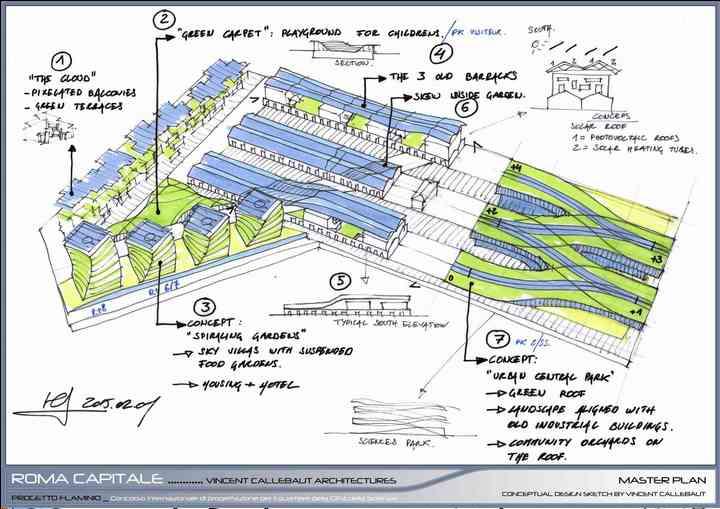
The project will regenerate the urban area along via Guido Reni, between the MAXXI and the Auditorium in northern Rome. Across the entire city, a grid of public spaces and pathways will link the structures, providing pedestrian access across the entire footprint, while existing tree-lined avenues will be integrated into the overall design. Building facades will have vertical gardens and balconies, which will provide free, organic edible plants to inhabitants. Instead of being adjacent to the buildings, fruit trees and food gardens become part of the buildings. Retail stores restaurants, etc. integrate with residential spaces to create a self-sustaining town within the city of Rome. Every roof will be covered in greenery that can be used to feed the people of Citta del Scienza. Rainwater will be recovered for irrigation, while hot water and electricity will be solar-generated. Biomass recycling, energy-efficient buildings and lighting will be powered by integrated wind turbines. [4]
Main beneficiaries
- Local government/Municipality
- Private sector/Corporate/Company
- Citizens or community groups
- Young people and children
Governance
Management set-up
- Led by non-government actors
Type of initiating organisation
- Private sector/corporate actor/company
Participatory approaches/ community involvement
- Unknown
Details on the roles of the organisations involved in the project
The project was created in collaboration with the COFFICE studio di architettura e urbanistica and Studio d’Architettura Briguglio Morales under the supervision of Prof. Ing. Paolo Colarossi in Rome. [4]
Project implemented in response to ...
... an EU policy or strategy?
Unknown
... a national policy or strategy?
Unknown
... a local policy or strategy?
Unknown
Financing
Total cost
More than €4,000,000
Source(s) of funding
- Unknown
Type of funding
- Unknown
Non-financial contribution
Unknown
Impacts and Monitoring
Environmental impacts
- Climate change
- Lowered local temperature
- Environmental quality
- Improved air quality
- Green space and habitat
- Increased green space area
Economic impacts
- Unknown
Socio-cultural impacts
- Social justice and cohesion
- Increased access to healthy/affordable food
Type of reported impacts
Expected impacts, No impacts reported
Presence of formal monitoring system
Unknown
Presence of indicators used in reporting
No evidence in public records
Presence of monitoring/ evaluation reports
No evidence in public records
Availability of a web-based monitoring tool
No evidence in public records
References
[1] Citta Della Scienza (2015) Vincent Callebaut Architectures, Available at Source link (Accessed 17-10-2020)
[2] Rinaldi, M. (2015) Citta Della Scienza: An Urban Ecosystem by PAolo Colarossi + Vincent Callebaut. A AS Architecture, Available at Source link (Accessed 17-10-2020)
[3] Vincent callebaut masterplans a self-sufficient city of science in rome (2015) Designboom, Available at Source link (Accessed 17-10-2020)
[4] Lofgren, K. (2015) Vincent Callebaut’s City of Science in Rome is turning a former military district into a self-sufficient urban ecosystem. Inhabitat, Available at Source link (Accessed 17-10-2020)
[2] Rinaldi, M. (2015) Citta Della Scienza: An Urban Ecosystem by PAolo Colarossi + Vincent Callebaut. A AS Architecture, Available at Source link (Accessed 17-10-2020)
[3] Vincent callebaut masterplans a self-sufficient city of science in rome (2015) Designboom, Available at Source link (Accessed 17-10-2020)
[4] Lofgren, K. (2015) Vincent Callebaut’s City of Science in Rome is turning a former military district into a self-sufficient urban ecosystem. Inhabitat, Available at Source link (Accessed 17-10-2020)
http://vincent.callebaut.org/object/150312_cittadellascienza/cittadellascienza/projects/user

http://vincent.callebaut.org/object/150312_cittadellascienza/cittadellascienza/projects/user
http://vincent.callebaut.org/object/150312_cittadellascienza/cittadellascienza/projects/user