

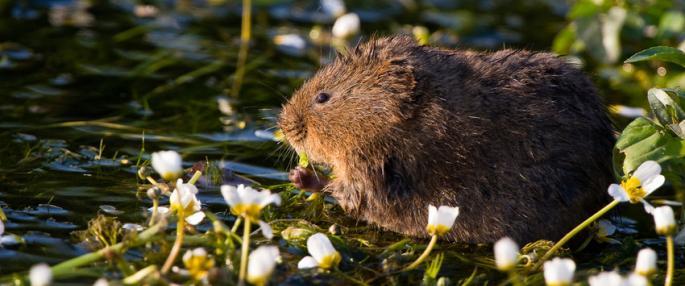
The Berkshire, Buckinghamshire and Oxfordshire Wildlife Trust (BBOWT) 'Water Vole Recovery Project' is working in partnership with the Environment Agency, the Canal & River Trust and Thames Water to monitor water voles. Water voles have undergone one of the most serious declines of any wild mammal in Britain during the 20th century. The intensification of agriculture in the 1940s and 1950s caused the loss and degradation of habitat, but the most rapid period of decline was during the 1980s and 1990s as American mink spread. Between 1989 and 1998, the population fell by almost 90 percent! The above project also is identifying habitat enhancement opportunities and influencing local landowners to manage sites sympathetically for water voles and implement mink control. (Ref. 1)
Overview
Nature-based solution
- Blue infrastructure
- Rivers/streams/canals/estuaries
- Other
Key challenges
- Green space, habitats and biodiversity (SDG 15)
- Habitat and biodiversity restoration
- Habitat and biodiversity conservation
- Green space creation and/or management
- Inclusive and effective governance (SDG 16)
- Inclusive governance
- Social justice, cohesion and equity (SDG 10)
- Environmental education
Focus
Project objectives
Implementation activities
Biodiversity conservation or restoration-focused activities
Biodiversity conservation:
- Protect and enhance urban habitats
- Preserve and strengthen existing habitats and ecosystems
- Promote environmentally-sound development in and around protected areas
- Create new habitats
- Preserve and strengthen habitat connectivity
- Protect species
- Undertake specific measures to protect native species
- Control and clean invasive alien species
- Means for conservation governance
- Biodiversity offsets
- Manage biological resources for conservation and sustainable use
Biodiversity restoration:
- Rehabilitate and restore damaged or destroyed ecosystems
- Restore species (native, endangered, or unspecified)
- Restore native species
- Clear and control invasive alien species
Main beneficiaries
- National-level government
- Local government/Municipality
- Citizens or community groups
Governance
Management set-up
- Co-governance with government and non-government actors
Type of initiating organisation
- Local government/municipality
- Non-government organisation/civil society
Participatory approaches/ community involvement
- Dissemination of information and education
- Consultation (e.g. workshop, surveys, community meetings, town halls)
Details on the roles of the organisations involved in the project
Project implemented in response to ...
Financing
Total cost
Source(s) of funding
- Public national budget
- Corporate investment
- Funds provided by non-governmental organization (NGO)
Type of funding
- Direct funding (grants, subsidies, or self-financed projects by private entities)
Non-financial contribution
- Provision of labour
- Citizens (e.g. volunteering)
Impacts and Monitoring
Environmental impacts
- Green space and habitat
- Increased number of protection areas
- Increased green space area
- Increased conservation or restoration of ecosystems
- Increase in protected green space areas
- Reduced biodiversity loss
- Increased protection of threatened species
- Increased ecological connectivity across regeneration sites and scales
Economic impacts
- Unknown
Socio-cultural impacts
- Cultural heritage and sense of place
- Protection of natural heritage
- Protection of historic and cultural landscape / infrastructure
- Increased awareness of flora and fauna as culturally and historically meaningful
- Education
- Increased support for education and scientific research
- Increased awareness of NBS and their benefits
Type of reported impacts
Presence of formal monitoring system
Presence of indicators used in reporting
Presence of monitoring/ evaluation reports
Availability of a web-based monitoring tool
References
Ref. 2. People's Trust for Endangered Species (no date) Water Vole. Available at: Source link. Accessed on 12th September, 2020.
Ref. 3. Reading Council (2006) The Reading Biodiversity Action Plan. Available at: Source link. Accessed on 12th September, 2020.
Ref. 4. Berkshire Life and Buckinghamshire Life (2014) Water vole appeal in Berkshire and Buckinghamshire. Available at: Source link. Accessed on 12th September, 2020.