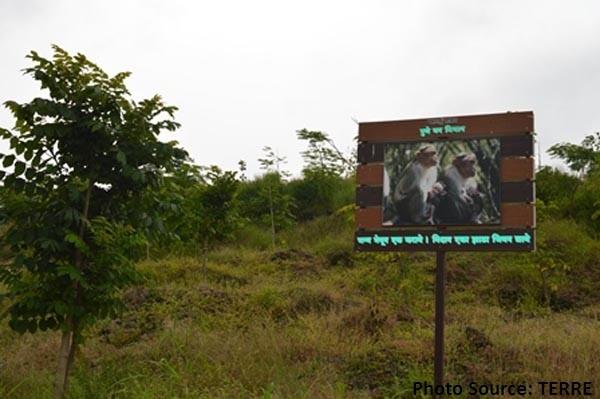
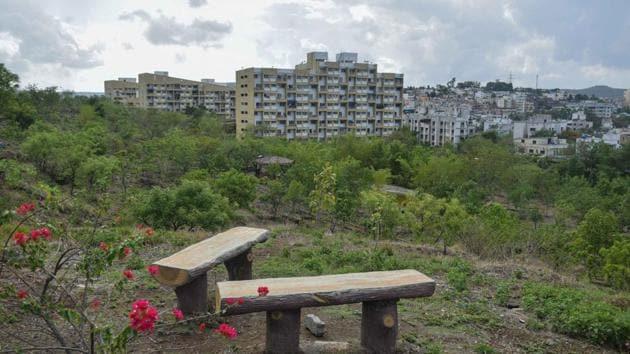
Wajre Urban Forest is Maharashtra state's first urban forestry project developed on the outskirts of Pune city (1, 2). This project was done in a collaboration involving the public, corporate, NGOs and governmental actors (3). A barren land of 16 hectares, also used as a dump yard by the nearby residents, belonging to the Maharashtra Forest Department, was taken by the TERRE Policy Centre in association with support from TATA Motors and Persistent Foundations as CSR Partners (1,3). The project was targeted to reduce air pollution and provide a site for the recreation and relaxation of urban residents of the city (4). A total of 9500 plants belonging to 23 indigenous plant species of 6-8 ft were planted (1,2). The plants have now transformed into trees 9-10 feet in height (1, 5). The park also provides the opportunity to engage citizens by the provision of adopting specific plants in your name (5). The park is frequented by morning and evening walkers, with approx. 1000-1500 people per day (1,3).
Overview
Nature-based solution
- Blue infrastructure
- Lakes/ponds
- Parks and urban forests
- Large urban parks or forests
Key challenges
- Environmental quality
- Air quality improvement
- Green space, habitats and biodiversity (SDG 15)
- Habitat and biodiversity restoration
- Green space creation and/or management
- Regeneration, land-use and urban development
- Promote natural styles of landscape design for urban development
- Health and well-being (SDG 3)
- Creation of opportunities for recreation
- Inclusive and effective governance (SDG 16)
- Effective management
Focus
Project objectives
Implementation activities
Biodiversity conservation or restoration-focused activities
Biodiversity restoration:
- Rehabilitate and restore damaged or destroyed ecosystems
- Restore species (native, endangered, or unspecified)
- Restore native species
- Restore valued species
Main beneficiaries
- Local government/Municipality
- Non-government organisation/Civil Society
- Citizens or community groups
Governance
Management set-up
- Co-governance with government and non-government actors
Type of initiating organisation
- Non-government organisation/civil society
Participatory approaches/ community involvement
- Unknown
Details on the roles of the organisations involved in the project
Project implemented in response to ...
Financing
Total cost
Source(s) of funding
- Unknown
Type of funding
- Unknown
Non-financial contribution
- Provision of labour
- Public authorities (e.g. land, utility services)
- Citizens (e.g. volunteering)
Impacts and Monitoring
Environmental impacts
- Climate change
- Lowered local temperature
- Enhanced carbon sequestration
- Environmental quality
- Improved air quality
- Improved soil quality
- Water management and blue areas
- Improved stormwater management
- Green space and habitat
- Promotion of naturalistic styles of landscape design for urban development
- Increased green space area
- Increased conservation or restoration of ecosystems
- Reduced biodiversity loss
- Increased number of species present
- Restoration of derelict areas
Economic impacts
- Other
Socio-cultural impacts
- Social justice and cohesion
- Improved access to urban green space
- Increased opportunities for social interaction
- Increased involvement of locals in the management of green spaces
- Health and wellbeing
- Gain in activities for recreation and exercise
- Cultural heritage and sense of place
- Improvement in people’s connection to nature
- Protection of natural heritage
- Education
- Increased awareness of NBS and their benefits
Type of reported impacts
Presence of formal monitoring system
Presence of indicators used in reporting
Presence of monitoring/ evaluation reports
Availability of a web-based monitoring tool
References
(2) Press Information Bureau (PIB) (2020), Warje Urban Forest in Pune now a role model for the country. available at Source link (accessed 29-01-2023)
(3) Equator Initiative(unknown), Urban forestry. available at Source link (accessed 29-01-2023)
(4) Hindustan Times (2020), Warje urban forest to be role model for 200 such forests across country: Javadekar, 07 June, viewed on 29 January 2023, Source link
(5) Punekar News (2020), Pune: Warje Urban Forest now a role model for the country, 04 June, viewed on 29 January 2023, Source link
(6) TERRE Policy Centre (2017), Warje Urban Forestry Biodiversity Report-2017. available at Source link (accessed 16-02-2023)