

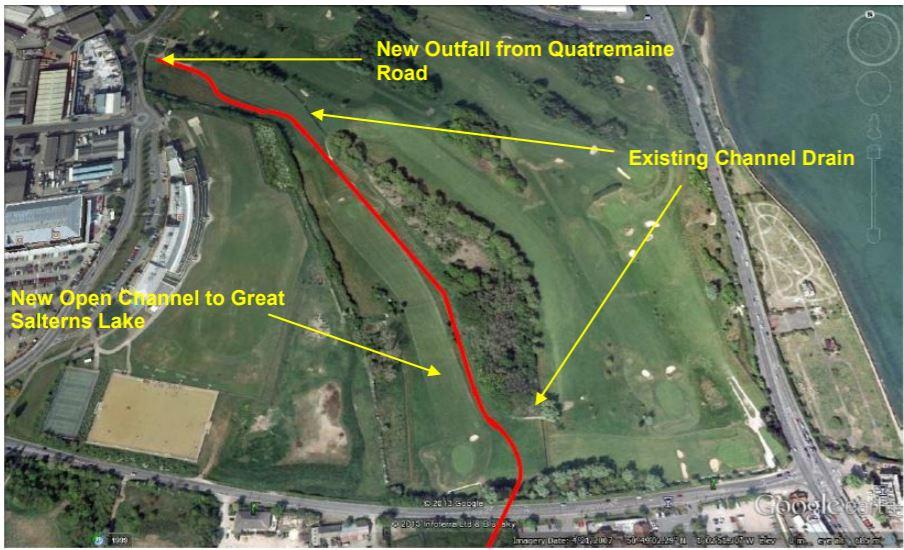
Following a severe storm in 2000 that overwhelmed the sewage system of Portsmouth along with its main Wastewater Pump Station, causing major flooding in the city with the destruction of private and public properties, prevention of such events become a key priority (5). The Portsmouth Flood Alleviation Scheme aims to relieve the pressure on the sewage system in wet weathers by diverting the accumulated surface water flows away from the combined sewer networks and discharge them into the harbours around the island (5). The Scheme consists of several measures across the city, among others the creation of a new open watercourse channel across the Great Salterns Golf Course diverting surface water directly into Great Salterns Lake (5). This measure of the scheme is a solution that separates surface water to provide resilience, boost flood protection and benefit the environment with the minimum of new infrastructure (1).
Overview
Nature-based solution
- Green areas for water management
- Swales and filter strips
Key challenges
- Climate action for adaptation, resilience and mitigation (SDG 13)
- Climate change adaptation
- Water management (SDG 6)
- Flood protection
- Stormwater and rainfall management and storage
- Coastal resilience and marine protection (SDG 14)
- Coastal protection / hazard mitigation
Focus
Project objectives
Implementation activities
Climate-focused activities
Climate change adaptation:
- Protect coastal and freshwater ecosystems to prevent coastal erosion and pollution
- Implement sustainable urban drainage infrastructure (e.g. to make space for water)
Main beneficiaries
- Local government/Municipality
- Citizens or community groups
Governance
Management set-up
- Co-governance with government and non-government actors
Type of initiating organisation
- Local government/municipality
Participatory approaches/ community involvement
- Dissemination of information and education
- Consultation (e.g. workshop, surveys, community meetings, town halls)
Details on the roles of the organisations involved in the project
Project implemented in response to ...
Financing
Total cost
Source(s) of funding
- Public national budget
Type of funding
- Earmarked public budget
Non-financial contribution
Impacts and Monitoring
Environmental impacts
- Climate change
- Strengthened capacity to address climate hazards/natural disasters
- Water management and blue areas
- Increased protection against flooding
- Improved stormwater management
Economic impacts
- Unknown
Socio-cultural impacts
- Unknown
Type of reported impacts
Presence of formal monitoring system
Presence of indicators used in reporting
Presence of monitoring/ evaluation reports
Availability of a web-based monitoring tool
References
2. Coterill T. (2017). Portsmouth £44m flood defences will protect thousands. Johnston Publishing Ltd. Accessed on November 12, 2020, Source link
3. McTaggart, R. (2015). Portsmouth Flood Alleviation Scheme. Accessed on November 12, 2020, Source link
4. Portsmouth City Council. nd. Local flood risk management strategy. Accessed on November 12, 2020, Source link
5. McTaggart, R. (n.d). Separating Portsmouth’s Sewerage System. 4Delivery. Accessed on November 12, 2020, Source link