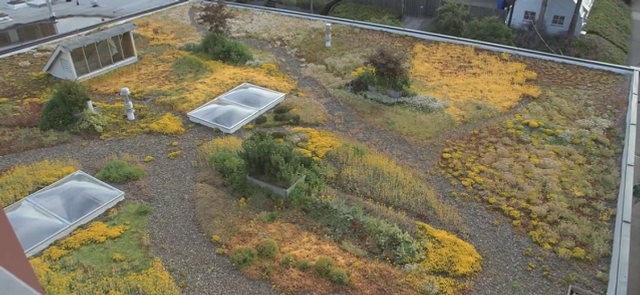
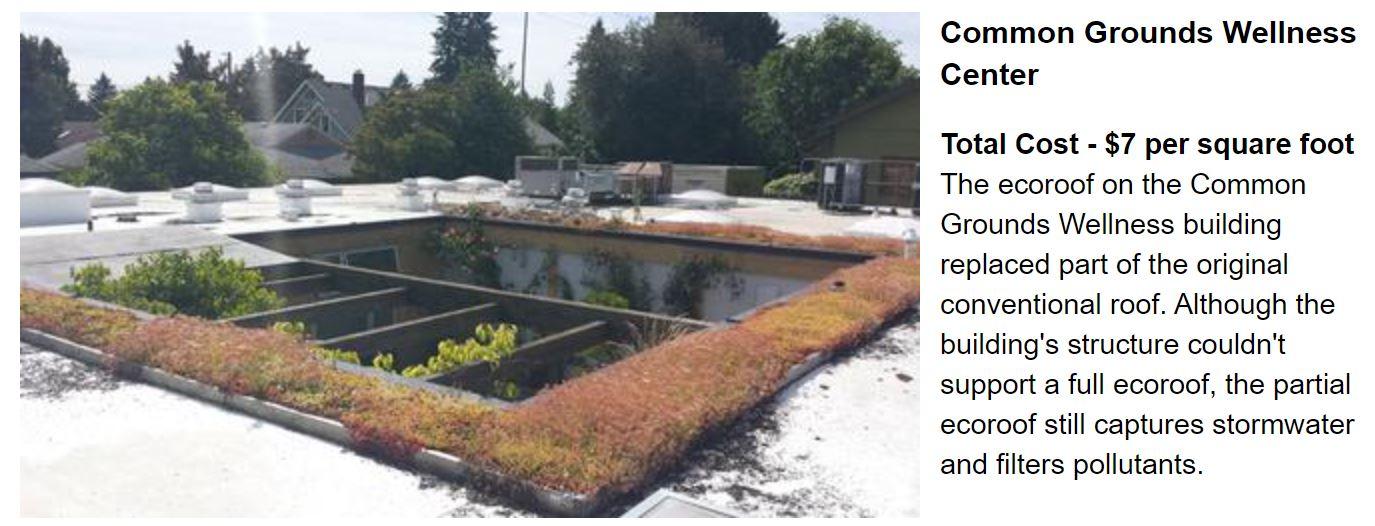
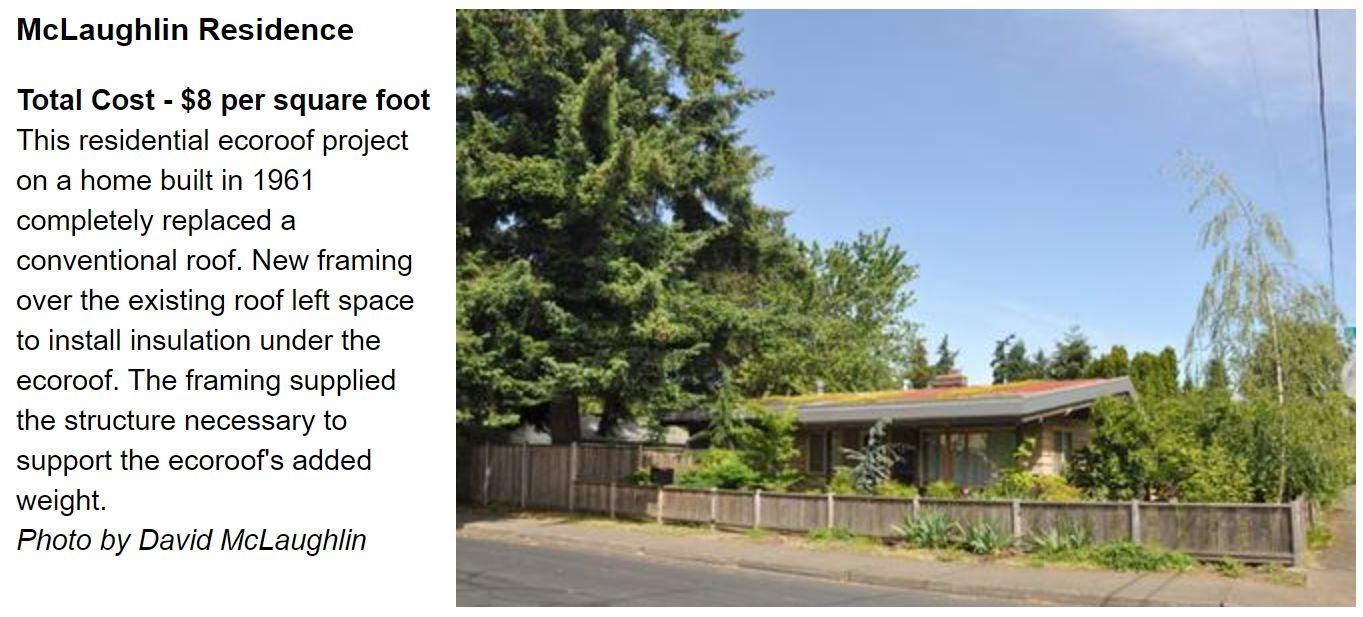
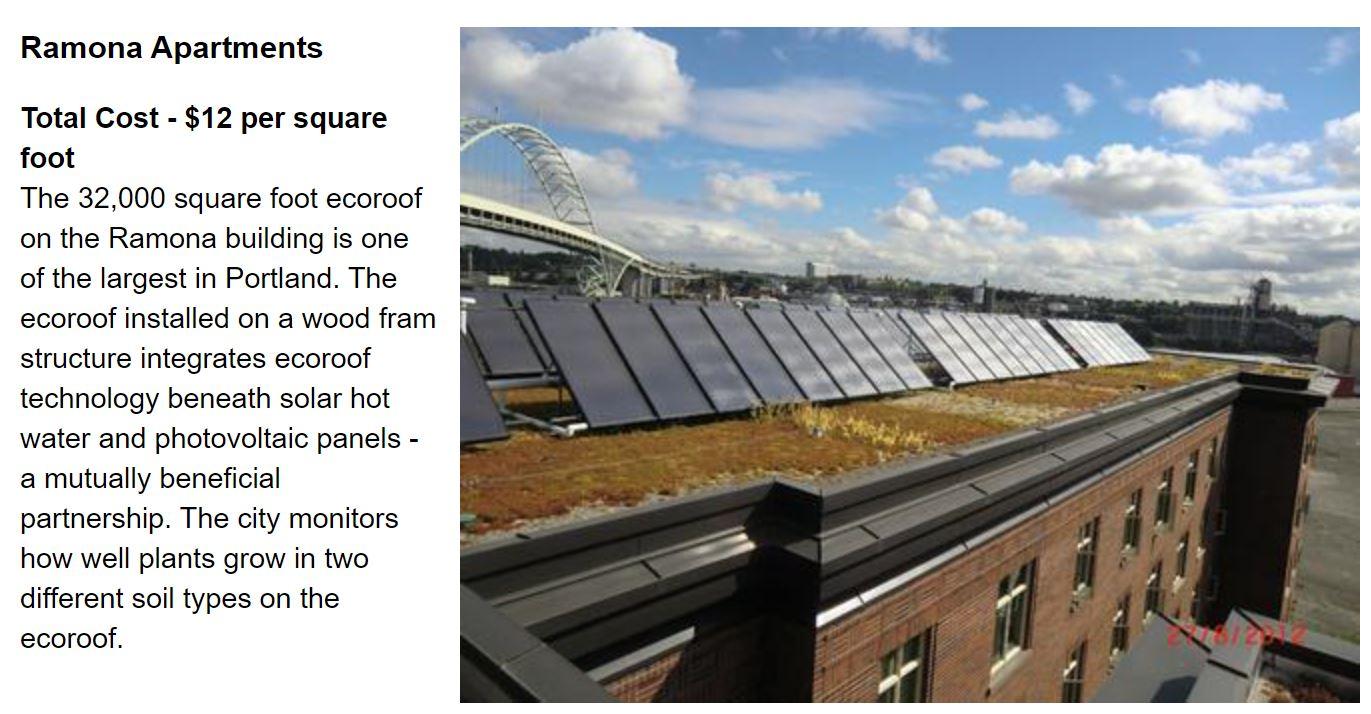
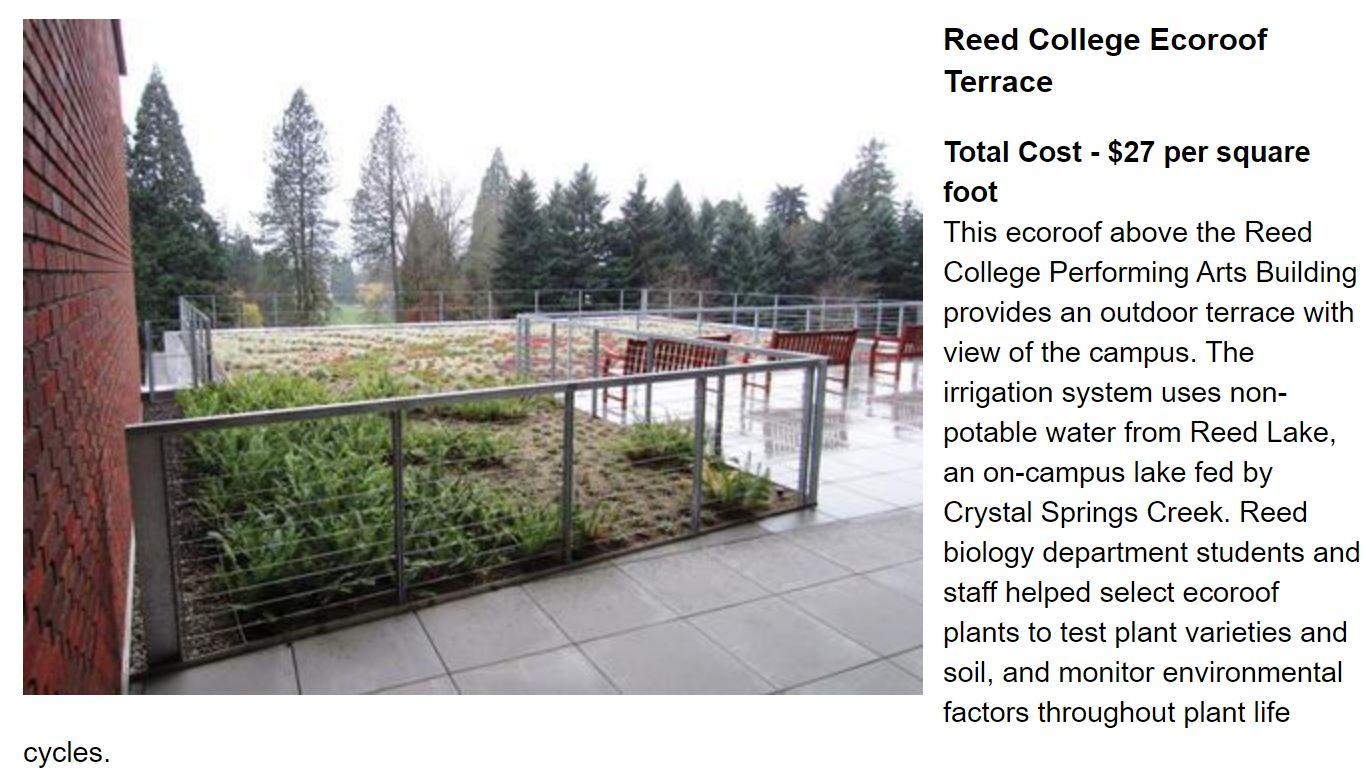
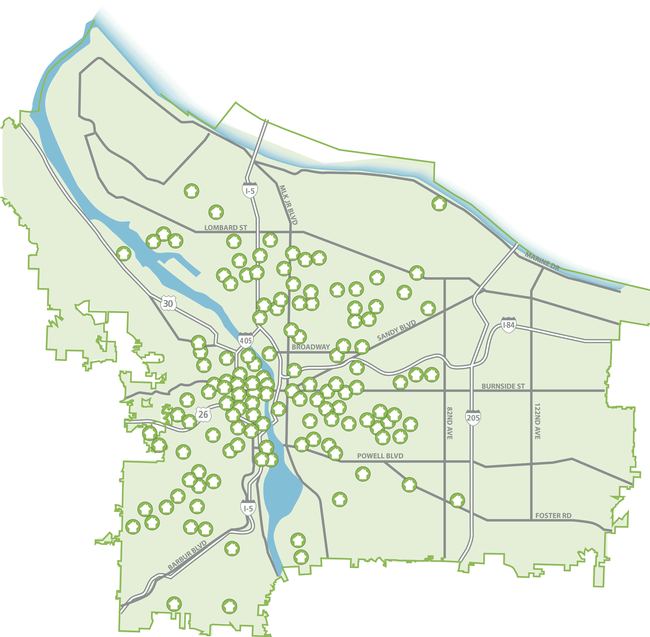
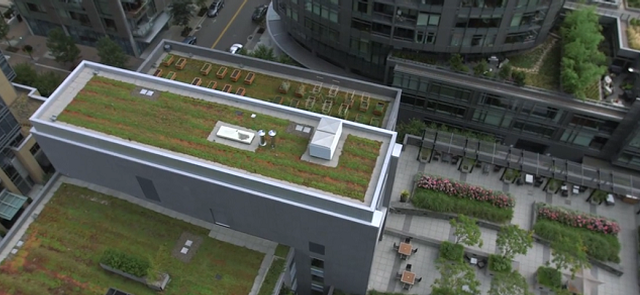
Since 2008, the City of Portland, Oregon has used various policies and programming to encourage the use of eco-roofs (vegetated roofs) throughout the city to address stormwater management (Ref. 2,3,4). In addition to stormwater management, eco-roofs have the benefits of: saving energy, reducing pollution and erosion in waterways, preserving fish habitats, creating new habitats for birds and insects, absorbing carbon dioxide, cooling urban heat islands, filtering air pollutants, and providing urban green space (Ref. 1,5). From 2008 to 2012, the City of Portland used the Ecoroof Incentive program to encourage property owners and developers to construct ecoroofs (Ref. 4,5,12). In 2018, the City of Portland adopted a mandate for ecoroofs in new buildings (Ref. 2,3,12). These policies and programs led to a growing interest in the use of ecoroofs, and resulted in the construction of over 130 ecoroofs (Ref. 3,4,11).
Overview
Nature-based solution
- Nature on buildings (external)
- Green roofs
- Green areas for water management
- Sustainable urban drainage systems
Key challenges
- Climate action for adaptation, resilience and mitigation (SDG 13)
- Climate change adaptation
- Water management (SDG 6)
- Flood protection
- Stormwater and rainfall management and storage
- Green space, habitats and biodiversity (SDG 15)
- Habitat and biodiversity conservation
- Green space creation and/or management
- Regeneration, land-use and urban development
- Promote natural styles of landscape design for urban development
Focus
Project objectives
Implementation activities
Climate-focused activities
Climate change adaptation:
- Implement sustainable urban drainage infrastructure (e.g. to make space for water)
Biodiversity conservation or restoration-focused activities
Biodiversity conservation:
- Protect species
- Undertake specific measures to protect species
- Undertake specific measures to protect valued species
- Other
Main beneficiaries
- Local government/Municipality
- Other
Governance
Management set-up
- Government-led
Type of initiating organisation
- Local government/municipality
Participatory approaches/ community involvement
- Dissemination of information and education
Details on the roles of the organisations involved in the project
Project implemented in response to ...
Financing
Total cost
Source(s) of funding
- Public local authority budget
Type of funding
- Earmarked public budget
- Direct funding (grants, subsidies, or self-financed projects by private entities)
Non-financial contribution
Impacts and Monitoring
Environmental impacts
- Water management and blue areas
- Improved stormwater management
- Green space and habitat
- Increased green space area
- Increased number of species present
- Enhanced support of pollination
Economic impacts
- Increase of green jobs (e.g. paid employment positions)
Socio-cultural impacts
- Unknown
Type of reported impacts
Presence of formal monitoring system
Presence of indicators used in reporting
Presence of monitoring/ evaluation reports
Availability of a web-based monitoring tool
References
2. Sabin Center for Climate Change Law. Portland’s EcoRoof Requirements. LPDD. Available at: Source link [Accessed: 19 September 2021].
3. Morris, E.H. (2018). Portland Adopts a Green Roof Requirement in the Central City 2035 Plan. Source link. Available at: Source link [Accessed: 19 September 2021].
4. Georgetown Climate Center. (2017). Case Study: City of Portland, Oregon Ecoroof Incentive. Adaptation Clearinghouse. Available at: Source link [Accessed: 19 September 2021].
5. Environmental Services. (2021). Ecoroof Incentive. City of Portland. Available at: Source link [Accessed: 19 September 2021].
6. City of Portland. (2021). Guidance on CC2035 Ecoroof Requirements and the Stormwater Management Manual. City of Porland. Available at: Source link [Accessed: 19 September 2021].
7. City of Portland. (2020). 2020 Stormwater Management Manual. City of Portland. Available at: Source link [Accessed: 20 September 2021].
8. City of Portland. (2015). 37122 Comprehensive update to the City's Green Building Policy to reflect advances in green building knowledge and practices exhibit. City of Portland. Retrieved from: Source link [Document provided].
9. City of Portland. (2020). As Adopted Plan – Central City 2035. Available at: Source link [Accessed: 20 September].
10. Slothower, C. (2021). Eco-roofs growing into urban role in Portland. DJC Oregon. Available at: Source link [Accessed: 19 September 2021].
11. Portland State University and the City of Portland. Portland Ecoroof Map. Available at: Source link [Accessed: 19 September 2021].
12. Netusil, N.R. and Thomas, B. (2019). Ecoroofs in Portland, Oregon, USA. University of Nottingham Blogs – Blue-Green Futures. Available at: Source link [Accessed: 20 September 2021].
13. Chomowicz, A. (n.d.). 49th International Making Cities Livable Conference: Ecoroofs in Portland, Oregon. City of Portland. Retrieved from: Source link [Document provided].
14. Cunningham, C. and Liebezeit, J. (2015). Portland’s Ecoroof Avian Monitoring Project 2012-14: Final report. City of Portland. Retrieved from: Source link [Document provided].
15. City of Portland. (2013). Vegetated Roofs and Energy Conservation. City of Portland. Retrieved from: Source link [Document provided].