

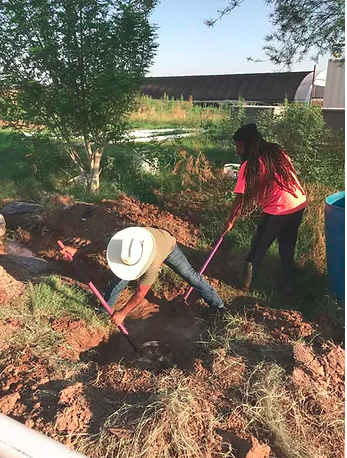
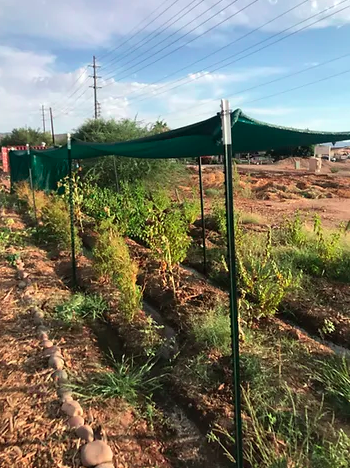
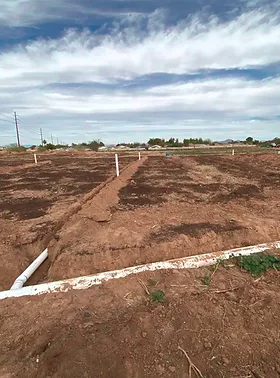
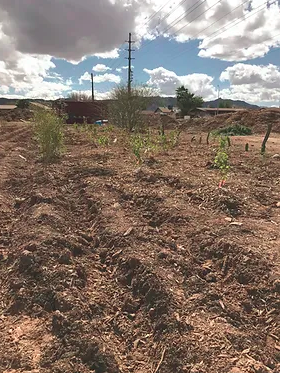
In Phoenix, many residents live in dead zones with little or no access to fresh food. These zones are called 'food deserts,' which represent a low-income area with low access to a grocery store (3). Out of the 43 food deserts identified by the city, 18 are fully or partly in south Phoenix (2-3). In 2017, Two researchers from Arizona State University’s School of Sustainability and Leuphana University Lüneburg in Germany began exploring the idea of creating a sustainable food forest cooperative in Phoenix to provide fresh, healthy food, supporting local entrepreneurs, and promote environmental sustainability (1). The project's development team spent months immersing themselves in the world of food forests, by exploring different types of community gardens, discussing preferred characteristics, anticipating local challenges, and identifying potential collaborators (1). As a result, The Food Forest Cooperative was established and planted roots in a 0.5 acre (0.20 ha) plot within the Spaces of Opportunity Community Garden in 2022 (1). This food forest engages the local community by offering educational opportunities around the value of culturally relevant, whole fruits and vegetables, medicine making, and learning about the many uses of edible/medicinal plants (4). The Food Forest Cooperative as a multi-generational project that members preserve for their children, and their children’s children (2). The intention behind the project is to address food insecurity in south Phoenix and empowering the community to take ownership of it and reconnect with their ancestors through the land and food (2). Through the Cooperative, members can contribute different skills, from administrative work to manual labor to community education and traditional medicine (2). It was created to empower community members and challenge the patterns of our food system through the blending of environmental, social and economic goals (4).
Overview
Nature-based solution
- Community gardens and allotments
- Community gardens
Key challenges
- Green space, habitats and biodiversity (SDG 15)
- Green space creation and/or management
- Cultural heritage and cultural diversity
- Preservation of historic traditions
- Inclusive and effective governance (SDG 16)
- Inclusive governance
- Social justice, cohesion and equity (SDG 10)
- Social justice and equity
- Environmental education
- Environmental and climate justice
- Sustainable consumption and production (SDG 12)
- Sustainable consumption
- Sustainable production
- Food scarcity / security
Principal problems in Functional Urban Area (FUA)
- Health, Well-being and Social cohesion
- Disconnection from nature
- Loss of sense of place and identity
- Resource Scarcity and Competition
- Food insecurity due to disruptions in food production and distribution
Key priorities
Focus
Project objectives
Implementation activities
Specification of climate or environmentally vulnerable communities
Main beneficiaries
- Citizens or community groups
- Marginalized groups: Socio-economically disadvantaged populations (e.g. low-income households, unemployed), Indigenous communities, Disadvantaged ethnic or racial groups
Governance
Management set-up
- Led by non-government actors
Type of initiating organisation
- Researchers/university
Participatory approaches/ community involvement
- Deliberative decision-making processes (e.g., consensus building, deliberative polling)
- Dissemination of information and education
- Consultation (e.g. workshop, surveys, community meetings, town halls)
- Joint implementation (e.g. tree planting)
- Citizen oversight (e.g. boards, advisory)
Details on the roles of the organisations involved in the project
Project implemented in response to ...
Type of enablers
Financing
Total cost
Source(s) of funding
- Corporate investment
- Funds provided by non-governmental organization (NGO)
- Private Foundation/Trust
Type of funding
- Direct funding (grants, subsidies, or self-financed projects by private entities)
Non-financial contribution
- Provision of land
- Provision of expertise
- Public authorities (e.g. land, utility services)
- Citizens (e.g. volunteering)
Impacts and Monitoring
Environmental impacts
- Environmental quality
- Improved soil quality
- Achieved improved soil quality
- Green space and habitat
- Increased green space area
- Achieved increased green space area
- Increased number of species present
- Achieved increased number of species present
Economic impacts
- Increase of green jobs (e.g. paid employment positions)
- Achieved increase of green jobs (e.g. paid employment positions)
Socio-cultural impacts
- Social justice and cohesion
- Increased visibility and opportunity for marginalised groups or indigenous peoples
- Expected increased visibility and opportunity for marginalised groups or indigenous peoples
- Increased involvement of locals in the management of green spaces
- Achieved increased involvement of locals in the management of green spaces
- Increased access to healthy/affordable food
- Expected increased access to healthy/affordable food
- Cultural heritage and sense of place
- Preserved spiritual and religious values
- Achieved preserved spiritual and religious values
- Increased sense of place identity, memory and belonging
- Expected increased sense of place identity, memory and belonging
- Education
- Increased support for education and scientific research
- Achieved increased support for education and scientific research
Type of reported impacts
Presence of formal monitoring system
Presence of indicators used in reporting
Presence of monitoring/ evaluation reports
Availability of a web-based monitoring tool
Potential risks of implementation and trade-offs
References
 Information about this nature-based solution was collected as part of the Naturescapes project funded by the European Union under Grant Agreement No 101084341.