Last updated: June 2024
As an archipelagic state, Indonesia consists of 18,000 islands and 18,000 km of coastline, which is inhabited by more than 60% of the Indonesian population. Its geographical position exposes the island country to several climate change challenges, ranging from an increase in high temperature to a sea level rise and severe floods. One of the cities affected by flash floods, flooding, and landslides is Pekalongan City, crossed by 7 rivers and home to approx. 300,000 people. Inundations can reach 50-100 cm in many communities, causing distress, evacuations, and severe damage to infrastructure and food security as well as loss of income for the inhabitants that work in the fisheries sector, in the Batik industry (the process of traditionally dyeing fabric, performed on cotton and silk using a resist technique) or in paddy rice farming. (1)
Responding to the climate risks became of utter importance to the municipality of Pekalongan City. To help the Municipal Government of Pekalongan City to overcome the problem caused by climate change, Kemitraan (Partnership for Governance Reform in Indonesia), an implementing and advocacy NGO developed the project on Safekeeping-Surviving-Sustaining towards Resilience, a 3S Approach. The aim was to Build Coastal City Resilience to Climate Change Impacts and Natural Disasters in Pekalongan City, Central Java Province. This was approved on 29 October 2020 and is currently entering its implementation phase. The project will focus on building resilience to climate change impacts with interventions of hard and soft nature. More precisely, the project aims to build capacity and resilience through training, mangrove ecosystem restoration and enhancement of coastal protection, and development of a Local Climate Adaptation Action Plan and implementation of climate-smart actions (1,2). The project aims to reach these goals by employing a collaborative and participatory approach that is locally driven and involves those most at risk. The program is expected to end in April 2023 (1).
Flood in Pekalongan City
Adaptation Fund
Overview
Nature-based solution
- Blue infrastructure
- Coastlines
- Coastal wetland, mangroves and salt marshes
Key challenges
- Climate action for adaptation, resilience and mitigation (SDG 13)
- Climate change adaptation
- Coastal resilience and marine protection (SDG 14)
- Coastal protection / hazard mitigation
- Marine and coastal biodiversity protection
- Environmental quality
- Waste management
- Green space, habitats and biodiversity (SDG 15)
- Green space creation and/or management
- Water management (SDG 6)
- Flood protection
- Inclusive and effective governance (SDG 16)
- Effective management
- Social justice, cohesion and equity (SDG 10)
- Environmental education
- Environmental and climate justice
- Economic development and employment (SDG 8)
- Economic development: agriculture
- Tourism support
- Employment/job creation
- Sustainable consumption and production (SDG 12)
- Sustainable production
Focus
Coastal landscape management or protection, Knowledge creation and awareness raising, Strategy, plan or policy development, Improved governance of green or blue areas
Project objectives
This project is specifically designed with a particular focus on pro-poor adaptation actions that involve and benefit the most vulnerable communities in Pekalongan city (1). This will be achieved through three actions that will be paramount, namely: safekeeping actions, surviving actions, and sustaining actions. The nature-based solution intervention is part of (1) and (3). The main goals of the interventions were defined below:
1. To restore the mangrove ecosystem in order to increase the natural protection of the coastal area from flood hazards and risk exposure (coastal erosion). And, to reduce vulnerability through a combination of semi-hard construction and ecosystem-based solution (the development and/or enforcement of coastal sediment to support the growth of mangroves that will be planted along the coastline of Pekalongan City). (1,2)
2. To develop resilient livelihood strategies that will increase food security but not damage the ecosystem through aquafarming developed and implemented by the community. (1)
3. To build awareness of the community in order to increase its adaptive capacity to climate change impact. (2)
4. To reduce adverse impact from anthropogenic activity through changes in coastal zoning and waste management e.g. community-based waste reduction and recycling schemes and energy-efficient building construction techniques. (1)
5. To strengthen collaboration between national and local governments in the climate adaptation context and aid the production of toolkits and methodologies in coastal resilience for the national government. (1,2)
Implementation activities
The inception phase of the 3S-Project started on 23 January 2021 and ended with the project kick-off held on 15 July 2021. The pandemic situation during this period poses challenges in conducting immediate coordination with the Municipal Government of Pekalongan City. Nevertheless, the project kick-off consisted of an introduction session to the project and intended intervention related to the 3S-approach and a technical session focusing on the coastal protection that currently sparks concerns among various stakeholders of Pekalongan City, especially the Municipal Government based on the widening impact of sea level rise along the city’s coastline. This was followed by a participatory workshop on 12 and 13 August to synchronise and synergise the provincial and municipal government plans and the intervention plan of the 3S-Project, especially related to the coastal protection system. Site visits were conducted during this time with the UN's Adaptation Fund team, the Kemitraan team, as well as 3 renowned universities from Semarang, Bogor and Bandung. It is expected now that a sediment trap will be built. Once the sediment is built and reach certain stability, mangrove can be planted and further grow naturally. During the installation of the construction for sediment trap, mangrove saplings can already be prepared in the nursery to be planted when the sediment is ready. The activities proposed are expected to be completed in a three-year period. The first year will be the programme preparation stage with activities that are mostly intended to strengthen local stakeholders’ (including community) awareness and understanding of the climate-related issue and also build their ownership of the programme. Key studies and assessments conducted at this stage, not only will serve
the purpose of building stakeholders’ knowledge and awareness but also ensure that the proposed actions will not lead to maladaptation and further jeopardise Pekalongan City's sustainability. The studies and assessments are expected to be completed within a time frame of 6 months. Afterwards, the programme will focus on action implementation. This arrangement is aimed to ensure the programme is completed in a timely manner. (1,2)
Climate-focused activities
Climate change adaptation:
- Protect coastal and freshwater ecosystems to prevent coastal erosion and pollution
- Restore wetlands and/or coastal ecosystems to dissipate the effects of flooding and/or storms
Biodiversity conservation or restoration-focused activities
Biodiversity conservation:
- Protect and enhance urban habitats
- Preserve and strengthen existing habitats and ecosystems
- Preserve and strengthen habitat connectivity
- Reduce negative impacts and avoid the alteration/damage of ecosystem
- Means for conservation governance
- Manage biological resources for conservation and sustainable use
- Raise public awareness
- Public engagement
- Capacity building
Biodiversity restoration:
- Rehabilitate and restore damaged or destroyed ecosystems
- Restore species (native, endangered, or unspecified)
- Restore ecological connectivity
Main beneficiaries
- National-level government
- Local government/Municipality
- Citizens or community groups
- Food producers and cultivators (i.e. farmers, gardeners)
- Young people and children
- Marginalized groups: Elderly people, Socio-economically disadvantaged populations (e.g. low-income households, unemployed)
Governance
Management set-up
- Led by non-government actors
Type of initiating organisation
- Non-government organisation/civil society
- Multilateral organisation
Participatory approaches/ community involvement
- Co-planning (e.g. stakeholder workshops, focus groups, participatory mapping)
- Dissemination of information and education
- Joint implementation (e.g. tree planting)
- Co-management/Joint management
Details on the roles of the organisations involved in the project
Implementing and executing entity is Kemitraan (The Partnership for Governance Reform), an independent legal entity established as a not-for-profit civil law association under Indonesian law (3). Funding is provided by the UN's Adaptation Fund (1).
Project implemented in response to ...
... an EU policy or strategy?
No
... a national policy or strategy?
Yes
(In general, the entire program is consistent with the following institutional and policy framework and commitment at National Level:
1. First Nationally Determined Contributions (NDC) Republic of Indonesia
2. National Action Plan for Climate Change Adaptation (RAN-API)
3. Law No. 32 Year 2009 on Environmental Protection and Management
4. Law No. 16 Year 2016 on Ratification of Paris Agreement to The United Nations Framework Convention on Climate Change
5. Government Regulation No. 2 Year 2015 on The National Midterm Development Plan (RPJMN) 2015 – 2019
6. Presidential Decree No. 60 Year 2015 on Government Work Plan Year 2016
7. Ministry of Environment and Forestry Regulation No. 33 Year 2016 on Guidance for the Development of Climate Change Adaptation Action
8. Ministry of Marine and Fisheries Regulation No. 23 Year 2016 on Management Plan of Coastal Area and Small Islands
9. Vulnerability Index Data Information System (2015) developed by Adaptation Directorate, Directorate General of Climate Change Control, Ministry of Environment and Forestry (1))
... a local policy or strategy?
Yes
(In general, the entire program is consistent with the following institutional and policy framework and commitment at Provincial and City Level:
1. Central Java Province Local Regulation No. 9 Year 2009 on Management of Coastal Area and Small Islands
2. Central Java Province Local Regulation No. 4 Year 2014 on 2014-2034 Zoning Plan of Central Java Province Coastal Area and Small Islands (RZWP3K)
3. Central Java Province Local Regulation No. 5 Year 2014 on 2013-2018 Mid-term Development Plan (RPJMD) of Central Java Province
4. Central Java Governor Regulation No. 1 Year 2011 on Strategic Plan of Central Java Province Coastal Area and Small Islands
5. Pekalongan City Local Regulation No. 4 Year 2010 on Zoning Plan of Pekalongan City Coastal Area (RZWP)
6. Pekalongan City Local Regulation No. 4 Year 2016 on 2016-2021 Mid-Term Development Plan (RPJMD) of Pekalongan City
7. Pekalongan City Local Regulation No. 7 Year 2012 on The Border (1))
Financing
Total cost
€2,000,000 - €4,000,000
Source(s) of funding
- Multilateral funds/international funding
Type of funding
- Direct funding (grants, subsidies, or self-financed projects by private entities)
Non-financial contribution
Type of non-financial contribution
- Provision of land
- Provision of labour
- Provision of expertise
Who provided the non-financial contribution?
- Public authorities (e.g. land, utility services)
- Citizens (e.g. volunteering)
Impacts and Monitoring
Environmental impacts
- Water management and blue areas
- Improved water quality
- Increased protection against flooding
- Green space and habitat
- Increased green space area
- Reduced biodiversity loss
Economic impacts
- Increase of green jobs (e.g. paid employment positions)
- Generation of income from NBS
- Other
Socio-cultural impacts
- Social justice and cohesion
- Fair distribution of social, environmental and economic benefits of the NBS project
- Increased involvement of locals in the management of green spaces
- Education
- Increased awareness of NBS and their benefits
- Other
Type of reported impacts
Expected impacts
Presence of formal monitoring system
Yes
Presence of indicators used in reporting
Yes
Presence of monitoring/ evaluation reports
No evidence in public records
Availability of a web-based monitoring tool
No evidence in public records
References
1. The Adaptation Fund (2020), Safekeeping-Surviving-Sustaining towards Resilience: 3S Approach to Build Coastal City Resilience to Climate Change Impacts and Natural Disasters in Pekalongan City, Central Java Province, available at
Source link (accessed 6-2-2023)
2. Adaptation fund (2021), Inception Report, available at
Source link (accessed 16-02-2023)
3. Kemitraan (no date), Sekilas Pandang Tentang Progam 3M AF Pekalongan, available at
Source link (accessed 6-2-2023)
4. Pemerintah Kota Pekalongan (2021), 8 Kelurahan Terdampak Banjir Rob di Kota Pekalongan Disasar Program Adaptation Fund, available at
Source link (accessed 6-2-2023)
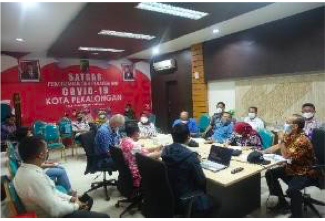
consultation with community members and Planning Bureau of Pekalongan City
Adaptation Fund
Briefing with Municipal Secretary during the site visit on 12 August 2021
Adaptation Fund
Information about this nature-based solution was collected as part of the "NBS 2022" UNA Asian extension project funded by the Asia-Europe Foundation.