

Last updated: October 2021
The project RUIS (Riqualificazone Urbana Infrastrutture e Sicurezza), stands for the regeneration of urban infrastructure and safety. The initiative is carried out by the municipality of Palermo, in order to improve the urban resiliency of the intervention area, with the creation of further green areas in neighbourhoods dealing with problems of heatwaves and environmental degradation. The main areas which will be the focus of the regeneration process will be those considered to be in degradation state. It is expected that the quality of life of the residents will significantly improve (Ref.1.).
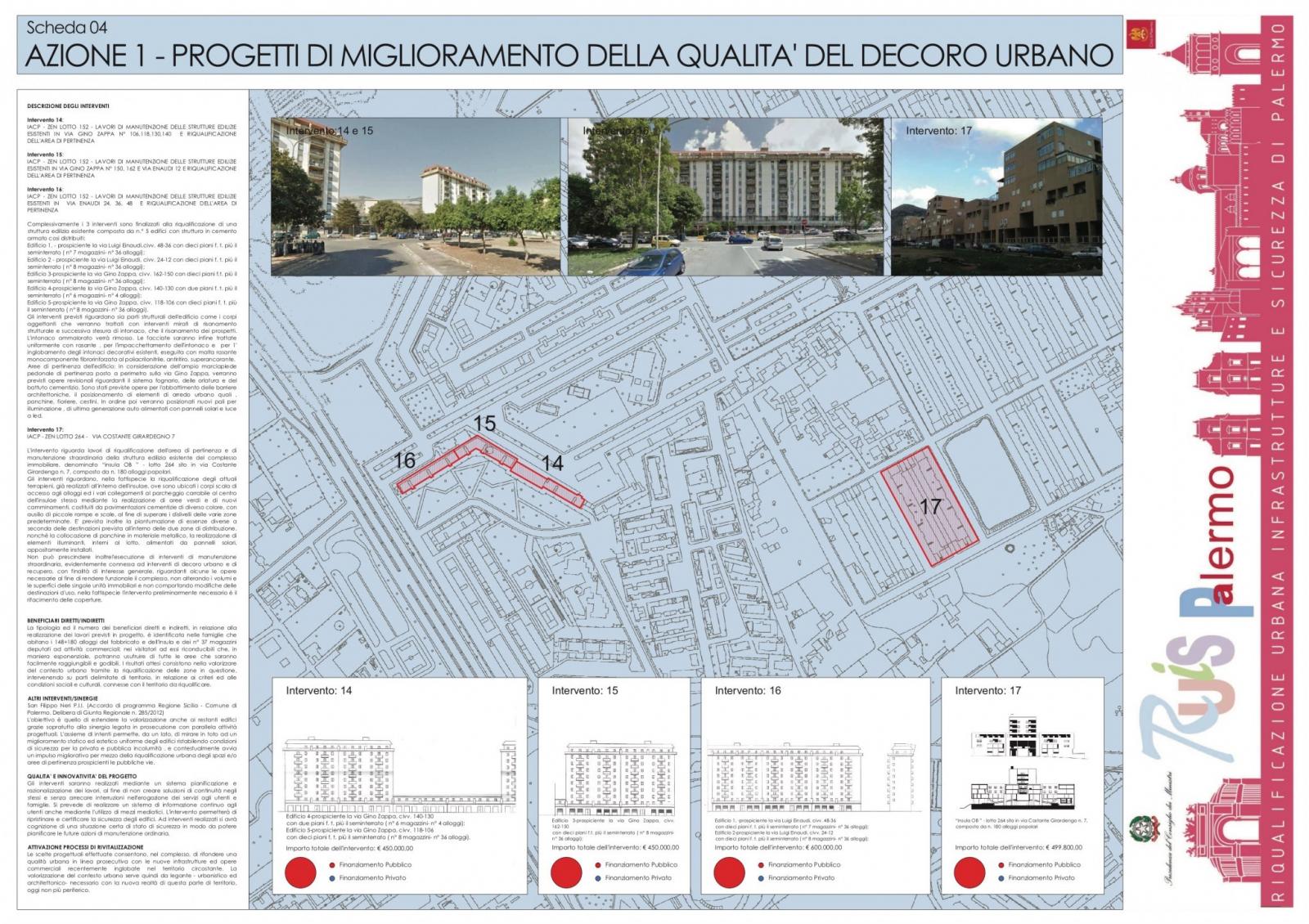
http://palermo.mobilita.org/?attachment_id=61647
Overview
Nature-based solution
- Grey infrastructure featuring greens
- Railroad bank and track greens
- Green playgrounds and school grounds
- Parks and urban forests
- Pocket parks/neighbourhood green spaces
Key challenges
- Climate action for adaptation, resilience and mitigation (SDG 13)
- Climate change adaptation
- Green space, habitats and biodiversity (SDG 15)
- Green space creation and/or management
- Social justice, cohesion and equity (SDG 10)
- Social justice and equity
- Social cohesion
Focus
Creation of new green areas, Transformation of previously derelict areas
Project objectives
The intervention aims at regenerating the northern part of the city of Palermo, which has experienced a state of urban decay. In particular, there are specific zones of the area (San Filippo Neri - Zen, Marinella, Sferracavallo e Partanna) which have been targeted as the parts of the city lacking green urban spots. Being the Northern area one of the most touristic ones, and by consequence highly populated (especially in summer), the creation of further green areas in neighbourhoods will face problems of heatwaves and environmental degradation (Ref.3.)
Implementation activities
The area of interventions were selected according to natural (e.g. coastal lines) or artificial (e.g. railway) delimitations. The areas of interventions are all highly populated, with a high index of social decay. The interventions will regenerate and expand existing areas within those neighbourhoods, by planting new trees and arboreal species. In addition, a playground for kids and the recreational area will be implemented to improve social cohesion. (Ref.4.)
Climate-focused activities
Climate change adaptation:
- Increase or improve urban vegetation cover to help reduce outdoor temperature
- Create or improve outdoor spaces to help people escape from urban heat
Main beneficiaries
- Citizens or community groups
- Young people and children
Governance
Management set-up
- Government-led
Type of initiating organisation
- National government
- Local government/municipality
Participatory approaches/ community involvement
- Unknown
Details on the roles of the organisations involved in the project
Presidency of Council of Ministries (Presidenza del Consiglio dei Ministri) = at the national level the government promoted and announcement of financial aids for the municipalities aiming at regenerating urban areas
Municipality of Palermo = at the local level the city presented the project to the national government. Once it was approved, they established the intervention areas (Ref.1.)
Project implemented in response to ...
... an EU policy or strategy?
Unknown
... a national policy or strategy?
Yes
(Regeneration processes are regulated at national level by the "Piano nazionale per la rigenerazione urbana sostenibile" (National plan for sustainable urban regeneration) which sets the norms and rules for the regeneration process at local level, and the sustainability challenges which need to be addresses in the process (Ref.5.))
... a local policy or strategy?
Unknown
Financing
Total cost
More than €4,000,000
Source(s) of funding
- Public national budget
- Public local authority budget
- Private Foundation/Trust
Type of funding
- Direct funding (grants, subsidies, or self-financed projects by private entities)
Non-financial contribution
Unknown
Impacts and Monitoring
Environmental impacts
- Environmental quality
- Improved air quality
- Green space and habitat
- Increased green space area
Economic impacts
- Unknown
Socio-cultural impacts
- Social justice and cohesion
- Improved liveability
Type of reported impacts
Expected impacts
Presence of formal monitoring system
Unknown
Presence of indicators used in reporting
No evidence in public records
Presence of monitoring/ evaluation reports
No evidence in public records
Availability of a web-based monitoring tool
No evidence in public records
References
Ref.1. Il giornale cittadino (2016). Riqualificazione urbana e sicurezza. Presentato il Progetto RUIS. Available at Source link (Accessed 11-10-2020)
Ref.2. Comune di Palermo (2017) Riqualificazione Urbana - Via libera al progetto RUIS del Comune di Palermo che riguarda la zona nord della città. Available at Source link (Accessed 11-10-2020)
Ref.3. EconomiaSicilia (2016) Palermo: riqualificazione urbana, via libera al progetto Ruis. Available at Source link (Accessed 11-10-2020)
Ref.4. Consiglio dei Ministri (2016). PROGETTO DI RIQUALIFICAZIONE URBANA INFRASTRUTTURE E SICUREZZA DELLA CITTÀ DI PALERMO D.P.C.M. 25/05/2016. RuisPalermo. Palermo: pp. 1-6
Ref.5. Ministero della Repubblica Italiana (2012). Il Piano Nazionale per la Rigenerazione Urbana Sostenibile. Roma: pp. 1-8
Ref.2. Comune di Palermo (2017) Riqualificazione Urbana - Via libera al progetto RUIS del Comune di Palermo che riguarda la zona nord della città. Available at Source link (Accessed 11-10-2020)
Ref.3. EconomiaSicilia (2016) Palermo: riqualificazione urbana, via libera al progetto Ruis. Available at Source link (Accessed 11-10-2020)
Ref.4. Consiglio dei Ministri (2016). PROGETTO DI RIQUALIFICAZIONE URBANA INFRASTRUTTURE E SICUREZZA DELLA CITTÀ DI PALERMO D.P.C.M. 25/05/2016. RuisPalermo. Palermo: pp. 1-6
Ref.5. Ministero della Repubblica Italiana (2012). Il Piano Nazionale per la Rigenerazione Urbana Sostenibile. Roma: pp. 1-8