

Last updated: October 2021
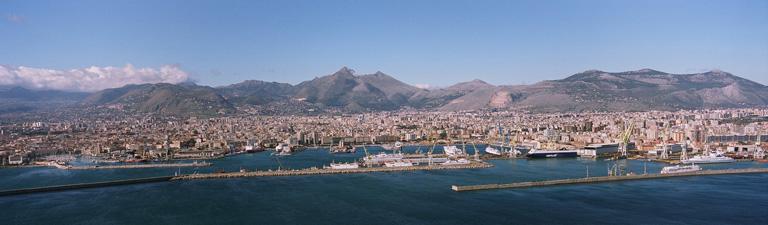
This intervention is part of a broader masterplan regarding harbours and seacoast in Palermo, with a specific focus on the Cala coastal area. The waterfront has importance for the city not just as a harbour, but for its relational, cultural and recreational functions as well. In particular, the Molo Trapezoidale can become the new “water district” in which compatible port functions will be integrated with the existing urban functions and the new residential areas, as well as the new cultural and recreational services with new infrastructures linked with natural features such as green areas and trees. (Ref.1.)

http://www1.unipa.it/mcarta/PIAU/piau_pa.html
Overview
Nature-based solution
- Grey infrastructure featuring greens
- Alley or street trees and other street vegetation
- Blue infrastructure
- Coastlines
Key challenges
- Coastal resilience and marine protection (SDG 14)
- Coastal protection / hazard mitigation
- Green space, habitats and biodiversity (SDG 15)
- Green space creation and/or management
- Economic development and employment (SDG 8)
- Tourism support
- Cultural heritage and cultural diversity
- Preservation of natural heritage
- Protection of historic and cultural landscape/infrastructure
Focus
Creation of new green areas, Coastal landscape management or protection
Project objectives
The goals of the intervention are to mainly improve the accessibility and functionality of the coastal area and the harbour area. The city wants to enhance its port functions and integrate them with urban services, residences and local area services; whose objective is to provide a natural space which links the city with the coast (Ref.1).
Implementation activities
In order to reach the above-mentioned goals, the city is willing to improve the area surrounding the coast by providing small green areas and trees plantation. Those will help to create new points of meeting in the area and improve economic activities (Ref.2.)
Main beneficiaries
- Local government/Municipality
- Citizens or community groups
Governance
Management set-up
- Co-governance with government and non-government actors
Type of initiating organisation
- Local government/municipality
Participatory approaches/ community involvement
- Co-planning (e.g. stakeholder workshops, focus groups, participatory mapping)
- Co-management/Joint management
Details on the roles of the organisations involved in the project
The Ministry of the Infrastructure at national level financed the project, with the active partnership of the City Government which sets the guidelines and regulation for the intervention, while the Port Authority and the Italian railway company collaborated in the provision of land. The partnership between the Ministry of Infrastructure, the municipality and the Port Authority operates for all interventions regarding the coastal area. The University of Palermo contributed with a scientific study on this case (Ref.1&2)
Project implemented in response to ...
... an EU policy or strategy?
Unknown
... a national policy or strategy?
Yes
(The regeneration project for the waterfront is part of a wider innovative program entitled “Ports&Stations”, implemented and financed by the Ministry of the Infrastructure (Ref.1.))
... a local policy or strategy?
Yes
(At local level the strategy derives from the municipal "Master Plan", which operates as “manifesto” for the requalification of urban waterfronts and for the consideration of the city and the practice of design (Ref.1.))
Financing
Total cost
Unknown
Source(s) of funding
- Public national budget
Type of funding
- Direct funding (grants, subsidies, or self-financed projects by private entities)
Non-financial contribution
Type of non-financial contribution
- Provision of land
Who provided the non-financial contribution?
- Public authorities (e.g. land, utility services)
Impacts and Monitoring
Environmental impacts
- Environmental quality
- Improved air quality
- Green space and habitat
- Increased green space area
Economic impacts
- Attraction of business and investment
Socio-cultural impacts
- Social justice and cohesion
- Improved social cohesion
Type of reported impacts
Expected impacts
Presence of formal monitoring system
Yes
Presence of indicators used in reporting
Yes
Presence of monitoring/ evaluation reports
Yes
Availability of a web-based monitoring tool
No evidence in public records
References
Ref.1. Maurizio Carta (2008). Plan Waterfront Palermo. University of Palermo. Palermo: pp. 1-6 (Attached document)
Ref.2. Perticau (2004). PROGETTO DI SISTEMAZIONE DEL WATERFRONT DI PALERMO. Available at Source link (Accessed 13-10-2020)
Ref.3. Biennale spazio pubblico (2011). Il progetto per il Waterfront Centrale di Palermo come motore di rigenerazione urbana. Available at Source link (Accessed 13-10-2020)
Ref.2. Perticau (2004). PROGETTO DI SISTEMAZIONE DEL WATERFRONT DI PALERMO. Available at Source link (Accessed 13-10-2020)
Ref.3. Biennale spazio pubblico (2011). Il progetto per il Waterfront Centrale di Palermo come motore di rigenerazione urbana. Available at Source link (Accessed 13-10-2020)

http://www1.unipa.it/mcarta/PIAU/piau_pa.html
http://www1.unipa.it/mcarta/PIAU/piau_pa.html