

Last updated: October 2021
"Nancy Grand Coeur" is the name of an urban renewal planning project in Nancy, which included several blue and green interventions. This area of Nancy received in 2009 the "EcoQuartier" (Eco-District) French label even though the renewal planning works started later, and are still ongoing. "Completely remodeling this district to make it an engaging "facade", adapted to the lifestyles of the time and to the evolutions of modern town planning (diversity of activities, fluidity of travel, sustainable development ...): that is all aims of the Nancy Grand Coeur operation" (Ref. 3).
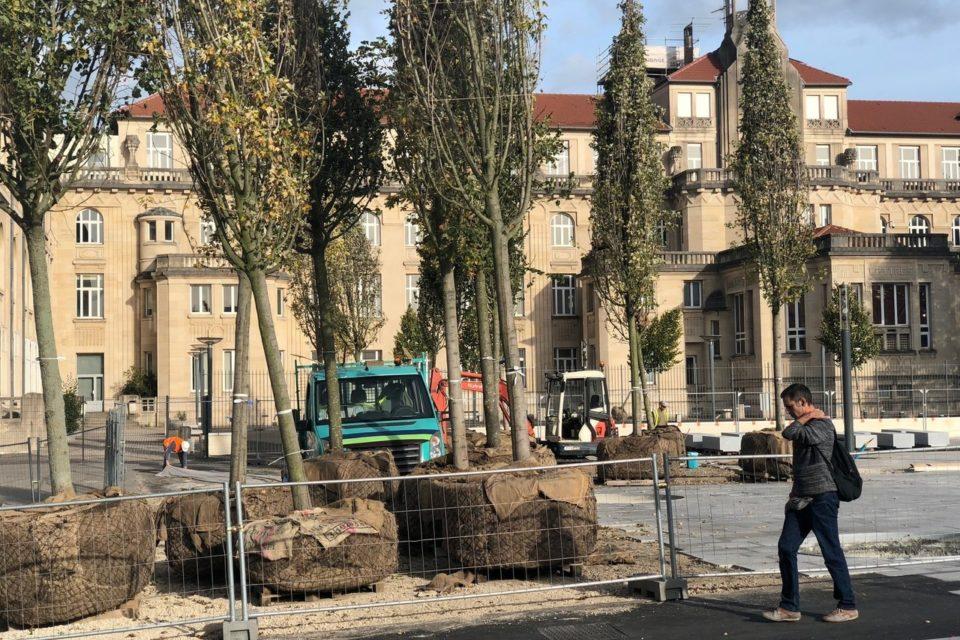
https://actu.fr/grand-est/nancy_54395/nancy-va-inaugurer-une-nouvelle-place-centre-ville-arbres-sont-arrives_28932461.html
Overview
Nature-based solution
- Grey infrastructure featuring greens
- Alley or street trees and other street vegetation
- Railroad bank and track greens
- Parks and urban forests
- Pocket parks/neighbourhood green spaces
- Green corridors and green belts
- Community gardens and allotments
- Community gardens
- Blue infrastructure
- Lakes/ponds
- Green areas for water management
- Swales and filter strips
- Sustainable urban drainage systems
Key challenges
- Climate action for adaptation, resilience and mitigation (SDG 13)
- Climate change mitigation
- Water management (SDG 6)
- Stormwater and rainfall management and storage
- Green space, habitats and biodiversity (SDG 15)
- Green space creation and/or management
- Regeneration, land-use and urban development
- Promote natural styles of landscape design for urban development
- Social justice, cohesion and equity (SDG 10)
- Social interaction
- Health and well-being (SDG 3)
- Creation of opportunities for recreation
- Economic development and employment (SDG 8)
- Real estate development
- Cultural heritage and cultural diversity
- Protection of historic and cultural landscape/infrastructure
Focus
Creation of new green areas, Creation of semi-natural blue areas
Project objectives
This old district near the main train station was considered as "Abandoned" and "without soul" (Ref.3). Therefore the main goal was to bring back life and attractiveness to the district and reconcile the inhabitants with this area. Public spaces are re-designed with vegetation to bring nature into the city (Ref. 4). As a result, "the former railway wasteland in the heart of Nancy (Meurthe-et-Moselle) is gradually transformed into a new district" (Ref 3) by "completely redesigning this neighborhood to make it an attractive "façade", adapted to the lifestyles of the time and to the evolutions of modern urbanism" (Ref. 3). ". The UDI president of Greater Nancy, André Rossinot, says today "we see concrete, tomorrow we will see some green", "The project also addresses sustainable mobility, urban planning, housing, public meeting spaces, water treatment agents" (Ref 3).
Implementation activities
Urban Project includes the creation of green spaces such as:
-200 trees planted in Place Thiers (in front of the main train station)
-Place Charles III: "Three fountains in water walls, reminding the presence of water in the city and defining a luminous landscape"
-Le Quai Vert "True garden in the heart of the agglomeration "will also be the place of a linear walk along the railway tracks, in an agglomeration where the natural spaces respect the environmental balance" and "two basins more or less vegetated, to finish in floodplains, useful to allow the natural evacuation of rainwater"
-Opened "Coeur d'îlots"(Real Estate Housing Buildings projects): "In keeping with the logic that governs the development of the district, with a balance between urban planning and the need for circulation, the "Coeurs d'îlots" will thus flow into the urban green corridor, possibly accommodating convivial places like community gardens." (Ref. 4)
"The place of water will also be important in this new district. Thus, several basins will enhance this new city center" (Ref. 6).
"A long tree-lined promenade between the Prouvé Center and the southern end of the Quartier and the future Jardin des fortifications on part of the park of the Congregation of the Sisters of Saint-Charles will be developed. The remains of these ramparts, updated during excavations carried out by the National Institute for Preventive Archaeological Research in spring 2016, will be highlighted in an educational way" (Ref. 6).
Climate-focused activities
Climate change mitigation:
- Invest in public transport/bicycle infrastructure as a means to prevent car use
Main beneficiaries
- Local government/Municipality
- Private sector/Corporate/Company
- Citizens or community groups
Governance
Management set-up
- Government-led
Type of initiating organisation
- Local government/municipality
Participatory approaches/ community involvement
- Dissemination of information and education
- Consultation (e.g. workshop, surveys, community meetings, town halls)
- Citizen oversight (e.g. boards, advisory)
Details on the roles of the organisations involved in the project
The "Grand Nancy" (local government) is at the initiative of this intervention, however "Inhabitants, shops owners and economic bodies also have a voice." (Ref. 3) SOLOREM, a mixed public and private institution of economy and urbanism of the territory, provides long-term support to cities, to the general and regional councils for the realization of their development projects. Michel Desvignes is the landscape designer (Ref. 1).
Project implemented in response to ...
... an EU policy or strategy?
Unknown
... a national policy or strategy?
Yes
("Ecoquartier" Label (Ref. 1))
... a local policy or strategy?
Yes
(Nature in the City Strategy (Ref. 8)
"The respect of nature in the city with a new landscape, gardens, alignment plantations and the reintroduction of water in the city" (Ref. 10))
Financing
Total cost
Unknown
Source(s) of funding
- Unknown
Type of funding
- Unknown
Non-financial contribution
Unknown
Impacts and Monitoring
Environmental impacts
- Climate change
- Reduced emissions
- Enhanced carbon sequestration
- Environmental quality
- Improved air quality
- Water management and blue areas
- Increased protection against flooding
- Improved stormwater management
- Green space and habitat
- Increased green space area
Economic impacts
- Stimulate development in deprived areas
Socio-cultural impacts
- Social justice and cohesion
- Improved liveability
- Improved access to urban green space
- Health and wellbeing
- Gain in activities for recreation and exercise
- Cultural heritage and sense of place
- Protection of historic and cultural landscape / infrastructure
Type of reported impacts
Expected impacts, Achieved impacts
Presence of formal monitoring system
Yes
Presence of indicators used in reporting
Yes
Presence of monitoring/ evaluation reports
No evidence in public records
Availability of a web-based monitoring tool
No evidence in public records
References
1. Solorem (n.d). "Un Ecoquartier Stratégique". Grand Coeur. Available at: Source link (Accessed: August 6, 2020).
2. Michel Desvignes Paysagiste (n.d). "Place Thiers, Nancy, France". Available at: Source link (Accessed: August 6, 2020).
3. Bastuck, Nicolas (2011). "Nancy Grand Coeur, le poumon vert de la gare". Available at: Source link (Accessed: August 6, 2020).
4. Anon. (n.d) "Un Ecoquartier moteur de dévolppement pour le Grand Nancy". Nancy Grand Coeur, Un quartier en devenir. Available at: Source link (Accessed: August 6, 2020).
5. Solarem (2017). "Nancy Grand Coeur, Un Ecoquartier majeur pour la métropole". Available at: Source link tx_news_pi1%5Bcontroller%5D=News&tx_news_pi1%5Baction%5D=detail&cHash=e441f6a525794a4431e2f552801413af (Accessed: August 6, 2020).
6. Anon. (2017). "Au cœur de Nancy, un nouveau quartier où le vert "remplace" le béton". Available at: Source link (Accessed: August 6, 2020).
7. Anon. (2017, April). "Après le béton, l’éclosion du vert". Available at: Source link (Accessed: August 6, 2020).
8. Nancy (n.d). "La nature dans la ville". Available at: Source link (Accessed: August 6, 2020).
9. Nancy (2017, June). "RÉUNION PUBLIQUE : présentation des avancées du projet "Nancy Grand Cœur". Available at: Source link (Website not available in 2020).
10. Nancy (n.d). "Nancy Grand Cœur". Available at: Source link (Accessed: August 6, 2020).
11. Zaugra, Nicolas (2020). "Le projet du quartier Nancy Grand Coeur suspendu le temps d’une nouvelle concertation". Available at: Source link (Accessed: August 6, 2020).
12. Zaugra, Nicolas (2020). "Municipales 2020 à Nancy : Laurent Hénart veut revoir la végétalisation du tram et de Nancy Grand Coeur". Available at: Source link (Accessed: August 6, 2020).
13. Nicolas, Zaugra (2020). "Municipales 2020 : Laurent Watrin veut transformer le quartier Nancy Grand Cœur « trop bétonné »". Available at: Source link (Accessed: August 6, 2020).
14. Zaugra, Nicolas (2019). "Nancy va inaugurer une nouvelle place au centre-ville : les arbres sont arrivés". Available at: Source link (Accessed: August 6, 2020).
2. Michel Desvignes Paysagiste (n.d). "Place Thiers, Nancy, France". Available at: Source link (Accessed: August 6, 2020).
3. Bastuck, Nicolas (2011). "Nancy Grand Coeur, le poumon vert de la gare". Available at: Source link (Accessed: August 6, 2020).
4. Anon. (n.d) "Un Ecoquartier moteur de dévolppement pour le Grand Nancy". Nancy Grand Coeur, Un quartier en devenir. Available at: Source link (Accessed: August 6, 2020).
5. Solarem (2017). "Nancy Grand Coeur, Un Ecoquartier majeur pour la métropole". Available at: Source link tx_news_pi1%5Bcontroller%5D=News&tx_news_pi1%5Baction%5D=detail&cHash=e441f6a525794a4431e2f552801413af (Accessed: August 6, 2020).
6. Anon. (2017). "Au cœur de Nancy, un nouveau quartier où le vert "remplace" le béton". Available at: Source link (Accessed: August 6, 2020).
7. Anon. (2017, April). "Après le béton, l’éclosion du vert". Available at: Source link (Accessed: August 6, 2020).
8. Nancy (n.d). "La nature dans la ville". Available at: Source link (Accessed: August 6, 2020).
9. Nancy (2017, June). "RÉUNION PUBLIQUE : présentation des avancées du projet "Nancy Grand Cœur". Available at: Source link (Website not available in 2020).
10. Nancy (n.d). "Nancy Grand Cœur". Available at: Source link (Accessed: August 6, 2020).
11. Zaugra, Nicolas (2020). "Le projet du quartier Nancy Grand Coeur suspendu le temps d’une nouvelle concertation". Available at: Source link (Accessed: August 6, 2020).
12. Zaugra, Nicolas (2020). "Municipales 2020 à Nancy : Laurent Hénart veut revoir la végétalisation du tram et de Nancy Grand Coeur". Available at: Source link (Accessed: August 6, 2020).
13. Nicolas, Zaugra (2020). "Municipales 2020 : Laurent Watrin veut transformer le quartier Nancy Grand Cœur « trop bétonné »". Available at: Source link (Accessed: August 6, 2020).
14. Zaugra, Nicolas (2019). "Nancy va inaugurer une nouvelle place au centre-ville : les arbres sont arrivés". Available at: Source link (Accessed: August 6, 2020).