Last updated: October 2024
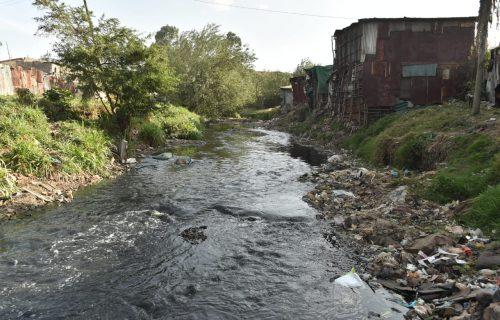
Rapid urbanization and a population density of 6,247 people per km² have placed significant stress on Nairobi's natural resources (Ref 1). The 40-km long Nairobi River Basin, originating from the Ondiri Swamp, serves as a vital water source for the city (Ref 1, 2). However, it has suffered severe pollution from untreated sewage, solid waste, industrial contaminants, plastics, and agricultural runoff (Ref 1, 3). This degradation has had a serious impact on the ecosystem, local residents, and biodiversity (Ref 3).
To address these issues, the Nairobi River Basin Programme (NRBP), sponsored by UNEP, was launched in 1999 (Ref 4). Since then, government and non-state actors have worked together on solid waste management, riparian restoration, and wastewater control (Ref 1). The program was implemented in two phases: Phase I (2003–2006) and Phase II (2006–2009), involving stakeholders from the government, private sector, and civil society (Ref 1, 4, 5). Despite these efforts, a study from 2017 found significant tree removal along the river, and between 1988 and 2014, encroachment into the 30-meter riparian buffer zone dramatically increased, particularly between 2010 and 2014, further degrading the river’s health (Ref 1).
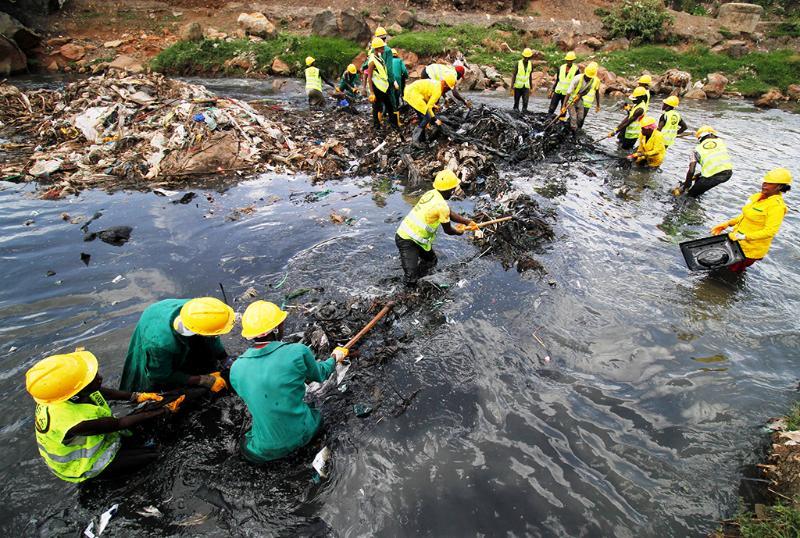
Nairobi River cleaning up
https://timeline.rotary9212.org/adopting-a-river-with-the-rotaract-club-of-ruiru/
Overview
Nature-based solution
- Blue infrastructure
- Rivers/streams/canals/estuaries
- Riverbank/Lakeside greens
Key challenges
- Environmental quality
- Soil quality improvement
- Waste management
- Green space, habitats and biodiversity (SDG 15)
- Green space creation and/or management
- Habitat and biodiversity restoration
- Regeneration, land-use and urban development
- Regulation of built environment
- Landslides reduction
- Water management (SDG 6)
- Improvements to water quality
- Inclusive and effective governance (SDG 16)
- Effective management
- Combatting crime and corruption
- Social justice, cohesion and equity (SDG 10)
- Social justice and equity
- Environmental education
- Sense of community and community engagement
Principal problems in Functional Urban Area (FUA)
- Environmental Degradation
- Biodiversity loss
- Poor water quality
- Land use and Socio-economic change
- Rapid urbanization
Key priorities
Biodiversity (conservation and/or restoration), Social Justice and community
Focus
Management and improved protection of rivers and other blue areas, River rehabilitation/ restoration, Upper watershed restoration and management, Restoration of riparian vegetation, Ecological restoration of ecosystems, Soil remediation and revegetation, Remediation activities of sites with very poor environmental quality, Restoration and protection of ecosystems (including water ecosystems), Knowledge creation and awareness raising, Educational and awareness raising programs, Scientific research of biodiversity or ecosystems
Project objectives
The objectives of the Nairobi River Basin Programme (NRBP) are to rehabilitate, restore, and manage the Nairobi River ecosystem. The goal is to provide improved livelihoods, particularly for the poor, enhance biodiversity, and ensure a sustainable supply of water for domestic, industrial, recreational, and emergency uses (Ref 5).
Phase 2 of the NRBP includes a ten-point strategy (Ref 4):
Raise awareness through public forums and assess the social impacts of the restoration efforts.
Survey and delineate the riparian reserve.
Stop illegal discharges into the river.
Complete the 2.5 km demonstration stretch of the river restoration project.
Relocate economic activities and informal settlements that negatively impact the river.
Develop and implement an integrated solid waste management system.
Rehabilitate the Nairobi Dam.
Repair and install sewerage infrastructure and other associated systems.
Develop a Master Plan for the sustainable economic use of the riparian zone.
Landscaping and beautification of the riparian zone through tree planting and soil erosion control.
Implementation activities
1) Conducting comprehensive investigation on the biological components of the three main tributaries of the Nairobi Rivers and Reservoirs (Ref 4);
2) Clearing waste and debris from the Nairobi River, co-implemented by the government and the UNEP (Ref 1, 3);
3) Replanting indigenous trees and flora along the riverbanks thus controlling soil erosion and filtering pollutants from entering the river were accomplished (ibid.); 4000 tree seedlings planted in the upper catchments (Ref 4);
4) Rehabilitation of 2.5km demo stretch from Museum Hill to Globe Cinema; Removal of 6000 tons of solid waste at the Demo stretch (ibid.);
5) Process of on-going stoppage of 367 illegal discharges that were identified (ibid.);
6) Repairing and installing sewerage and associated infrastructure undertaken (ibid.);
7) Delineation of a 30-metre riparian reserve on Ngong River, the branch that leaves the dam (Ref 4, 6);
8) Land for transfer station at Kariobangi are surveyed and fencing on-going; 3 main abandoned quarries identified for alternative land filling prior construction a sanitary land fill; Land construction a sanitary land fill identified at Ruai (Ref 4);
9) On-going land acquisition for relocating 130,000 people for plan to demolish 16,046 structures; Population census and business along the riparian reserve undertaken (Ref 6);
10) Six public awareness forums on the importance of the program held, rallying communities to take part in clean-ups and promoting cleaner production (Ref 4, 6).
Communities vulnerable to environmental hazards or climate change impacts
Yes
Specification of climate or environmentally vulnerable communities
Riverfront communities
Biodiversity conservation or restoration-focused activities
Biodiversity restoration:
- Rehabilitate and restore damaged or destroyed ecosystems
- Restore species (native, endangered, or unspecified)
- Public engagement
Main beneficiaries
- National-level government
- Local government/Municipality
- Public sector institution (e.g. school or hospital)
- Non-government organisation/Civil Society
- Private sector/Corporate/Company
- Researchers/University
- Citizens or community groups
Governance
Type of initiating organisation
- National government
- Multilateral organisation
Participatory approaches/ community involvement
- Co-planning (e.g. stakeholder workshops, focus groups, participatory mapping)
- Taskforce groups
- Dissemination of information and education
- Joint implementation (e.g. tree planting)
- Co-management/Joint management
Details on the roles of the organisations involved in the project
The NRBP was started and supervised by the Office of the then Prime Minister with the sponsorship of UNEP in 1999, while the Ministry of Environment and Mineral Resources provided leadership and coordination of a series of start-up and program development activities involving seventeen key Government ministries and agencies (Ref 4). The University of Nairobi (Ref 4) Citizens were encouraged to participate in tree planting (Ref 6). Awareness raising programs were delivered in the form of forums (Ref 4). The cost for NRBP was US$147,000 provided by
UNEP and an additional budget of Sh1.4 billion had been set aside for relocation by the Kenyan Government (Ref 6, 11). The program was a multi-stakeholder initiative that brought together the Government, development partners, university, the private sector and civil society (Ref 4, 5).
Project implemented in response to ...
... an EU policy or strategy?
Unknown
... a national policy or strategy?
Unknown
... a local policy or strategy?
Unknown
Type of enablers
Support from transitional governance actors, Funds, subsidies or investment for GI/NBS in the city (available for the city or provided by the city)
Financing
Total cost
€100,000 - €500,000
Source(s) of funding
- Multilateral funds/international funding
Type of funding
- Direct funding (grants, subsidies, or self-financed projects by private entities)
Non-financial contribution
Unknown
Impacts and Monitoring
Environmental impacts
- Environmental quality
- Improved waste management
- Achieved improved waste management
- Improved stability of slopes
- Achieved improved stability of slopes
- Improved soil quality
- Achieved improved soil quality
- Water management and blue areas
- Enhanced protection and restoration of freshwater ecosystems
- Achieved enhanced protection and restoration of freshwater ecosystems
- Green space and habitat
- Increased number of species present
- Achieved increased number of species present
Socio-cultural impacts
- Education
- Increased support for education and scientific research
- Achieved increased support for education and scientific research
- Increased awareness of NBS and their benefits
- Expected increased awareness of NBS and their benefits
- Safety
- Decreased crime rates
- Achieved decreased crime rates
Presence of formal monitoring system
Yes
Presence of indicators used in reporting
Yes
Presence of monitoring/ evaluation reports
Yes
Availability of a web-based monitoring tool
No evidence in public records
Potential risks of implementation and trade-offs
Ecosystems and biodiversity, Habitat destruction, fragmentation, or alteration (e.g. use of monocultures)
References
1.
KIPPRA (2024). Restoring the Nairobi River Corridor. KIPPRA, Accessed on September 18, 2024, [
Source link];
2.
Tana and Athi Rivers Development Authority (TARDA) (n.d.). Nairobi River Basin Restoration Programme. Tana and Athi Rivers Development Authority (TARDA), Accessed on September 18, 2024, [
Source link];
3.
Dancan, O. (2024). Kenya: More Effort Needed to Reclaim Nairobi River. Science Africa, Accessed on September 18, 2024, [
Source link];
4.
Mwanik, P. (2005). Survey and Situation Analysis of the Biological Characteristics of the Main Tributaries of the Nairobi Rivers, Reservoirs and Wetlands. University of Nairobi, Accessed on September 18, 2024,;
5.
Kenya Rivers & Water Resources (2016). Master Plan for Nairobi River Basin. Kenya Rivers & Water Resources, Accessed on September 18, 2024, [
Source link];
6.
The Standard (2009). Tough choices will save Nairobi River. The Standard, Accessed on September 18, 2024, [
Source link];
7.
Kenya National Bureau of Statistics (KNBS) (2019). 2019 Kenya Population and Housing Census: Volume 4 Distribution of Population by Administrative Units. Kenya National Bureau of Statistics (KNBS), Accessed on September 17, 2024, [
Source link];
8.
Kenya National Bureau of Statistics (KNBS) (2019). 2019 Kenya Population and Housing Census: Volume 3 Distribution of Population by Age and Sex. Kenya National Bureau of Statistics (KNBS), Accessed on September 17, 2024, [
Source link];
9.
Kenya National Bureau of Statistics (KNBS) (2019). 2019 Kenya Population and Housing Census: Volume 4 Distribution of Population by Socio Economic Characteristics. Kenya National Bureau of Statistics (KNBS), Accessed on September 17, 2024, [
Source link];
10.
Kenya National Bureau of Statistics (KNBS) (2019). 2019 Kenya Population and Housing Census: Volume 1 Population By County And Sub County. Kenya National Bureau of Statistics (KNBS), Accessed on September 17, 2024, [
Source link];
11.
UN-HABITAT (n.d.). Nairobi River Basin Programme (NRBP). UN-HABITAT, Accessed on September 18, 2024, [
Source link];
12.
Motella, M. (2009). Nairobi River Basin Programme, Problems and delays in the project. International Alliance for Inhabitants (IAI), Accessed on September 18, 2024, [
Source link];
Nairobi Riverbank
https://nrc.or.ke/

Information about this nature-based solution was collected as part of the
Naturescapes project funded by the European Union under Grant Agreement No 101084341.