

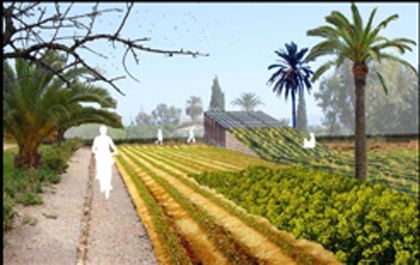
The municipality aimed to establish a zone in Murcia that worked as a "green lung" for the city while making it its engine for economic, social and cultural development (Ref 2). For this, the municipality planned and implemented the project of "Integrated Alcantarilla Parks". It includes several parks, with the priority of creating one in the surroundings of the Ethnological Orchards Murcia's Museum (Ref 1). The project is called integrated as it is based on the integral values of sustainability where the environment, the economic development and the socio-cultural needs are compatible (Ref 2). For this, there will be sustainable architecture, recovery of the natural environment, as well as incorporating the historical heritage in the public green areas of a specific zone (Ref 3). There are many parks that are part of this project, the last one was the Ibarra de Murcia Park in 2020 (Ref 7 and 8).
Overview
Nature-based solution
- Grey infrastructure featuring greens
- Institutional green space
- Parks and urban forests
- Large urban parks or forests
Key challenges
- Green space, habitats and biodiversity (SDG 15)
- Green space creation and/or management
- Regeneration, land-use and urban development
- Promote natural styles of landscape design for urban development
- Inclusive and effective governance (SDG 16)
- Inclusive governance
- Economic development and employment (SDG 8)
- Economic development: industry
- Tourism support
- Employment/job creation
Focus
Project objectives
Implementation activities
Climate-focused activities
Climate change mitigation:
- Increase green urban nature for carbon storage (wetlands, tree cover)
- Invest in public transport/bicycle infrastructure as a means to prevent car use
Main beneficiaries
- Public sector institution (e.g. school or hospital)
- Citizens or community groups
Governance
Management set-up
- Co-governance with government and non-government actors
Type of initiating organisation
- Local government/municipality
Participatory approaches/ community involvement
- Crowd-sourcing/Crowd-funding/Participatory budget
- Consultation (e.g. workshop, surveys, community meetings, town halls)
Details on the roles of the organisations involved in the project
Project implemented in response to ...
Financing
Total cost
Source(s) of funding
- EU funds
- Public local authority budget
Type of funding
- Earmarked public budget
- Direct funding (grants, subsidies, or self-financed projects by private entities)
Non-financial contribution
Impacts and Monitoring
Environmental impacts
- Green space and habitat
- Increased green space area
- Increased conservation or restoration of ecosystems
Economic impacts
- More sustainable tourism
- Stimulate development in deprived areas
- Attraction of business and investment
Socio-cultural impacts
- Social justice and cohesion
- Improved liveability
- Improved access to urban green space
- Cultural heritage and sense of place
- Protection of historic and cultural landscape / infrastructure
- Increased appreciation for natural spaces
- Education
- Increased support for education and scientific research
Type of reported impacts
Presence of formal monitoring system
Presence of indicators used in reporting
Presence of monitoring/ evaluation reports
Availability of a web-based monitoring tool
References
2. Tomas Martinez, Carmen Maria. (2013). Alicante: Parques Integrados de Alcantarilla. We Are the City Heroes. 31st January. Available at: Source link (Accessed 15/July/2020)
3. La Verdad. (2008). Una Gran area verde y de servicios ayudara a regenerar el entorno del Museo de la Huerta. Murcia: La Verdad. Available at: Source link (Accessed 15/July/2020)
4. Ecoproyecta. (n.d.). Parques Integrados Alcantarillas. : Murcia: Ecoproyecta. Available at: Source link (Accessed 15/July/2020)
5. Franco Sanchez, Isabel. (2011). La Crisis y el retraso de los fondos europeos ‘ahogan’ el pulmon verde. Available at: Source link (Accessed 15/July/2020)
6. La Opinión de Murcia. (2008). Comunidad impulsa pulmón verde alcantarilla. Murcia: La Opinión de Murcia. Available at: Source link (Accessed 15/July/2020)
7. C’Mon Murcia (2020). El nuevo Jardín Maestro Ibarra de Murcia, un nuevo pulmón verde dedicado al deporte. Murcia: C’Mon Murcia. 19th may. Available at : Source link 15/July/2020)
8.GEA (2020) Plan Director de Parques Integrados de Alcantarilla. Murcia: Gea 21 – Grupo de Estudios y Alternativas. Available at : Source link (Assessed 15/July/2020).