

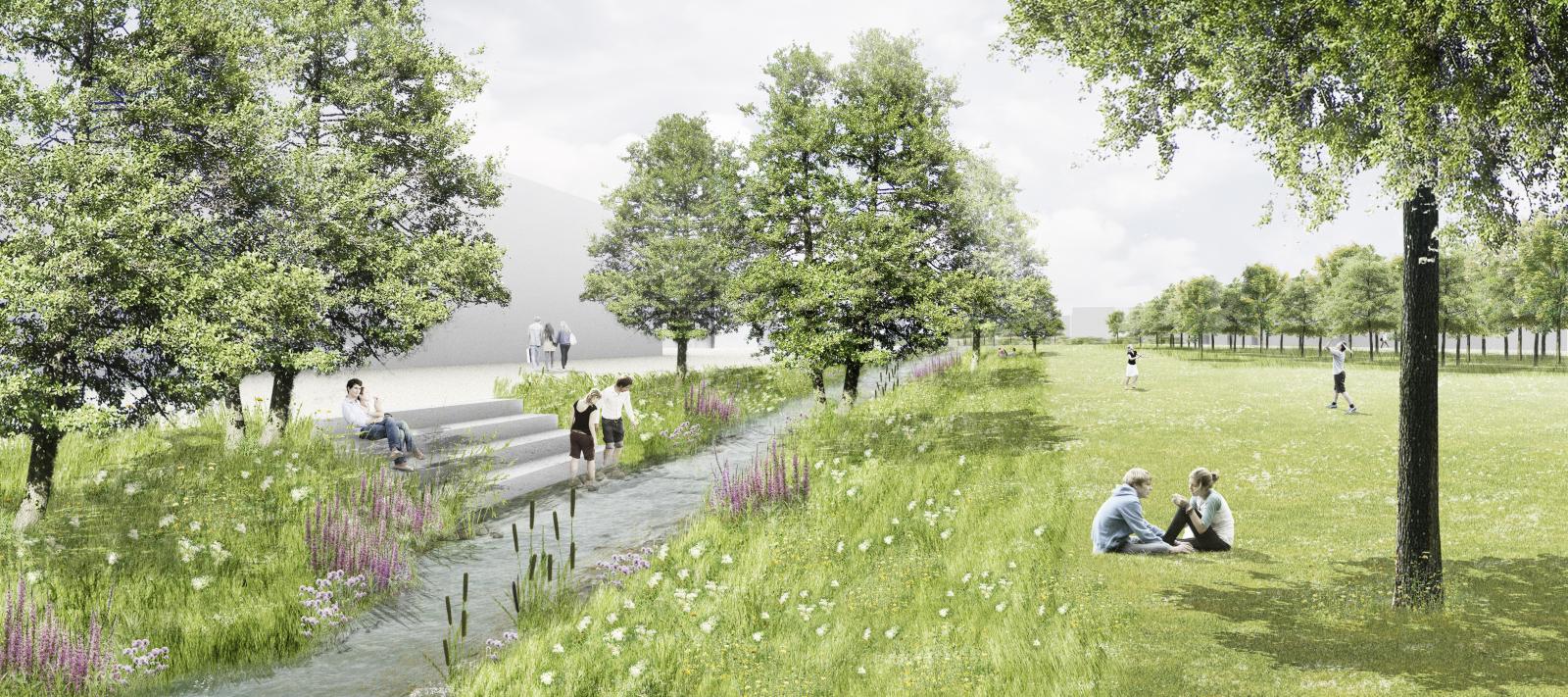
The Hachinger Brook is a natural water body, which level of water is highly influenced by groundwater. Due to the spatial expansion of Munich, sections of the brook were forced into concrete canals and pipes. The idea of restoring the brook into a quasi-natural state had already emerged in the committee of city panning in 1984. The city council of Munich decided in 2014 is to reconstruct the natural state on a 2,6 km stretch of the Hachinger Brook between Kampenwandstraße and Hüllgraben by excavating it and to turn it into a recreational area. In addition to the stream, the former village pond next to the stream is planned to be restored. (Reference 1) Trees and other vegetation will be planted alongside some sections of the brook. (Reference 1, 2). Because of the reluctance of the landowners on the proposed site of the intervention to accept a brook flowing through their property, in 2020, the implementation still hasn’t begun. (Reference 7)
Overview
Nature-based solution
- Grey infrastructure featuring greens
- Blue infrastructure
- Riverbank/Lakeside greens
- Parks and urban forests
- Green corridors and green belts
- Lakes/ponds
- Rivers/streams/canals/estuaries
Key challenges
- Water management (SDG 6)
- Stormwater and rainfall management and storage
- Improvements to water quality
- Green space, habitats and biodiversity (SDG 15)
- Habitat and biodiversity restoration
- Green space creation and/or management
- Regeneration, land-use and urban development
- Promote natural styles of landscape design for urban development
- Health and well-being (SDG 3)
- Enabling opportunities for physical activity
- Creation of opportunities for recreation
Focus
Project objectives
Implementation activities
Biodiversity conservation or restoration-focused activities
Biodiversity restoration:
- Rehabilitate and restore damaged or destroyed ecosystems
- Restore ecological connectivity
Main beneficiaries
- Local government/Municipality
- Researchers/University
- Citizens or community groups
Governance
Management set-up
- Government-led
Type of initiating organisation
- Local government/municipality
- Researchers/university
- Citizens or community group
Participatory approaches/ community involvement
- Consultation (e.g. workshop, surveys, community meetings, town halls)
Details on the roles of the organisations involved in the project
Project implemented in response to ...
Financing
Total cost
Source(s) of funding
- Public regional budget
- Public local authority budget
- Other
Type of funding
- Earmarked public budget
- Direct funding (grants, subsidies, or self-financed projects by private entities)
Non-financial contribution
Impacts and Monitoring
Environmental impacts
- Water management and blue areas
- Enhanced protection and restoration of freshwater ecosystems
- Green space and habitat
- Increased green space area
- Increased conservation or restoration of ecosystems
- Reduced biodiversity loss
- Increased number of species present
- Increased ecological connectivity across regeneration sites and scales
- Other
Economic impacts
- Unknown
Socio-cultural impacts
- Social justice and cohesion
- Improved liveability
- Health and wellbeing
- Gain in activities for recreation and exercise
Type of reported impacts
Presence of formal monitoring system
Presence of indicators used in reporting
Presence of monitoring/ evaluation reports
Availability of a web-based monitoring tool
References
2. Disse, M., Schwarz, J. and Lisson, M. (2013). Nachhaltigkeitsbewertung: Studie zur ganzheitlichen Projektbewertung der Freilegung Hachinger Bach. München: Universität Der Bundeswehr München.
3. Reissl, A. and Messinger, B. (2012). Draft Resolution: Freilegung Hachinger Bach Zwischen Kampenwandstraße und Hüllgraben. München: Baureferat.
4. Source link. (2017). Neuer Park für Berg am Laim: Nach 80 Jahren: Der Hachinger Bach soll wieder auftauchen. [online]. Available at: Source link 31 Jul. 2020].
5. Source link. (2014). Submittals of Freilegung Hachinger Bach zwischen Kampenwandstraße und Hüllgraben im 14. Stadtbezirk Berg am Laim. [online] Available at: Source link 31 Jul. 2020].
6. Münchener Baureferat. (2017). Neuer Park für Berg am Laim: Nach 80 Jahren: Der Hachinger Bach soll wieder auftauchen. Source link [image]. Available at: Source link 31 Jul. 2020].
7. Süddeutsche Zeitung. (2020). Angst um die Wasserader. [online]. Available at: Source link [Accessed: 31 Jul. 2020]