Montevideo , Uruguay
City population: 1381000
Duration: 2018 – ongoing
Implementation status: Ongoing
Scale: Micro-scale: District/neighbourhood level
Project area: unknown
Type of area: Residential, Public Greenspace Area, Central Business District / City Centre
Last updated: November 2021

Uruguay is highly vulnerable to climate change and its cities particularly vulnerable to the adverse effects of climate change, including extreme events such as droughts, floods, heat and cold waves, strong winds, tornadoes, hailstorms, frosts, heavy rains and severe storms. According to the latest census in Uruguay, more than 93 per cent of its population lives in urban areas. Montevideo is one of Uruguay's cities most affected by the changing weather. In 2014 most of the city has been left underwater after suffering its worst flooding in 50 years so much so that the city was declared a multi-hazard risk zone. Thousands of homes and businesses have been damaged in the process. This has been described as the worst flooding in almost a century. In 2018 the municipality developed the idea of rain gardens to counteract heavy rains and flooding effects. Initially, it was adopted in a number of neighbourhoods but over the years it has been extended to the entire area of Montevideo (1,2,3)
Results 2
https://montevideo.gub.uy/noticias/medio-ambiente-y-sostenibilidad/nuevos-jardines-de-lluvia-en-montevideo

Overview

Nature-based solution

  • Grey infrastructure featuring greens
  • Alley or street trees and other street vegetation
  • Green areas for water management
  • Rain gardens
  • Sustainable urban drainage systems

Key challenges

  • Climate action for adaptation, resilience and mitigation (SDG 13)
  • Climate change adaptation
  • Water management (SDG 6)
  • Flood protection
  • Stormwater and rainfall management and storage
  • Green space, habitats and biodiversity (SDG 15)
  • Green space creation and/or management

Focus

Creation of new green areas, Knowledge creation and awareness raising

Project objectives

In Montevideo every three to four years, major storms cause significant flooding in certain areas of the city, with water reaching up to 4 feet above street level and entering households. Most of these events are intense and happen without warning. The municipality decided to invest in resilience to floods only in recent years and one of the ways of doing it was by introducing rain gardens. The objectives of this ongoing intervention are: 1. To protect water quality and reduce rainwater runoff -they allow cushioning part of the low-intensity rain flow, preventing their direct entry into the city's main drainage system, and as a result, overflow into the inland watercourses and the bay 2. To fulfil a function comparable to that of storm hydrants 3. To generate new green spaces 4. To favour the urban hydrological cycle by decreasing the amount of water poured into the city's rainwater drainage system, because frequent rains are retained and gradually permeate. 5. To improve the quality of the water that enters watercourses, because contaminants dragged by rainwater runoff enter the stonemason and are filtered and retained in the ground. 6. To give environmental value to rainwater. 7. To incorporate low impact development strategies (DBI or Low Impact Development) and green infrastructures. (1,2,3)

Implementation activities

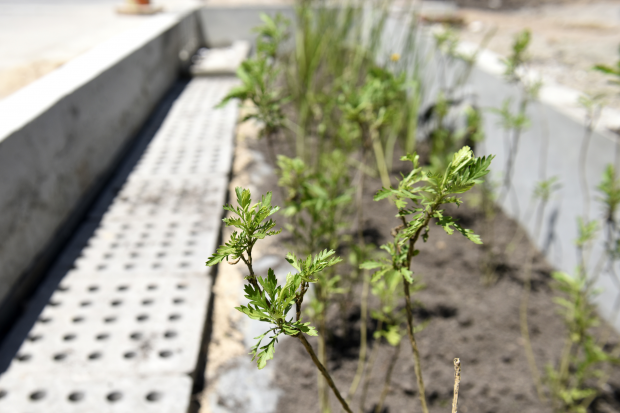
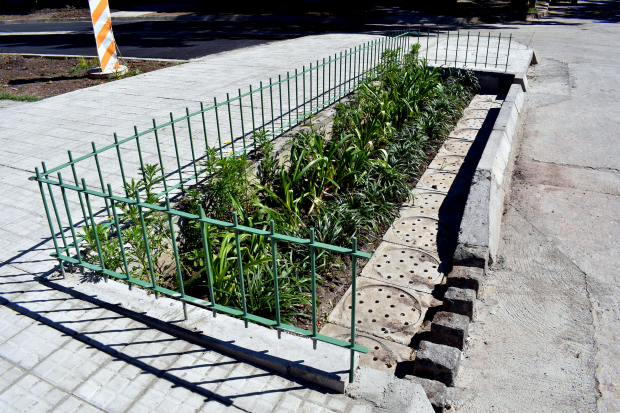
In 2018 work began in the second week of December and was completed during the first half of February. The plan also included the construction of a ditch cordon, a parking sector and the innovative implementation of two Rain Gardens. The structures, similar to a stonemason with vegetation, receive rainwater that infiltrates the ground and enters a storage area below. Once it fills up, it leaves the system by entering the sanitation network. The structures were installed both in public spaces but also any citizen can do it on their sidewalk or patio. Work continued through 2019 and in 2020 other 6 rain gardens were inaugurated (3) The rain gardens are divided into 3 layers. From the bottom to the top there is a drainage layer of 40 cm height to support the plants and a ponding area of 15 cm height. (4)

Climate-focused activities

Climate change adaptation:

  • Implement measures that prevent/manage desertification, soil erosion and landslides
  • Implement sustainable urban drainage infrastructure (e.g. to make space for water)

Main beneficiaries

  • Citizens or community groups

Governance

Management set-up

  • Government-led

Type of initiating organisation

  • Local government/municipality

Participatory approaches/ community involvement

  • Consultation (e.g. workshop, surveys, community meetings, town halls)
  • Other

Details on the roles of the organisations involved in the project

The intervention has been entirely implemented by the environmental division of the Municipality of Montevideo who strategised and implemented the action as it fit into the division's strategy: to formulate, project, execute and evaluate departmental plans for environmental management and protection, promoting integral management for the continuous improvement of environmental quality, within the framework of sustainable development. (1,3)

Project implemented in response to ...

... an EU policy or strategy? No
... a national policy or strategy? Yes (In 2018, the government of Uruguay started to develop the National Adaptation Plan for Cities and Infrastructures (NAP-Cities), a new effort at the national level to integrate the adaptation approach in cities, in infrastructures and in planning at the national and local levels. Within the framework of the NAP-Cities, a multi-hazard assessment was carried out for climate change scenarios in four urban areas: Canelones (inland), Rivera (border city), Juan Lacaze (coastal), and the area of Pantanoso stream in Montevideo (capital). These four cities were strategically selected for the multi-hazard assessment considering the diversity of climate risks they each face. Some of these actions referred directly to rain gardens or greening the cities. All these actions developed for the preparation of the National Adaptation Plan for Cities and Infrastructure are contributing to the long-term vision for a resilient Uruguay. (5))
... a local policy or strategy? Yes (Yes, the Environmental Development Division of the Montevideo Municipality is in a process of paradigm shift, trying to build a green, resilient and sustainable Montevideo. Within this framework, the application of resilient drainage and sanitation measures is proposed. In 2019 the Municipality of Montevideo issued a document entitled : "Resilience measures for Montevideo: floods and sanitation" which contained many measures including rain gardens and other green infrastructure. The Administration has made a proposal of several strategies, adaptable to the territory and that have worked in implementation contexts similar to that of the city of Montevideo. These strategies include: property measures of resilience and resistance to flooding in consolidated soil in Montevideo, green public road profile, rain gardens, optimization of cesspools, resilient public space, waterproofing factor for urban soil.(2) The intervention and the strategy of rain gardens have also been included in the Master Plan for Urban Sanitation and Drainage, where the strategic planning of the sector projects work with the horizon to 2050. (3))

Financing

Total cost

Unknown

Source(s) of funding

  • Public local authority budget

Type of funding

  • Earmarked public budget

Non-financial contribution

Unknown

Impacts and Monitoring

Environmental impacts

  • Environmental quality
  • Improved soil quality
  • Water management and blue areas
  • Increased protection against flooding
  • Improved stormwater management
  • Green space and habitat
  • Increased green space area
  • Enhanced support of pollination

Economic impacts

  • Reduce financial cost for urban management

Socio-cultural impacts

  • Education
  • Increased awareness of NBS and their benefits

Type of reported impacts

Expected impacts, Achieved impacts

Presence of formal monitoring system

Yes

Presence of indicators used in reporting

Yes

Presence of monitoring/ evaluation reports

No evidence in public records

Availability of a web-based monitoring tool

No evidence in public records

References

Finished rain garden
https://montevideo.gub.uy/noticias/medio-ambiente-y-sostenibilidad/nuevos-jardines-de-lluvia-en-montevideo
Results
https://montevideo.gub.uy/noticias/medio-ambiente-y-sostenibilidad/nuevos-jardines-de-lluvia-en-montevideo
Rain garden work
https://montevideo.gub.uy/noticias/medio-ambiente-y-sostenibilidad/nuevos-jardines-de-lluvia-en-montevideo
Information about this nature-based solution was collected as part of the UNA global extension project funded by the British Academy.