

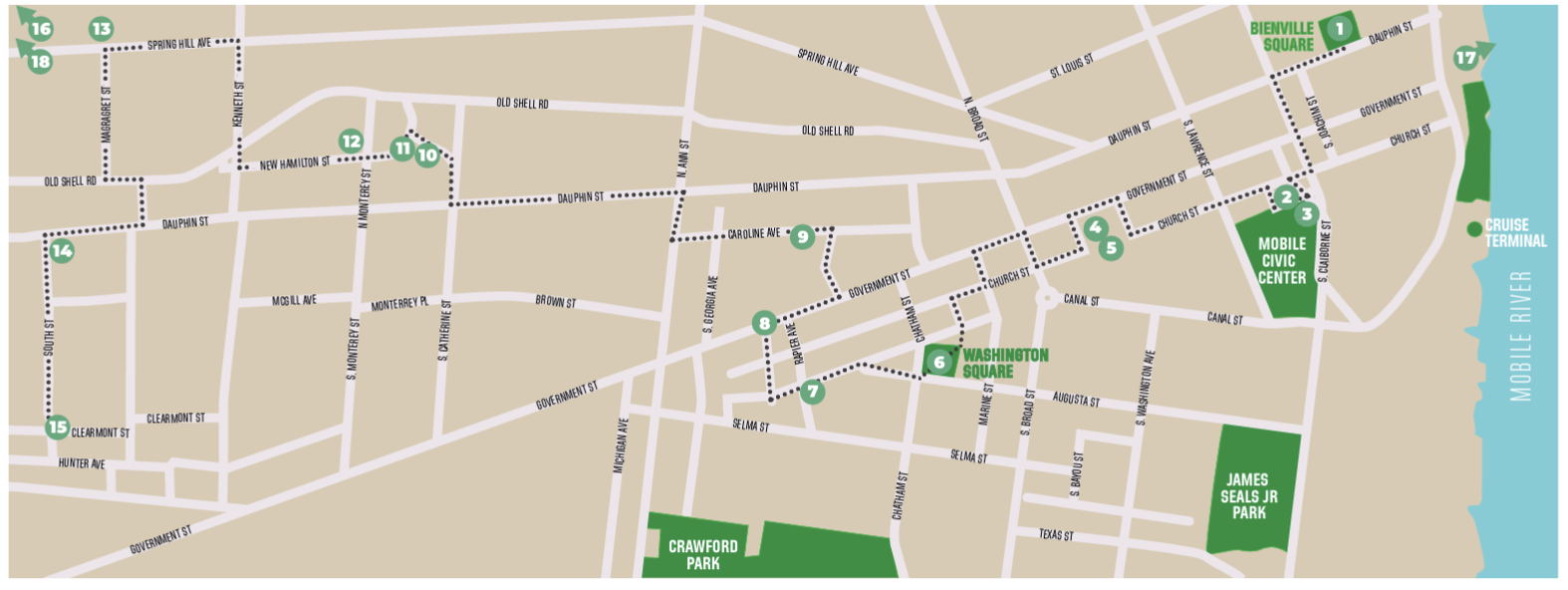
The Mobile Tree Trail is a nature-based solutions (NBS) initiative aimed at preserving Mobile, Alabama’s urban forest while celebrating its cultural and ecological heritage (Ref 1, Ref 2). First established in the early 1990s by volunteers, the original trail featured 24 iconic trees, selected for their historical significance, environmental value, and beauty (Ref 1, Ref 2). Over the years, some trees were lost to development and storms, and the trail faded into obscurity (Ref 1, Ref 4). From 2021, the Mobile Tree Commission, with support from The Nature Conservancy, is leading efforts to revive the trail (Ref 3, Ref 6). Activities include reviewing past entries, opening public nominations, and selecting new trees that best represent Mobile’s identity (Ref 3, Ref 4). The project emphasises inclusivity and public participation, welcoming volunteers and local input to shape a trail that evolves with the city (Ref 4, Ref 6). Mobile faces environmental threats such as hurricanes, urban expansion, and loss of native tree cover (Ref 1, Ref 6). The revitalised trail helps address these challenges by promoting awareness, conserving old-growth specimens like the 300-year-old Duffie Oak, and maintaining vital green spaces (Ref 4, Ref 6). The Mobile Tree Trail blends education, tourism, and conservation, enhancing urban resilience while telling the city’s story through its trees (Ref 3, Ref 6).
Overview
Nature-based solution
- Grey infrastructure featuring greens
- Alley or street trees and other street vegetation
- Parks and urban forests
- Pocket parks/neighbourhood green spaces
Key challenges
- Green space, habitats and biodiversity (SDG 15)
- Green space creation and/or management
- Habitat and biodiversity conservation
- Regeneration, land-use and urban development
- Promote natural styles of landscape design for urban development
- Cultural heritage and cultural diversity
- Preservation of natural heritage
- Social justice, cohesion and equity (SDG 10)
- Environmental education
Principal problems in Functional Urban Area (FUA)
- Land use and Socio-economic change
- Rapid urbanization
- Unequal availability and access to public green spaces
Key priorities
Focus
Project objectives
Implementation activities
Biodiversity conservation or restoration-focused activities
Biodiversity conservation:
- Protect species
- Undertake specific measures to protect species
- Undertake specific measures to protect native species
- Control and clean invasive alien species
- Means for conservation governance
- Raise public awareness
- Public engagement
Main beneficiaries
- Local government/Municipality
- Non-government organisation/Civil Society
- Citizens or community groups
- Young people and children
Governance
Management set-up
- Co-governance with government and non-government actors
Type of initiating organisation
- Local government/municipality
Participatory approaches/ community involvement
- Co-planning (e.g. stakeholder workshops, focus groups, participatory mapping)
- Deliberative decision-making processes (e.g., consensus building, deliberative polling)
- Dissemination of information and education
- Joint implementation (e.g. tree planting)
Details on the roles of the organisations involved in the project
Project implemented in response to ...
Type of enablers
Financing
Total cost
Source(s) of funding
- Funds provided by non-governmental organization (NGO)
- Private funding by citizens
- Other funding sources are unclear
Type of funding
- Donations
- Other funding types are unknown
Non-financial contribution
- Provision of labour
- Provision of expertise
- Citizens (e.g. volunteering)
Impacts and Monitoring
Environmental impacts
- Green space and habitat
- Increased green space area
- Expected increased green space area
- Increased protection of threatened species
- Expected increased protection of threatened species
- Improved prevention or control of invasive alien species
- Expected improved prevention or control of invasive alien species
Economic impacts
- More sustainable tourism
- Expected more sustainable tourism
- Increased property prices
- Expected increased property prices
Socio-cultural impacts
- Social justice and cohesion
- Increased involvement of locals in the management of green spaces
- Expected increased involvement of locals in the management of green spaces
- Cultural heritage and sense of place
- Protection of natural heritage
- Expected protection of natural heritage
- Increased awareness of flora and fauna as culturally and historically meaningful
- Expected increased awareness of flora and fauna as culturally and historically meaningful
- Education
- Increased support for education and scientific research
- Expected increased support for education and scientific research
- Increased knowledge of locals about local nature
- Expected increased knowledge of locals about local nature
Type of reported impacts
Presence of formal monitoring system
Presence of indicators used in reporting
Presence of monitoring/ evaluation reports
Availability of a web-based monitoring tool
Potential risks of implementation and trade-offs
References

 Information about this nature-based solution was collected as part of the Naturescapes project funded by the European Union under Grant Agreement No 101084341.