

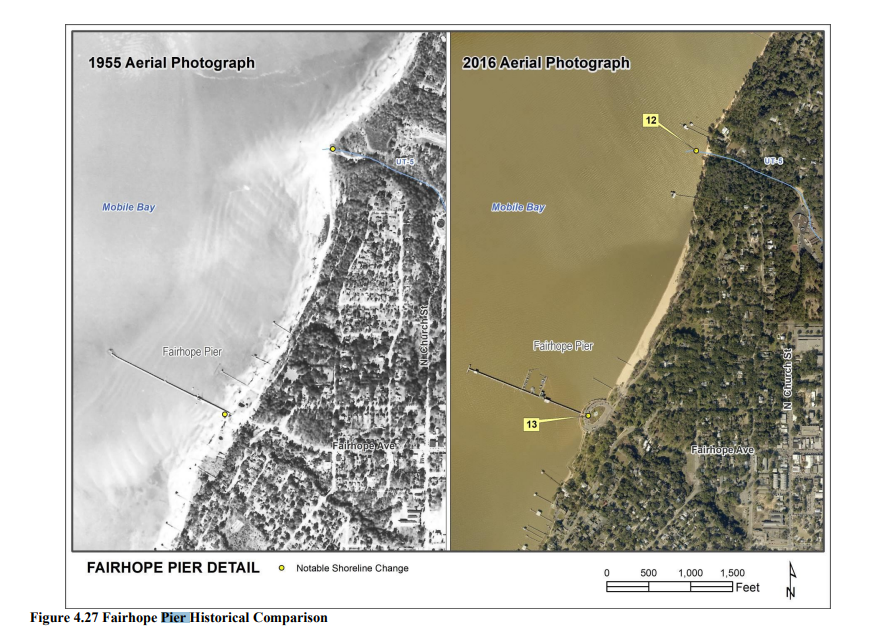
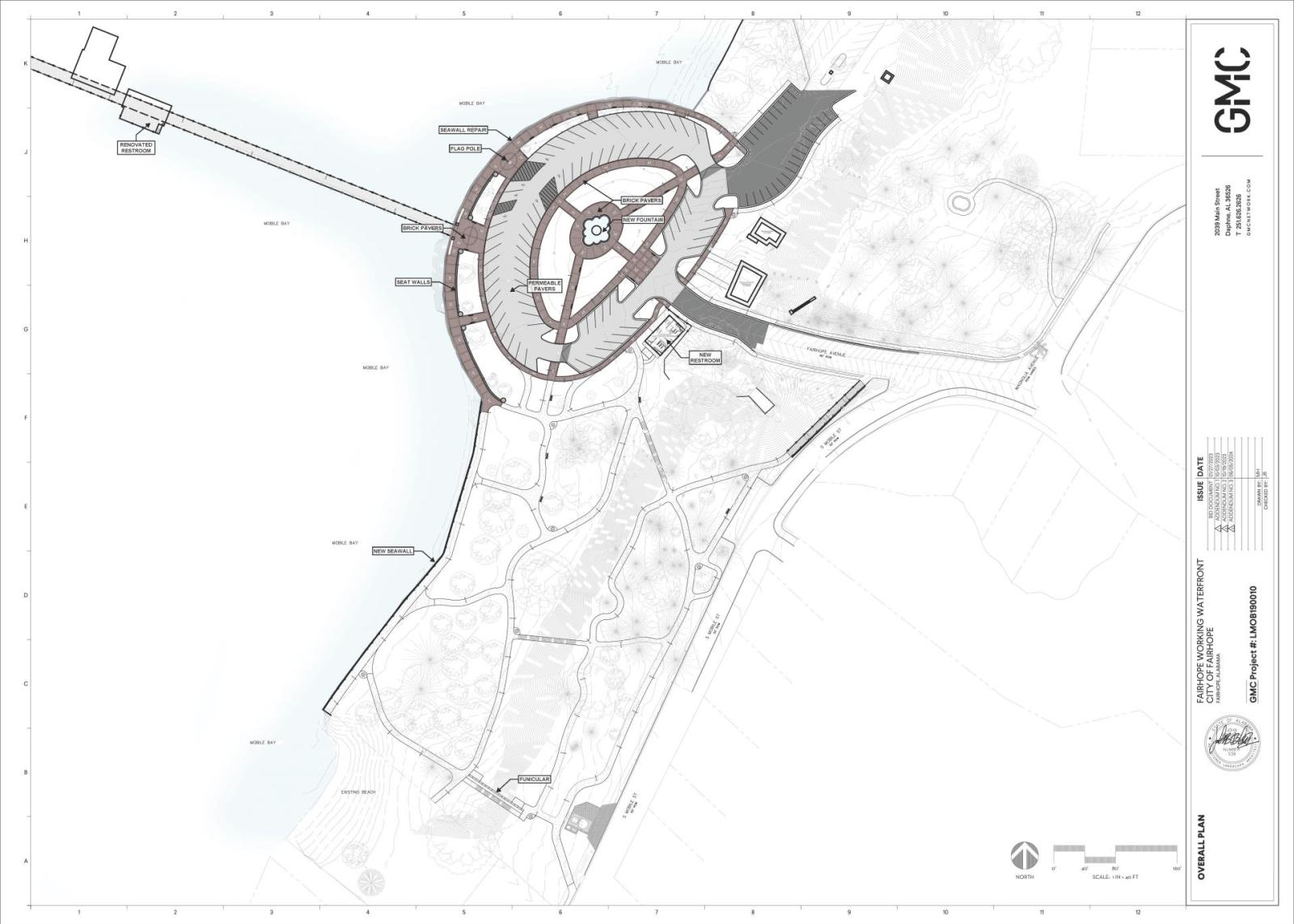
Fairhope's Municipal Pier is a popular bayfront destination featuring a 1/4-mile pier, swimming areas, picnic spots, a landscaped rose garden, benches, restrooms, a marina, a restaurant, walking trails, and a duck pond. However, the area has been fragilized over the years. The beaches are absent and less prominent now, due in large measure to the presence of shoreline hardening (Ref 5), making the shoreline more vulnerable to climate hazards (Ref 5). The main goal of the Working Waterfront and Greenspace Restoration Project is to introduce safe and user-friendly improvements to the 10-acre South Beach Park area, which encompasses the Municipal Pier (Ref 2). These upgrades aim to enhance the public's use and access of the waterfront, while ensuring the park's long-term resilience and sustainability (Ref 2). The new design tackles both the structural issues of the bulkhead/seawall and the overall aesthetics of the Fairhope Pier area (Ref 2). Over the years, storms, particularly Hurricanes Sally and Zeta, have compromised the structural integrity of the anchoring hardware of the bulkhead/seawall, causing parts of the wall to shift. Additionally, water intrusion behind the wall has eroded the soil supporting the walkway in certain areas (Ref 2). Other important features include new handrails, decking, restroom facilities, and lights on the pier. The project will also add new stairs leading to the bluff, restore the fountain, and renovate the parking lot. A funicular lift will be installed at the bluff to enhance accessibility (Ref 5). Pedestrian safety will be improved to meet the requirements of the Americans with Disabilities Act. Other enhancements include landscaping with new irrigation, and the construction of new sidewalks (Ref 2, Ref 4).

Overview
Nature-based solution
- Blue infrastructure
- Coastlines
- Grey infrastructure featuring greens
- Green parking lots
- Coastal defences / dikes
- Parks and urban forests
- Pocket parks/neighbourhood green spaces
Key challenges
- Climate action for adaptation, resilience and mitigation (SDG 13)
- Climate change adaptation
- Coastal resilience and marine protection (SDG 14)
- Coastal protection / hazard mitigation
- Green space, habitats and biodiversity (SDG 15)
- Green space creation and/or management
- Water management (SDG 6)
- Flood protection
- Health and well-being (SDG 3)
- Creation of opportunities for recreation
- Enabling opportunities for physical activity
Principal problems in Functional Urban Area (FUA)
- Climate-Related Hazards
- Coastal flooding
- Coastal hazards (e.g. erosion, flooding)
- Environmental Degradation
- Soil degradation and loss
- Land use and Socio-economic change
- Economic losses due to disasters and environmental degradation
Key priorities
Focus
Project objectives
Implementation activities
Climate-focused activities
Climate change adaptation:
- Restore sediment supply to coastal zone
- Protect and restore coastal ecosystems, to address loss of land and livelihoods, due to rising sea levels
Specification of climate or environmentally vulnerable communities
Main beneficiaries
- Citizens or community groups
- Marginalized groups: People with functional diversities, People with invisible disabilities
Governance
Management set-up
- Government-led
Type of initiating organisation
- Local government/municipality
Participatory approaches/ community involvement
- Dissemination of information and education
- Consultation (e.g. workshop, surveys, community meetings, town halls)
Details on the roles of the organisations involved in the project
Project implemented in response to ...
Type of enablers
Financing
Total cost
Source(s) of funding
- Public local authority budget
- Public national budget
- Public regional budget
Type of funding
- Earmarked public budget
- Direct funding (grants, subsidies, or self-financed projects by private entities)
Non-financial contribution
Impacts and Monitoring
Environmental impacts
- Climate change
- Storm / wave induced erosion and flooding
- Expected storm / wave induced erosion and flooding
- Strengthened capacity to address climate hazards/natural disasters
- Expected strengthened capacity to address climate hazards/natural disasters
- Enhanced protection against extreme weather events (e.g. storms, cyclones, tidal surges, coastal erosion)
- Expected enhanced protection against extreme weather events (e.g. storms, cyclones, tidal surges, coastal erosion)
- Green space and habitat
- Increased green space area
- Expected increased green space area
Economic impacts
- More sustainable tourism
- Expected more sustainable tourism
Socio-cultural impacts
- Social justice and cohesion
- Improved access to urban green space
- Expected improved access to urban green space
- Health and wellbeing
- Gain in activities for recreation and exercise
- Expected gain in activities for recreation and exercise
- Cultural heritage and sense of place
- Improvement in people’s connection to nature
- Expected improvement in people’s connection to nature
- Protection of historic and cultural landscape / infrastructure
- Expected protection of historic and cultural landscape / infrastructure
- Education
- Increased knowledge of locals about local nature
- Expected increased knowledge of locals about local nature
- Safety
- Improved community safety to climate-related hazards
- Expected improved community safety to climate-related hazards
Type of reported impacts
Presence of formal monitoring system
Presence of indicators used in reporting
Presence of monitoring/ evaluation reports
Availability of a web-based monitoring tool
Potential risks of implementation and trade-offs
References
 Information about this nature-based solution was collected as part of the Naturescapes project funded by the European Union under Grant Agreement No 101084341.