

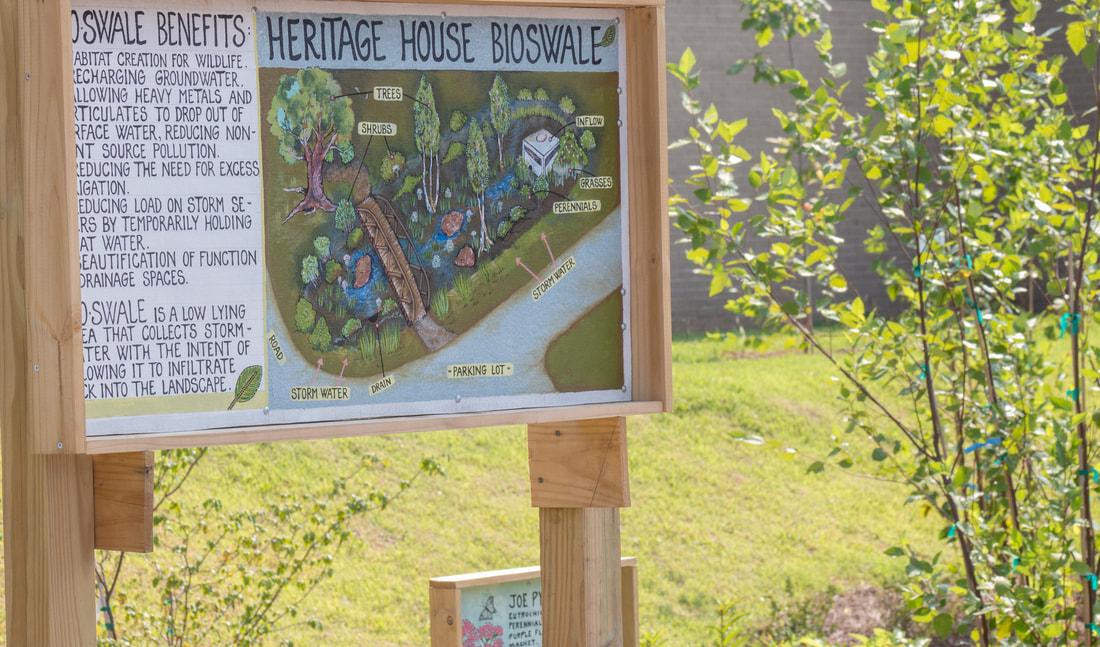
The Africatown Heritage House Bioswale is a gently sloping green space with multiple functions which include catchment of runoff water and filtration of pollution in the runoff water (Ref 2), erosion control (Ref 2), and creation of habitat for biodiversity (Ref 1). It also has an educational purpose for students and the local community (Ref 2) and contributes to overall beautification (Ref 5). The Bioswale was built by Birmingham-Southern College’s Environmental Center (Ref 6) and developed through the collaboration between the Mobile County Commission, the Mobile Area Lodging Association, Mobile County Training School, Mobile County Training School Alumni Association, and the National Academies of Science (NAS) Gulf Research Program (Ref 2). The project aims to address heavy rainwater management (Ref 5) and drainage issues (Ref 3).
Overview
Nature-based solution
- Green areas for water management
- Swales and filter strips
Key challenges
- Climate action for adaptation, resilience and mitigation (SDG 13)
- Climate change adaptation
- Water management (SDG 6)
- Flood protection
- Stormwater and rainfall management and storage
- Improvements to water quality
- Social justice, cohesion and equity (SDG 10)
- Environmental education
Principal problems in Functional Urban Area (FUA)
- Climate-Related Hazards
- Urban flooding (stormwater)
Key priorities
Focus
Project objectives
Implementation activities
Climate-focused activities
Climate change adaptation:
- Implement measures that prevent/manage desertification, soil erosion and landslides
- Implement sustainable urban drainage schemes to manage stormwater
- Reducing socio-economic vulnerability to climate impacts (e.g. awareness raising)
- Other
Specification of climate or environmentally vulnerable communities
Biodiversity conservation or restoration-focused activities
Biodiversity conservation:
- Protect and enhance urban habitats
- Create new habitats
- Protect species
- Undertake specific measures to protect native species
- Means for conservation governance
- Manage biological resources for conservation and sustainable use
- Raise public awareness
Main beneficiaries
- Public sector institution (e.g. school or hospital)
- Citizens or community groups
Governance
Management set-up
- Led by non-government actors
Type of initiating organisation
- Researchers/university
Participatory approaches/ community involvement
- Unknown
Details on the roles of the organisations involved in the project
Project implemented in response to ...
Type of enablers
Financing
Total cost
Source(s) of funding
- Research organisation / University
Type of funding
- Direct funding (grants, subsidies, or self-financed projects by private entities)
Non-financial contribution
Impacts and Monitoring
Environmental impacts
- Water management and blue areas
- Improved water quality
- Expected improved water quality
- Improved stormwater management
- Expected improved stormwater management
- Reduced risk of damages by drought
- Expected reduced risk of damages by drought
- Green space and habitat
- Increased green space area
- Expected increased green space area
- Increased number of species present
- Expected increased number of species present
- Increased presence and recovery of wild species
- Expected increased presence and recovery of wild species
- Enhanced support of pollination
- Expected enhanced support of pollination
Economic impacts
- Unknown
Socio-cultural impacts
- Social justice and cohesion
- Improved social cohesion
- Expected improved social cohesion
- Improved liveability
- Expected improved liveability
- Education
- Increased support for education and scientific research
- Expected increased support for education and scientific research
- Increased awareness of NBS and their benefits
- Expected increased awareness of NBS and their benefits
Type of reported impacts
Presence of formal monitoring system
Presence of indicators used in reporting
Presence of monitoring/ evaluation reports
Availability of a web-based monitoring tool
Potential risks of implementation and trade-offs
References
 Information about this nature-based solution was collected as part of the Naturescapes project funded by the European Union under Grant Agreement No 101084341.