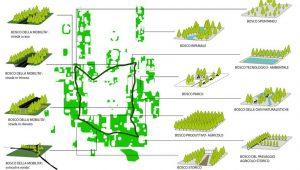
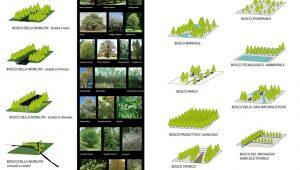
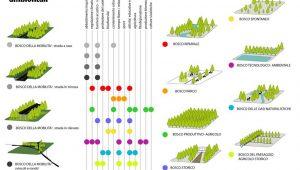
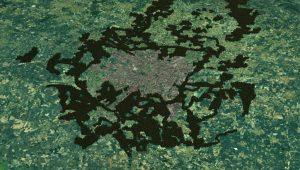
This is a pilot project part of the strategic plan "Città di Città" in the Milano province, launched in 2006 by the Direzione Centrale Risorse Ambientali, by the Parco Agricolo Sud Milano and by the Multiplicity.lab of the Politecnico di Milano. The project consists in the realisation of a green ring surrounding the city for an extension of 30.000 hectares (15% of the metropolitan area). The ring will connect a series of green areas already existing in the city. The project will insert a total of 3 million new trees along different areas of the city (2). The "metrobosco" is described as: a green belt made up of new forests, parks and rows that extend along the borders of the capital of Milan. A continuous ring of trees and small and large clearings to meet farms, abbeys, watercourses, agricultural areas and spaces for recreation and sports. The project arises from the need to redefine the relationship between city and country, to intensify plant and animal biodiversity, the preservation of existing and the construction of new "ecological corridors", the mitigation of climate imbalances, the abatement of noise and atmospheric pollution, the care and maintenance of the territory and the production of sources for agro-energies (4).
Overview
Nature-based solution
- Parks and urban forests
- Large urban parks or forests
- Green corridors and green belts
- Other
Key challenges
- Climate action for adaptation, resilience and mitigation (SDG 13)
- Climate change mitigation
- Green space, habitats and biodiversity (SDG 15)
- Green space creation and/or management
- Environmental quality
- Air quality improvement
- Social justice, cohesion and equity (SDG 10)
- Environmental and climate justice
- Health and well-being (SDG 3)
- Enabling opportunities for physical activity
- Improving physical health
- Creation of opportunities for recreation
Focus
Project objectives
Implementation activities
Climate-focused activities
Climate change mitigation:
- Increase green urban nature for carbon storage (wetlands, tree cover)
Main beneficiaries
- Local government/Municipality
- Private sector/Corporate/Company
- Citizens or community groups
- Young people and children
Governance
Management set-up
- Co-governance with government and non-government actors
Type of initiating organisation
- Local government/municipality
Participatory approaches/ community involvement
- Crowd-sourcing/Crowd-funding/Participatory budget
- Dissemination of information and education
- Joint implementation (e.g. tree planting)
Details on the roles of the organisations involved in the project
Project implemented in response to ...
Financing
Total cost
Source(s) of funding
- EU funds
- Public local authority budget
- Corporate investment
- Funds provided by non-governmental organization (NGO)
Type of funding
- Earmarked public budget
- Direct funding (grants, subsidies, or self-financed projects by private entities)
Non-financial contribution
- Provision of land
- Provision of labour
- Public authorities (e.g. land, utility services)
- Citizens (e.g. volunteering)
Impacts and Monitoring
Environmental impacts
- Climate change
- Enhanced carbon sequestration
- Environmental quality
- Improved air quality
- Green space and habitat
- Increased green space area
Economic impacts
- Reduce financial cost for urban management
Socio-cultural impacts
- Social justice and cohesion
- Increased opportunities for social interaction
- Increased involvement of locals in the management of green spaces
- Health and wellbeing
- Improved physical health
- Education
- Increased support for education and scientific research
- Increased knowledge of locals about local nature
- Increased awareness of NBS and their benefits
Type of reported impacts
Presence of formal monitoring system
Presence of indicators used in reporting
Presence of monitoring/ evaluation reports
Availability of a web-based monitoring tool
References
2. Stefano Boeri Architetti (2007), Project Webpage, Available at Source link (Accessed 7-9-2020)
3. Article mentioning the project: Source link (Website not available in 2020)
4. Citta Metropolitana (no date), La nuova Politica. Agricola Comunitaria (PAC). Principi e strumenti Available at Source link (Accessed 7-9-2020)
5. TubeTVItalia (2008), Project presentation, Available at Source link (Accessed 7-9-2020)
6. Ecodallecitta (2008), Metrobosco, un parco antismog che circonda Milano, Available at Source link (Accessed 7-9-2020)
7. Ecopolis (2008), Project communication, Available at Source link (Accessed 7-9-2020)
8. Trees cost: Source link (Website not available in 2020)
9.Comune di Milano (2018), VERSO UN PARCO METROPOLITANO, Available at Source link, (Accessed 7-9-2020)