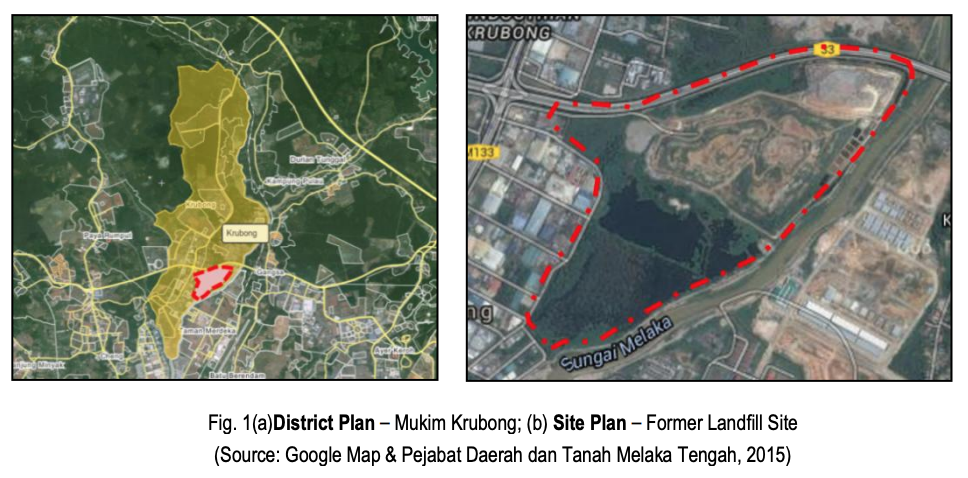
The Krubong landfill site has been proposed to undergo a "thorough and safe environmental rehabilitation program[me]" so that the site can be developed as a public park (Ref. 1). Following completion of a feasibility study, it is envisaged that significant rehabilitation work to address environmental degradation and restoration of natural habitats will be required, after which the site will be developed into a public park (Ref. 1). The programme remains in its planning stage, but seeks to address Sustainable Development Goals (SGDs) 11.6 and 15.1 through protecting, restoring and promoting sustainable use of ecosystems and reversing land degradation and/or biodiversity loss; and reducing the environmental impact of cities by paying special attention to waste management and providing access to safe, open public spaces (Ref. 1). At a more local level, the programme intends to complement additional programmes laid out in Melaka's Resilience strategy document, including promoting both cycling and pedestrian networks and reshaping public spaces in the city (Ref. 1).

Overview
Nature-based solution
- Parks and urban forests
- Large urban parks or forests
- Blue infrastructure
- Lakes/ponds
- Rivers/streams/canals/estuaries
Key challenges
- Climate action for adaptation, resilience and mitigation (SDG 13)
- Climate change adaptation
- Water management (SDG 6)
- Flood protection
- Stormwater and rainfall management and storage
- Improvements to water quality
- Green space, habitats and biodiversity (SDG 15)
- Habitat and biodiversity restoration
- Green space creation and/or management
- Environmental quality
- Air quality improvement
- Waste management
- Health and well-being (SDG 3)
- Enabling opportunities for physical activity
- Improving physical health
- Creation of opportunities for recreation
Focus
Project objectives
Implementation activities
Climate-focused activities
Climate change adaptation:
- Increase or improve urban vegetation cover to help reduce outdoor temperature
- Other
Biodiversity conservation or restoration-focused activities
Biodiversity restoration:
- Rehabilitate and restore damaged or destroyed ecosystems
Main beneficiaries
- Citizens or community groups
Governance
Management set-up
- Government-led
Type of initiating organisation
- Regional government
- Local government/municipality
Participatory approaches/ community involvement
- Consultation (e.g. workshop, surveys, community meetings, town halls)
- Other
Details on the roles of the organisations involved in the project
Project implemented in response to ...
Financing
Total cost
Source(s) of funding
- Public regional budget
- Public local authority budget
- Other
Type of funding
- Unknown
Non-financial contribution
Impacts and Monitoring
Environmental impacts
- Climate change
- Lowered local temperature
- Strengthened capacity to address climate hazards/natural disasters
- Environmental quality
- Improved air quality
- Water management and blue areas
- Improved water quality
- Increased protection against flooding
- Green space and habitat
- Increased green space area
- Increased conservation or restoration of ecosystems
- Increased conversion of degraded land or soil
- Restoration of derelict areas
Economic impacts
- Other
Socio-cultural impacts
- Social justice and cohesion
- Improved access to urban green space
- Health and wellbeing
- Improved physical health
- Gain in activities for recreation and exercise
Type of reported impacts
Presence of formal monitoring system
Presence of indicators used in reporting
Presence of monitoring/ evaluation reports
Availability of a web-based monitoring tool
References
2. Yachiyo Engineering Co. Ltd. and EX Corp. (2004). The Study on the Safe Closure and Rehabilitation of Landfill Sites in Malaysia: Final Report, Volume 3 Guideline for Safe Closure and Rehabilitation of MSW Landfill Sites. Tokyo: Yachiyo Engineering Co. Ltd. and EX Corp for Japan International Cooperation Agency and Ministry of Housing and Local Government, Malaysia. Source link [accessed 28/9/21];
3. Khalizah, S, Syed Othman Thani, S, Noorjannah, A, Rahim, Hanita, N, Mohamad, N and Hashim, M (2016). Grey to Green: Rehabilitation of Urban Dumpsite through Regenerative Landscape Approach. 7th Asian Conference on Environment-Behaviour Studies (AcEBs2016). Taipei: Environment-Behaviour Proceedings Journal and National Taiwan University. Source link [accessed 28/9/21];
4. Asian Development Bank (2014). Green City Action Plan: A Framework for GrEEEn Actions Melaka, Malaysia. Master Plan on ASEAN Connectivity Implementation (RETA 8040). Manila: Asian Development Bank. Source link [accessed 28/9/21]; and
5. Zen, I S, Hashim, H & Sinniah, G K (2019). Melaka State Climate Action Plan 2020 - 2030. Melaka: Melaka Green Technology Corporation (MGTC). Source link [accessed 28/9/21].