

Last updated: November 2021
The "New Nature" also called "La Calanque" is a new housing residency and business designed by the famous architect Jean Nouvel. The building design is inspired by the typical Mediterranean sea landscape called "calanque" (creek in english). "As an essential component of the project, vegetation is ubiquitous from the ground to the façades, from the heart of the buildings to the terraced roofs" (Ref. 2).
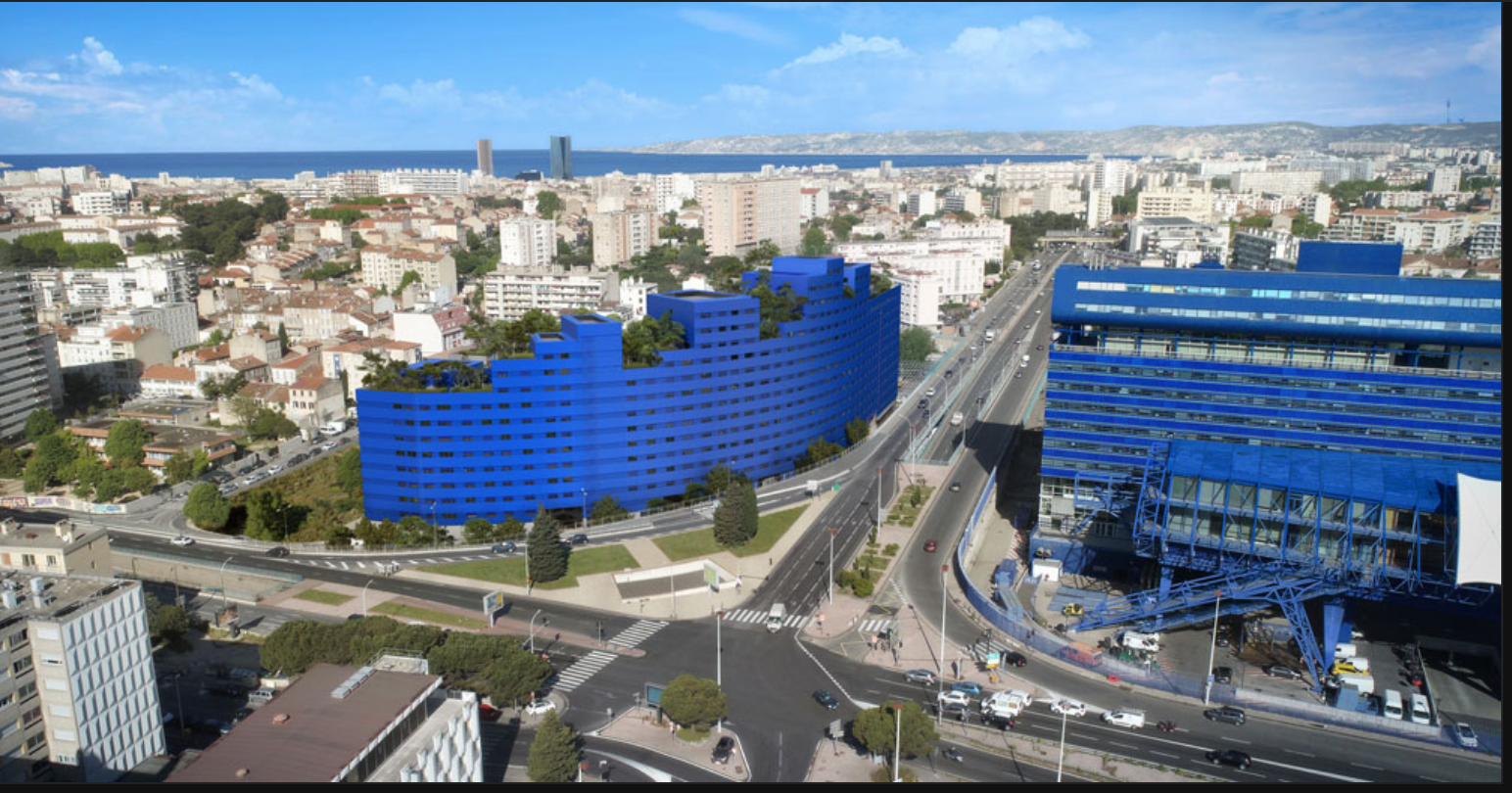
La Calanque
https://lacalanque-ametis.com/projet-immobilier-lacalanque-marseille
Overview
Nature-based solution
- Nature on buildings (external)
- Green roofs
- Green walls or facades
- Balcony greens
- Grey infrastructure featuring greens
- Green playgrounds and school grounds
- Other
- Community gardens and allotments
- Community gardens
- Blue infrastructure
- Lakes/ponds
Key challenges
- Climate action for adaptation, resilience and mitigation (SDG 13)
- Climate change adaptation
- Green space, habitats and biodiversity (SDG 15)
- Green space creation and/or management
- Environmental quality
- Air quality improvement
- Noise reduction
- Regeneration, land-use and urban development
- Regulation of built environment
- Promote natural styles of landscape design for urban development
- Economic development and employment (SDG 8)
- Real estate development
- Cultural heritage and cultural diversity
- Preservation of natural heritage
- Promotion of cultural diversity
- Sustainable consumption and production (SDG 12)
- Sustainable consumption
Focus
Creation of new green areas, Creation of semi-natural blue areas
Project objectives
-"The project is part of a desire to develop a bioclimatic architecture that respects the environment and sustainable development." (Ref. 1)
-"The project is entirely supported by the landscape constituted around geographical facades, planted soil recreating canopies of shadows and lights, and garden roofs inspired by the Mediterranean gardens." (Ref. 2)
-Helping local economies by working with local small and medium-sized companies
-"The project "La Calanque" is a model of social diversity" (Ref. 3)
-Reduce noise and air pollution (Ref. 3)
Implementation activities
-"The plant interior facades of the heart of the island are planted with real trees installed in concrete containers of adequate depth. They are part of the overall landscape composition of the project."
-"In order to plant the trees of the Calanque project, a marking in the nursery of the trees of the project is necessary to ensure the quality of the plants: visual checks of the architecture and height and width requested, observations on the arrangement of plants between rows, observations on good phytosanitary status" (Ref. 4)
-"A pond located in a fully enclosed and vegetated space will provide an ideal place to meet and allow children to play safely. Likewise, user-friendliness will be required in the community gardens located in roof terrace of the residence. Culture of vegetable gardens and access to a peasant basket will be on the program for these young residents with modest incomes." (Ref. 8)
“A monumental blue screen facade will envelop the entire urban composition in the north, east and west, thus protecting it from an aggressive acoustic environment” (Ref. 2).
“A shared garden will be set up on the roof terraces, providing residents with a place for market gardening and meetings. The other two shared gardens will be located at the foot of the building , allowing the common space to be displayed with maintenance at the expense of the residents” (Ref. 9).
“Structured around a simple and bio-climatic architecture, the project is entirely carried by the landscape made up around geographical facades, planted soils recreating canopies of shadows and lights, and garden roofs, a true fifth vegetal facade, inspired by by the Mediterranean gardens” (Ref. 2).
-Creating meeting areas and community gardens as well as a safe place for children to play (Ref. 8)
Climate-focused activities
Climate change adaptation:
- Implement green walls or roofs to lower indoor temperature and provide insulation
Main beneficiaries
- Private sector/Corporate/Company
- Citizens or community groups
- Marginalized groups: Socio-economically disadvantaged populations (e.g. low-income households, unemployed), Other
- Young people and children
Governance
Management set-up
- Led by non-government actors
Type of initiating organisation
- Private sector/corporate actor/company
Participatory approaches/ community involvement
- Unknown
Details on the roles of the organisations involved in the project
AMETIS and IDEOM (Housing developers) with the architect agency "Ateliers Jean Nouvel".
"Promologis" is the initiator of the project: "Project sponsor: the social lessor PROMOLOGIS" (Ref. 10, page 4)
Grant awarded: 300,000 euros by the Marseille Provence Métropole (Local Authority) for the Habitat Innovation Fund Awards in 2016 (Ref. 10, page 4)
Project implemented in response to ...
... an EU policy or strategy?
Unknown
... a national policy or strategy?
Unknown
... a local policy or strategy?
Yes
("It meets the demanding participation of the edification of the city of Marseille." (Ref. 2)
"To follow a policy of urban transformation wished by local elected representatives." (Ref. 3))
Financing
Total cost
More than €4,000,000
Source(s) of funding
- Public local authority budget
- Corporate investment
Type of funding
- Direct funding (grants, subsidies, or self-financed projects by private entities)
Non-financial contribution
Unknown
Impacts and Monitoring
Environmental impacts
- Climate change
- Lowered local temperature
- Environmental quality
- Improved air quality
- Reduced noise exposure
- Green space and habitat
- Promotion of naturalistic styles of landscape design for urban development
- Increased green space area
- Increased number of species present
Economic impacts
- Increase of green jobs (e.g. paid employment positions)
- Increase in agricultural production (for profit or not)
- Increased market share for green economies
- Other
Socio-cultural impacts
- Social justice and cohesion
- Increased opportunities for social interaction
- Cultural heritage and sense of place
- Promotion of cultural diversity
- Improvement in people’s connection to nature
- Protection of natural heritage
- Increased sense of place identity, memory and belonging
- Other
Type of reported impacts
Expected impacts, Achieved impacts
Presence of formal monitoring system
Unknown
Presence of indicators used in reporting
No evidence in public records
Presence of monitoring/ evaluation reports
No evidence in public records
Availability of a web-based monitoring tool
Yes
References
1. AMETIS (n.d). "La Calanque". Available at: Source link (Accessed: July 24, 2020).
2. AMETIS (n.d). "La Calanque - Le Projet". Available at: Source link (Accessed: July 24, 2020).
3. Georges, Suzie (2017). "Marseille : une calanque signée Jean Nouvel". Available at: Source link (Accessed: July 24, 2020).
4. AMETIS (2017). La Calanque: LE CONTRAT DE CULTURE. Available at: Source link (Accessed: July 24, 2020).
5. SRCE PACA (2016). “Trames vertes et bleues dans le PLU de Marseille”. Available at: Source link (Accessed: July 24, 2020).
6. Ville de Marseille (n.d). “La nature à Marseille: presentation”. Available at: Source link (Accessed: July 24, 2020).
7. Julia (2017). "Découvrez la première résidence végétale de Marseille imaginée par Jean Nouvel". Available at: Source link (Accessed: July 24, 2020).
8. Destimed (2017). "Marseille : Jean Nouvel dessine la Calanque du bien-vivre au cœur de Saint-Just". Available at: Source link (Accessed: July 24, 2020).
9. Ametis (2017). "Jardin partagés" - UNE NOUVELLE MANIÈRE DE FAIRE ENTRER LA NATURE EN VILLE. Available at: Source link (Accessed: July 24, 2020).
10. MPM (2016). "Remise des prix du Fonds d’innovation de l’Habitat". Dossier de Presse. Available at: Source link (Accessed: July 24, 2020).
2. AMETIS (n.d). "La Calanque - Le Projet". Available at: Source link (Accessed: July 24, 2020).
3. Georges, Suzie (2017). "Marseille : une calanque signée Jean Nouvel". Available at: Source link (Accessed: July 24, 2020).
4. AMETIS (2017). La Calanque: LE CONTRAT DE CULTURE. Available at: Source link (Accessed: July 24, 2020).
5. SRCE PACA (2016). “Trames vertes et bleues dans le PLU de Marseille”. Available at: Source link (Accessed: July 24, 2020).
6. Ville de Marseille (n.d). “La nature à Marseille: presentation”. Available at: Source link (Accessed: July 24, 2020).
7. Julia (2017). "Découvrez la première résidence végétale de Marseille imaginée par Jean Nouvel". Available at: Source link (Accessed: July 24, 2020).
8. Destimed (2017). "Marseille : Jean Nouvel dessine la Calanque du bien-vivre au cœur de Saint-Just". Available at: Source link (Accessed: July 24, 2020).
9. Ametis (2017). "Jardin partagés" - UNE NOUVELLE MANIÈRE DE FAIRE ENTRER LA NATURE EN VILLE. Available at: Source link (Accessed: July 24, 2020).
10. MPM (2016). "Remise des prix du Fonds d’innovation de l’Habitat". Dossier de Presse. Available at: Source link (Accessed: July 24, 2020).