

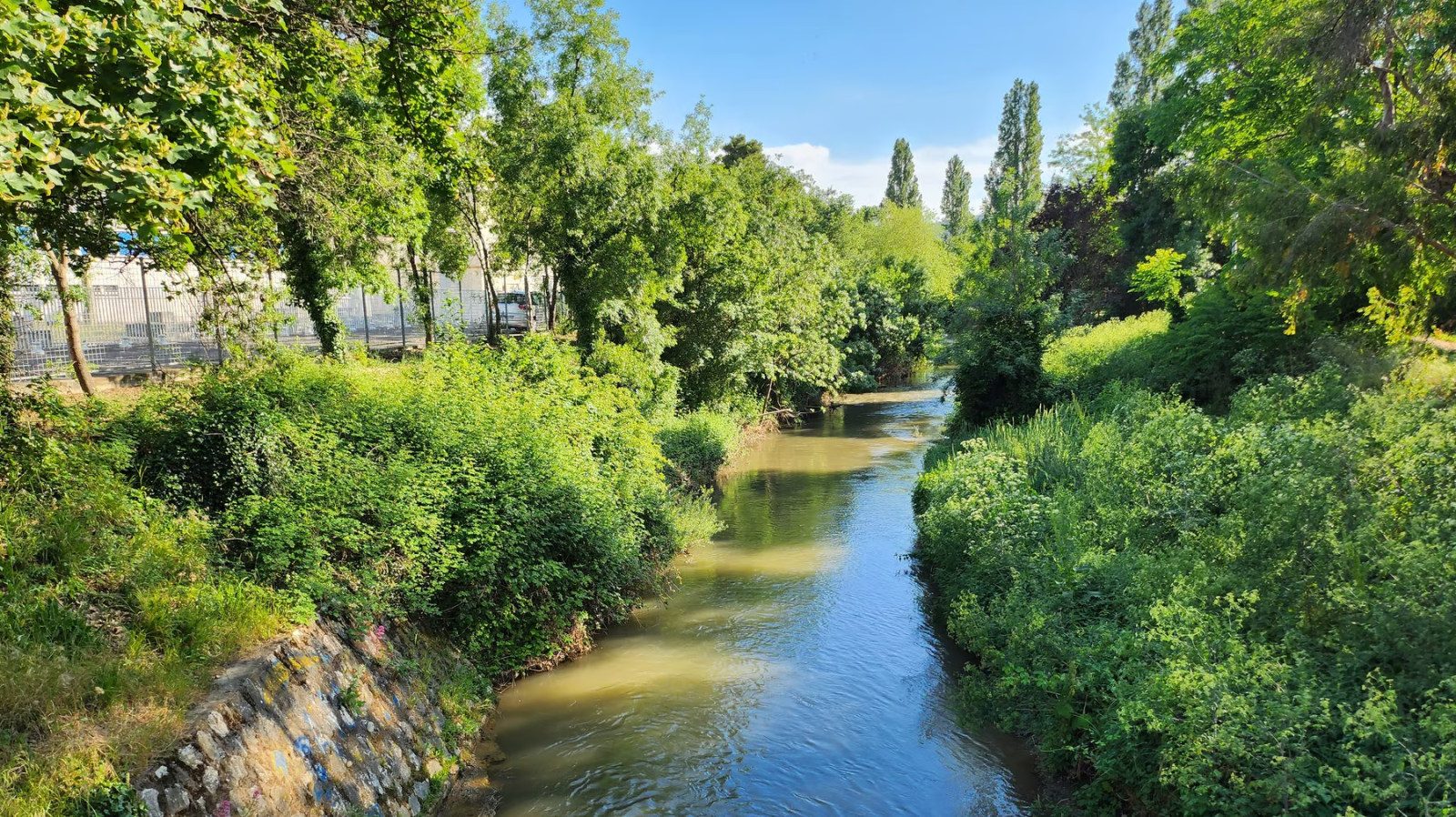
The project to revitalize the Huveaune River and its biodiversity is taking place in Aubagne, a city within the Marseille Metropolitan area. For a long time, the river received little attention, constrained by urbanization, and was even covered for several hundred meters. Urbanization and the construction of a road have made the floodplain more susceptible to flooding (Ref 2). The initiative aims not only to restore the Huveaune and its environment but also to strengthen the connection between residents and the river (Ref 1) while reducing flood risk as a critical objective (Ref 1). The challenge is transforming the area into a higher-quality environmental space with resilient ecosystems. A diagnostic conducted during the project's design phase revealed the site's degraded state, including the presence of invasive species, steep banks unsuitable for riparian vegetation, poor waterway conservation, and disrupted ecological continuity (Ref 2). Key actions include revitalizing the river and its biodiversity, removing artificial banks, and creating new meanders to give the river a more natural shape. Diversifying flow patterns will create habitats for aquatic and fish species by varying water heights and flow speeds. This involves increasing the river's sinuosity and varying the width of the minor riverbed (Ref 2). Additional steps include planting trees and shrubs adapted to the Mediterranean climate with low water needs (Ref 2). To bring residents closer to the river, plans include creating walking and cycling routes, sports equipment, educational panels, and useful visitor facilities such as benches, water points, and restrooms (Ref 3).
Overview
Nature-based solution
- Blue infrastructure
- Rivers/streams/canals/estuaries
- Riverbank/Lakeside greens
- Green areas for water management
- Sustainable urban drainage systems
- Parks and urban forests
- Pocket parks/neighbourhood green spaces
Key challenges
- Green space, habitats and biodiversity (SDG 15)
- Green space creation and/or management
- Habitat and biodiversity restoration
- Water management (SDG 6)
- Flood protection
- Stormwater and rainfall management and storage
- Health and well-being (SDG 3)
- Creation of opportunities for recreation
- Enabling opportunities for physical activity
Principal problems in Functional Urban Area (FUA)
- Climate-Related Hazards
- River flooding
- Urban flooding (stormwater)
- Environmental Degradation
- Biodiversity loss
- Invasive alien species
- Land use and Socio-economic change
- Rapid urbanization
- Unequal availability and access to public green spaces
Key priorities
Focus
Project objectives
Implementation activities
Specification of climate or environmentally vulnerable communities
Biodiversity conservation or restoration-focused activities
Biodiversity restoration:
- Restore species (native, endangered, or unspecified)
- Restore native species
- Clear and control invasive alien species
- Public engagement
Main beneficiaries
- Citizens or community groups
- Young people and children
Governance
Management set-up
- Government-led
Type of initiating organisation
- Local government/municipality
Participatory approaches/ community involvement
- Co-planning (e.g. stakeholder workshops, focus groups, participatory mapping)
- Consultation (e.g. workshop, surveys, community meetings, town halls)
- Citizen monitoring and review
Details on the roles of the organisations involved in the project
Project implemented in response to ...
Type of enablers
Financing
Total cost
Source(s) of funding
- Public local authority budget
Type of funding
- Earmarked public budget
Non-financial contribution
Impacts and Monitoring
Environmental impacts
- Water management and blue areas
- Increased protection against flooding
- Expected increased protection against flooding
- Enhanced protection and restoration of freshwater ecosystems
- Expected enhanced protection and restoration of freshwater ecosystems
- Green space and habitat
- Increased green space area
- Expected increased green space area
- Increased conservation or restoration of ecosystems
- Expected increased conservation or restoration of ecosystems
- Increased ecological connectivity across regeneration sites and scales
- Expected increased ecological connectivity across regeneration sites and scales
- Increased number of species present
- Expected increased number of species present
- Improved prevention or control of invasive alien species
- Expected improved prevention or control of invasive alien species
Economic impacts
- Unknown
Socio-cultural impacts
- Social justice and cohesion
- Improved liveability
- Expected improved liveability
- Improved access to urban green space
- Expected improved access to urban green space
- Health and wellbeing
- Gain in activities for recreation and exercise
- Expected gain in activities for recreation and exercise
- Enhanced cognitive restoration, relaxation and stress relief
- Expected enhanced cognitive restoration, relaxation and stress relief
- Cultural heritage and sense of place
- Improvement in people’s connection to nature
- Expected improvement in people’s connection to nature
- Education
- Increased knowledge of locals about local nature
- Expected increased knowledge of locals about local nature
- Safety
- Improved community safety to climate-related hazards
- Expected improved community safety to climate-related hazards
Type of reported impacts
Presence of formal monitoring system
Presence of indicators used in reporting
Presence of monitoring/ evaluation reports
Availability of a web-based monitoring tool
Potential risks of implementation and trade-offs
References


 Information about this nature-based solution was collected as part of the Naturescapes project funded by the European Union under Grant Agreement No 101084341.