

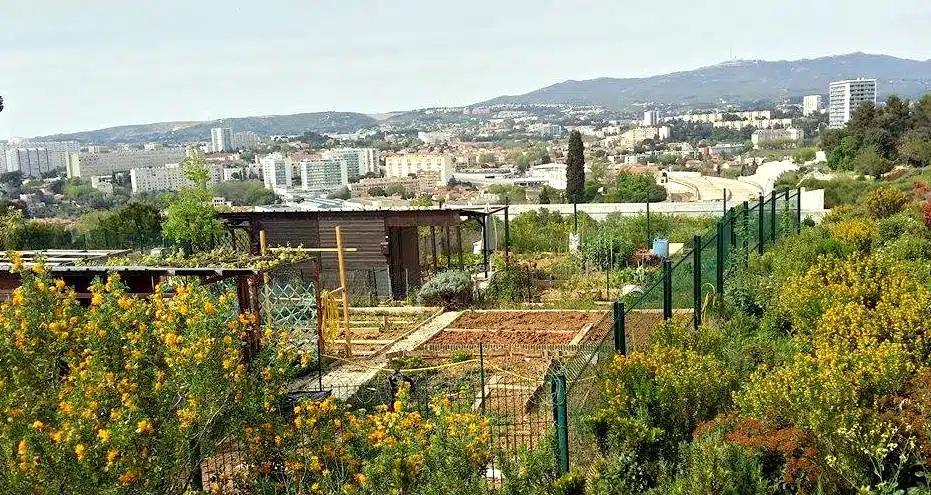
The City of Marseille is engaged in a city-wide project to develop community gardens across its territory. It supports project leaders by providing municipal land and offering a framework along with technical support (Ref 5). Currently, there are 80 community gardens, including 66 shared gardens and 14 family gardens, covering nearly 32 hectares in total (Ref 1). Marseille aims to provide all residents with spaces for relaxation and socialization in every neighbourhood, particularly fostering shared gardening spaces in neglected land, forgotten squares, building bases, or areas awaiting development. (Ref 1). Community gardens contribute to the city's beautification and support biodiversity (Ref 1) and are founded on values of solidarity, conviviality, and fostering connections between generations and cultures (Ref 4). This initiative also addresses the issue of agricultural land disappearing due to urbanization, while Marseille's many abandoned wastelands offer genuine opportunities to rethink production models (Ref 3). The city has created a Charter to be signed between the city and garden managers, which can include groups of residents or associations (Ref 2). The charter includes criteria such as citizen involvement, fostering social connections, promoting biodiversity, restoring soils’ health, planting local species, and eco-responsible gardening practices (Ref 2). In return, the city supports the development of these gardens, providing land and offering technical and methodological assistance, including soil analysis and advice on environmentally friendly gardening practices (Ref 2). Additionally, community gardens can serve an economic purpose by creating jobs and enabling the production of healthy and flavorful fruits and vegetables at a lower cost (Ref 2).
Overview
Nature-based solution
- Community gardens and allotments
- Allotments
- Community gardens
Key challenges
- Green space, habitats and biodiversity (SDG 15)
- Green space creation and/or management
- Habitat and biodiversity restoration
- Health and well-being (SDG 3)
- Creation of opportunities for recreation
- Improving mental health
- Inclusive and effective governance (SDG 16)
- Inclusive governance
- Social justice, cohesion and equity (SDG 10)
- Social cohesion
- Social interaction
- Environmental education
- Sense of community and community engagement
- Economic development and employment (SDG 8)
- Economic development: agriculture
- Sustainable consumption and production (SDG 12)
- Sustainable consumption
- Sustainable production
Principal problems in Functional Urban Area (FUA)
- Environmental Degradation
- Biodiversity loss
- Land use and Socio-economic change
- Agriculture/ crop production
- Rapid urbanization
- Unequal availability and access to public green spaces
Key priorities
Focus
Project objectives
Implementation activities
Biodiversity conservation or restoration-focused activities
Biodiversity restoration:
- Rehabilitate and restore damaged or destroyed ecosystems
- Restore species (native, endangered, or unspecified)
- Restore native species
- Restore ecological connectivity
- Public engagement
Main beneficiaries
- Non-government organisation/Civil Society
- Citizens or community groups
- Food producers and cultivators (i.e. farmers, gardeners)
Governance
Management set-up
- Government-led
Type of initiating organisation
- Local government/municipality
Participatory approaches/ community involvement
- Co-planning (e.g. stakeholder workshops, focus groups, participatory mapping)
- Deliberative decision-making processes (e.g., consensus building, deliberative polling)
- Dissemination of information and education
- Joint implementation (e.g. tree planting)
- Citizen oversight (e.g. boards, advisory)
Details on the roles of the organisations involved in the project
Project implemented in response to ...
Type of enablers
Financing
Total cost
Source(s) of funding
- Public local authority budget
Type of funding
- Earmarked public budget
Non-financial contribution
- Provision of land
- Provision of labour
- Provision of expertise
- Public authorities (e.g. land, utility services)
- Citizens (e.g. volunteering)
Impacts and Monitoring
Environmental impacts
- Environmental quality
- Improved soil quality
- Expected improved soil quality
- Green space and habitat
- Increased green space area
- Expected increased green space area
- Increased conservation or restoration of ecosystems
- Expected increased conservation or restoration of ecosystems
- Increased ecological connectivity across regeneration sites and scales
- Expected increased ecological connectivity across regeneration sites and scales
- Increased conversion of degraded land or soil
- Expected increased conversion of degraded land or soil
- Reduced biodiversity loss
- Expected reduced biodiversity loss
- Increased number of species present
- Expected increased number of species present
Economic impacts
- Increase of green jobs (e.g. paid employment positions)
- Expected increase of green jobs (e.g. paid employment positions)
- Increase in agricultural production (for profit or not)
- Expected increase in agricultural production (for profit or not)
Socio-cultural impacts
- Social justice and cohesion
- Improved social cohesion
- Expected improved social cohesion
- Improved liveability
- Expected improved liveability
- Improved access to urban green space
- Expected improved access to urban green space
- Increased opportunities for social interaction
- Expected increased opportunities for social interaction
- Increased involvement of locals in the management of green spaces
- Expected increased involvement of locals in the management of green spaces
- Increased access to healthy/affordable food
- Expected increased access to healthy/affordable food
- Increased sustainability of agriculture practices
- Expected increased sustainability of agriculture practices
- Health and wellbeing
- Gain in activities for recreation and exercise
- Expected gain in activities for recreation and exercise
- Enhanced cognitive restoration, relaxation and stress relief
- Expected enhanced cognitive restoration, relaxation and stress relief
- Education
- Increased knowledge of locals about local nature
- Expected increased knowledge of locals about local nature
Type of reported impacts
Presence of formal monitoring system
Presence of indicators used in reporting
Presence of monitoring/ evaluation reports
Availability of a web-based monitoring tool
Potential risks of implementation and trade-offs
References

 Information about this nature-based solution was collected as part of the Naturescapes project funded by the European Union under Grant Agreement No 101084341.