

Last updated: November 2021
The San Rafael Park is an urban park and commemoration site built over former communal graves containing more than 2000 bodies of victims of the Spanish Civil War and the Franquista regime. The large project has had 4 phases, three of which have been completed, including the building of a Historical Memory Pantheon to commemorate the victims in the communal graves exhumed from the grounds where the park now stands. (ref 1) In these phases are numerous reforestation and water preservation plans (ref 1-7) including the gardening of more than 4,000m² of green area with 104 shade trees, 8 palm trees and more than 400 units of shrubs, in addition to covering the rest of the surface with perennials and meadows (ref 3).
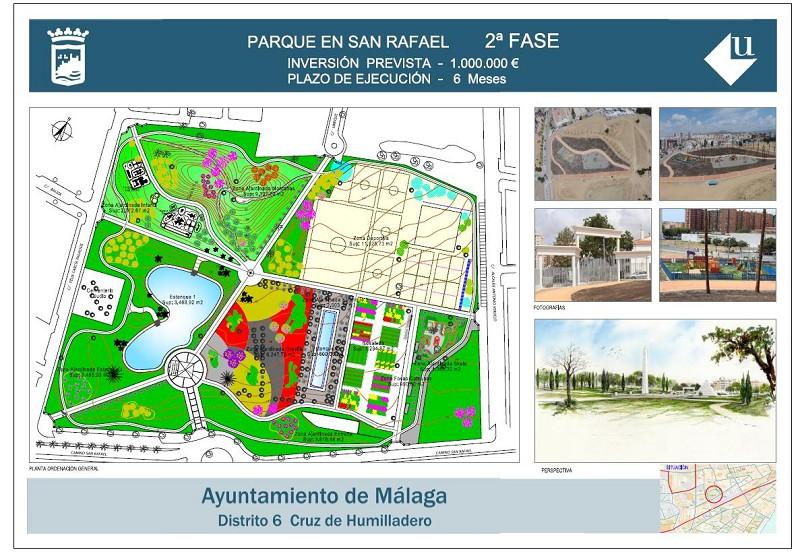
Source: Ref. 1
Overview
Nature-based solution
- Grey infrastructure featuring greens
- Alley or street trees and other street vegetation
- Parks and urban forests
- Large urban parks or forests
- Other
- Community gardens and allotments
- Other
- Blue infrastructure
- Lakes/ponds
- Other
Key challenges
- Water management (SDG 6)
- Stormwater and rainfall management and storage
- Green space, habitats and biodiversity (SDG 15)
- Green space creation and/or management
- Environmental quality
- Waste management
- Regeneration, land-use and urban development
- Regulation of built environment
- Health and well-being (SDG 3)
- Creation of opportunities for recreation
- Cultural heritage and cultural diversity
- Protection of historic and cultural landscape/infrastructure
- Preservation of historic traditions
Focus
Creation of new green areas, Creation of semi-natural blue areas, Maintenance and management of urban nature, Other
Project objectives
This NBS aims to enhance the grounds of the former San Rafael Cemetery through the development of an urban park for residents of the Cruz del Humilladero district (ref 3,7).
Implementation activities
Four planned phases involving the creation of two ponds, one of great dimensions, which has already been excavated in the first phase, and which will also function as a reservoir regulator of the irrigation network, and another, of much smaller dimensions, which serves to configure a Space more classic, taking advantage of the existence of an already consolidated woodland. (ref 1)
Planting new forested trees (ref 1)
Gardening of more than 4,000m² of green area with 104 shade trees, 8 palm trees and more than 400 units of shrubs, in addition to covering the rest of the surface with perennials and meadows (ref 3)
Building of a Historical Memory Pantheon to commemorate the victims in the communal graves exhumed from the grounds where the park now stands. (ref 1)
The latest phase, phase 3 was planned for 6 months, during which 8 400 m2 were rehabilitated. (ref 3)
Participatory process for the design of children’s area, and it was the schoolchildren of the CEIP Simón Bolîvar, Camino de San Rafael and Hernández Cánovas who decided by vote the model of these two areas: one of a forest nature and the other with swings and grass floor. (ref 1)
Biodiversity conservation or restoration-focused activities
Biodiversity conservation:
- Means for conservation governance
- Manage biological resources for conservation and sustainable use
- Other
Main beneficiaries
- Local government/Municipality
- Citizens or community groups
- Other
Governance
Management set-up
- Government-led
Type of initiating organisation
- Regional government
- Local government/municipality
Participatory approaches/ community involvement
- Consultation (e.g. workshop, surveys, community meetings, town halls)
- Other
Details on the roles of the organisations involved in the project
El Ayuntamiento de Málaga, Malaga City Council – project coordinator & financer (ref 1,2,3)
Municipal Urbanization Management (Gerencia Municipal de Urbanismo), government body of the City council – project coordinator (ref 1,2,3)
Center for Historic Memory, Centro de la Memoria Historica (non-profit organization/ association)- site’s history consultation body (ref 1,2,3)
Environmental Sustainability (local government) – project collaborator (ref 1,3)
Cruz de Humilladero district council (local government)– project collaborator (ref 1,3)
Junta de Andalucia (regional government) – some funding provided for construction of the Pantheon of the Historical Memory of Malaga, built on the grounds of the San Rafael Park (ref 1)
Verosa (company): awarded to do demolitions, earthworks (ref 7)
Sando (company): awarded to build roads, lighting, irrigation infrastructures, paving works, pond, skatepark (ref 7)
Project implemented in response to ...
... an EU policy or strategy?
Unknown
... a national policy or strategy?
Unknown
... a local policy or strategy?
Yes
(Organization Plan of the Aglomeration of Malaga (Plan de Ordenacion del Territorio de la Aglomeracion de Malaga) (2009) a regional plan with future projects. (ref 5))
Financing
Total cost
More than €4,000,000
Source(s) of funding
- Public regional budget
- Public local authority budget
Type of funding
- Direct funding (grants, subsidies, or self-financed projects by private entities)
Non-financial contribution
Type of non-financial contribution
- Other
Who provided the non-financial contribution?
- Citizens (e.g. volunteering)
- Other
Impacts and Monitoring
Environmental impacts
- Water management and blue areas
- Improved stormwater management
- Green space and habitat
- Increased green space area
- Other
Economic impacts
- Unknown
Socio-cultural impacts
- Social justice and cohesion
- Increased visibility and opportunity for marginalised groups or indigenous peoples
- Increased involvement of locals in the management of green spaces
- Cultural heritage and sense of place
- Protection of historic and cultural landscape / infrastructure
- Increased sense of place identity, memory and belonging
- Education
- Increased awareness of NBS and their benefits
- Other
Type of reported impacts
Expected impacts, Achieved impacts
Presence of formal monitoring system
Unknown
Presence of indicators used in reporting
No evidence in public records
Presence of monitoring/ evaluation reports
No evidence in public records
Availability of a web-based monitoring tool
No evidence in public records
References
1. Diputacion de Malaga. (2016). El Ayuntamiento de Málaga y la Diputación impulsan la segunda fase del parque de San Rafael. Available at: Source link [Accessed 20 September 2020].
2. Hinojosa, Jesus. (2014). Urbanismo cambia el diseño del parque de San Rafael por otro menos ambicioso. Diario Sur. Available at: Source link [Accessed 20 September 2020].
3. Diputacion de Malaga. (2017). La Diputación y el Ayuntamiento de Málaga impulsan la tercera fase del parque de San Rafael. Available at: Source link [Accessed 20 September 2020].
4. Quiros, Pilar R. (2016). De la Torre defiende su gestión en San Rafael diciendo que han hecho «suficientes gestos». Diario Sur. Available at: Source link [Accessed 20 September 2020].
5. Junta de Andalucia. (2009). Plan de Ordenación del Territorio de la Aglomeración Urbana de Málaga: Memoria Ambiental. [Document provided].
6. La Opinion de Malaga. (2019). Llevan a aprobación el edificio del parque de San Rafael.
Available at: Source link [Accessed 20 September 2020].
7. Hinojas, J. (2020). San Rafael: dos millones de parque para esto. Source link. Available at: Source link [Accessed 20 September 2020].
2. Hinojosa, Jesus. (2014). Urbanismo cambia el diseño del parque de San Rafael por otro menos ambicioso. Diario Sur. Available at: Source link [Accessed 20 September 2020].
3. Diputacion de Malaga. (2017). La Diputación y el Ayuntamiento de Málaga impulsan la tercera fase del parque de San Rafael. Available at: Source link [Accessed 20 September 2020].
4. Quiros, Pilar R. (2016). De la Torre defiende su gestión en San Rafael diciendo que han hecho «suficientes gestos». Diario Sur. Available at: Source link [Accessed 20 September 2020].
5. Junta de Andalucia. (2009). Plan de Ordenación del Territorio de la Aglomeración Urbana de Málaga: Memoria Ambiental. [Document provided].
6. La Opinion de Malaga. (2019). Llevan a aprobación el edificio del parque de San Rafael.
Available at: Source link [Accessed 20 September 2020].
7. Hinojas, J. (2020). San Rafael: dos millones de parque para esto. Source link. Available at: Source link [Accessed 20 September 2020].

Source: Ref. 4