

Last updated: October 2021
The planned intervention focuses on creating accessible green spaces for meaningful social exchanges. The City Council seeks to achieve this through a ground plan of connecting green spaces and ease of access into buildings. The intervention, proposed as a lineal green area, centers its structural organization around green spaces and public spaces. Accessibility for pedestrians is facilitated through spines of green spaces that cross the planned neighbourhood horizontally and vertically. These green spaces are planned to be watered with collected rain water, consequently the smart use of water is also a focus of the intervention. (ref 1)
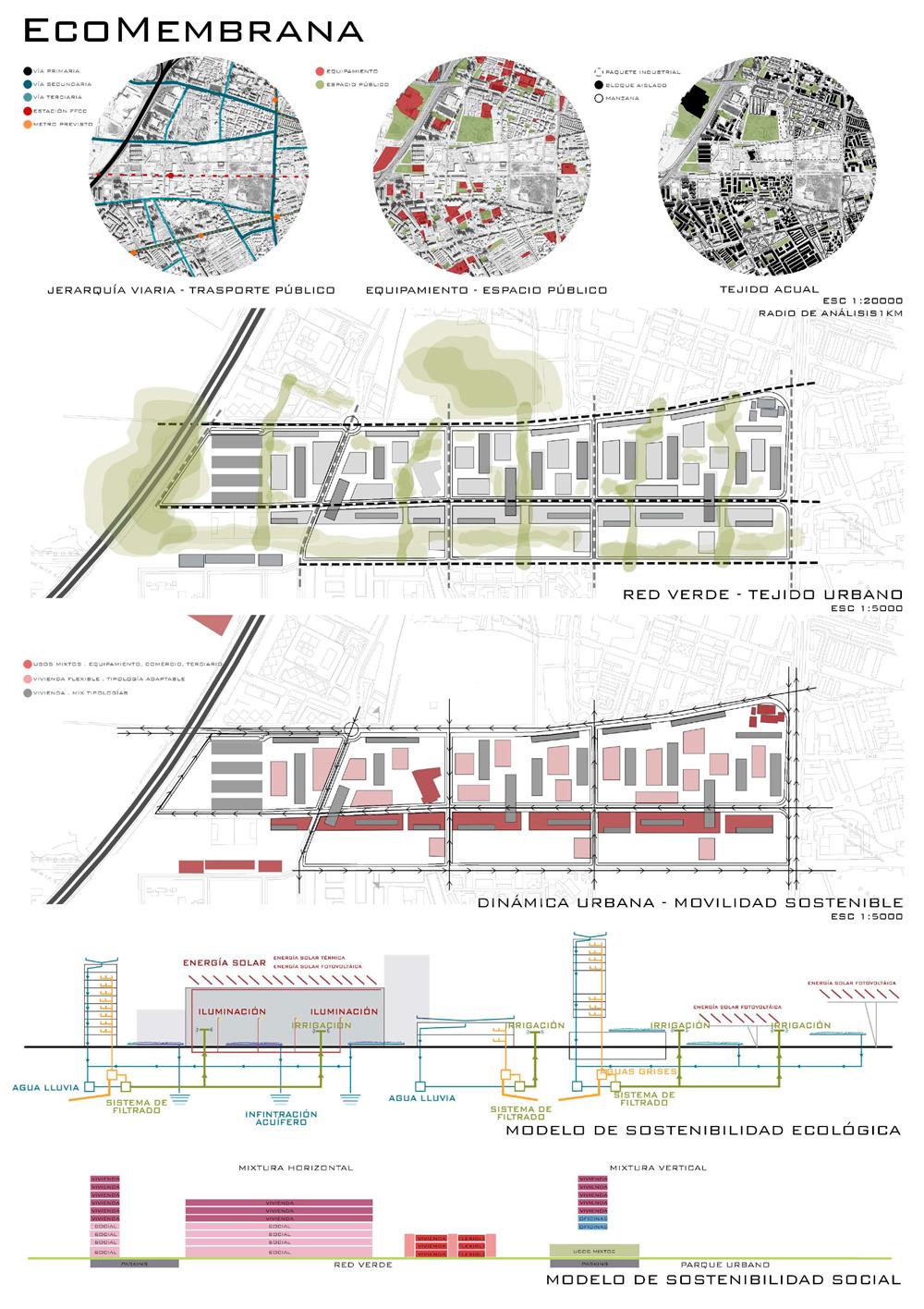
Source: COAM, https://www.coam.org/media/Default%20Files/servicios/concursos/concursos_ocam/2017_propuestas/manzana/paneles/048_eco-01.jpg
Overview
Nature-based solution
- Grey infrastructure featuring greens
- Alley or street trees and other street vegetation
- Parks and urban forests
- Pocket parks/neighbourhood green spaces
Key challenges
- Water management (SDG 6)
- Stormwater and rainfall management and storage
- Green space, habitats and biodiversity (SDG 15)
- Green space creation and/or management
- Environmental quality
- Waste management
- Regeneration, land-use and urban development
- Conversion of former industrial areas
- Promote natural styles of landscape design for urban development
- Social justice, cohesion and equity (SDG 10)
- Social interaction
- Health and well-being (SDG 3)
- Enabling opportunities for physical activity
- Creation of opportunities for recreation
- Economic development and employment (SDG 8)
- Economic development: service sectors
- Sustainable consumption and production (SDG 12)
- Sustainable production
Focus
Creation of new green areas, Strategy, plan or policy development
Project objectives
A) Understand green neighbourhoods as an opportunity to remake the urban fabric of the city, rather than as an isolated element. (ref 1)
B) Guarantee sustainable mobility, and a network with the rest of the city. (ref 1)
C) Define a new model of city in which urban nature is a key piece for the organization of the system of open-green spaces in the city of Malaga. (ref 1)
Implementation activities
- Longitudinal connectivity is improved with extension of autochthonous and shrubby tree vegetation (ref 1)
- Prioritize pedestrian access and minimize vehicular use (ref 1)
- Incorporate a network of hydrological resources, energy resources and organic waste management resources to maximize the plan’s ecological potential (ref 1)
- Management of rain and used water through an underground deposit to guarantee the reduction of water-usage and the sustainability of green spaces (ref 1)
- Incorporates new leisure activities related to sport, culture and food through a space for social exchange. (ref 1)
- Incorporate flexible spaces for productivity: lower floors with activity commercial or shop-trade type premises, production and free spaces that favor social relationships and host various activities: small market, exhibitions, festivals. (ref 1)
Main beneficiaries
- Local government/Municipality
- Citizens or community groups
Governance
Management set-up
- Government-led
Type of initiating organisation
- Local government/municipality
- Other
Participatory approaches/ community involvement
- Unknown
Details on the roles of the organisations involved in the project
City Council of Malaga (Ayuntamiento de Malaga): host of the "New ways of living- the Green Neighborhood" (Nuevos Modos de Habitar-Manzana Verde) architectural innovation contest and main backer of the project. (ref 2)
Official Association of Architects of Malaga and Madrid: collaborator in architectural innovation contest (ref 3)
European Programs Service (OMAU): promoted architectural innovation contest (ref 3)
Architects: submitted proposal for Ecomembrana design (and other designs) (ref 1-4)
Project implemented in response to ...
... an EU policy or strategy?
Unknown
... a national policy or strategy?
Unknown
... a local policy or strategy?
Yes
(PGOU de Malaga (Urban Organization Plan)- SUN-R-P.2-A, the city’s organizational and urban development plan. (ref 1,3)
The project is also supported by the Observatory of Urban Natural Environment which directs the city's Agenda 21, a document that proposes measure to convert Malaga into a sustainable city. (ref 3)
)
Financing
Total cost
More than €4,000,000
Source(s) of funding
- Public local authority budget
- Unknown
Type of funding
- Direct funding (grants, subsidies, or self-financed projects by private entities)
- Unknown
Non-financial contribution
Unknown
Impacts and Monitoring
Environmental impacts
- Environmental quality
- Improved waste management
- Water management and blue areas
- Improved stormwater management
- Green space and habitat
- Promotion of naturalistic styles of landscape design for urban development
- Increased green space area
- Other
Economic impacts
- Attraction of business and investment
Socio-cultural impacts
- Social justice and cohesion
- Improved access to urban green space
- Increased opportunities for social interaction
- Health and wellbeing
- Gain in activities for recreation and exercise
Type of reported impacts
Expected impacts, Achieved impacts
Presence of formal monitoring system
Unknown
Presence of indicators used in reporting
No evidence in public records
Presence of monitoring/ evaluation reports
No evidence in public records
Availability of a web-based monitoring tool
No evidence in public records
References
1. EcoMembrana. (2017). EcoMembrana. [Document provided].
2. Plataforma Arquitectura. (2017). Concurso ‘Nuevos Modeos de Habitar-Manzana Verde’ en Malaga, Espana. Available at: Source link [Accessed: 23 September 2020].
3. Colegio de Arquitectos de la Ciudad Autonoma de Melilla. (2017). Concurso ‘Nuevos Modeos de Habitar-Manzana Source link Available at: Source link [Accessed: 23 September 2020].
4. Colegio Oficial Arquitectos de Madrid. (2017). Desarrollo Arquitectónico Del Peri "Manzana Verde" De Málaga "Nuevos Modos De Habitar - Manzana Verde". Available at: Source link [Accessed: 23 September 2020].
2. Plataforma Arquitectura. (2017). Concurso ‘Nuevos Modeos de Habitar-Manzana Verde’ en Malaga, Espana. Available at: Source link [Accessed: 23 September 2020].
3. Colegio de Arquitectos de la Ciudad Autonoma de Melilla. (2017). Concurso ‘Nuevos Modeos de Habitar-Manzana Source link Available at: Source link [Accessed: 23 September 2020].
4. Colegio Oficial Arquitectos de Madrid. (2017). Desarrollo Arquitectónico Del Peri "Manzana Verde" De Málaga "Nuevos Modos De Habitar - Manzana Verde". Available at: Source link [Accessed: 23 September 2020].