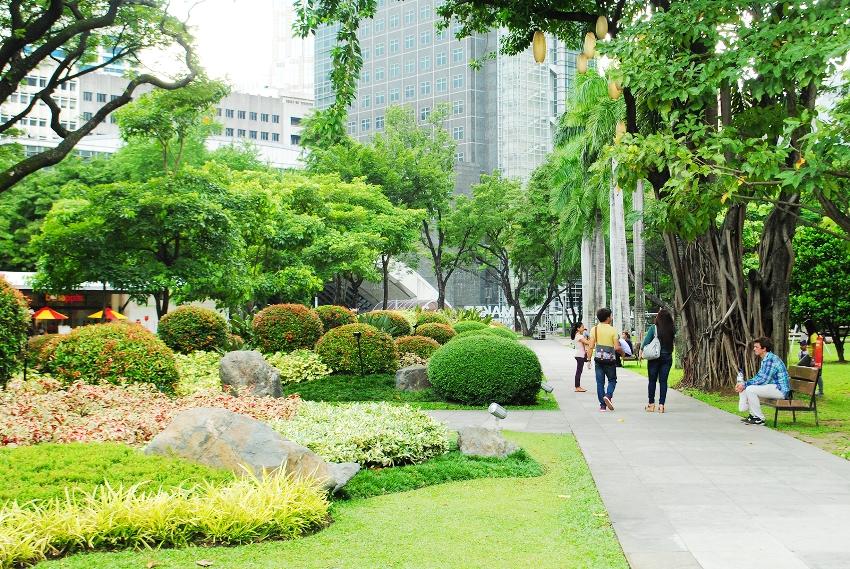
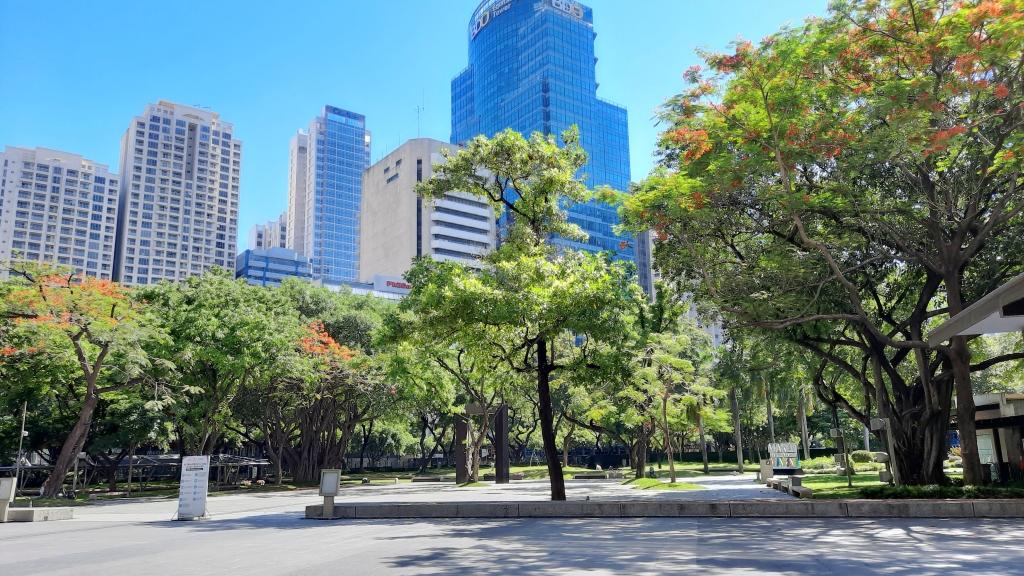
The 2-hectares public garden is located in Makati Central Business District of Metro Manila between the main arteries of Makati - Paseo de Roxas, Makati Avenue and Ayala Avenue - that form a triangle in the backyard of business towers. [2, 4]. The Garden was opened to the public in 2009 and showcases various trees and other plant species alongside numerous public artworks created by local artists [2]. The park provides habitat for hundreds of various trees of types, including rain trees, golden palms, fire trees, orange jasmines, and podocarpus. Two Filipino artists, Ovvian Castrillo-Hill and Ral Arrogante have created public art pieces scattered throughout the park [2,4]. The garden is also paved with verdant patches, providing a space for office workers to unwind and destress. In addition to serving as a place of recreation, the Ayala Triangle Gardens also hosts the yearly Festival of Lights as well as various music festivals. The Ayala Triangle Park is the first urban park to be built in Manila and the lush gardens are now considered a refuge for the residents of Makati [1,2,3].
Overview
Nature-based solution
- Parks and urban forests
- Large urban parks or forests
Key challenges
- Climate action for adaptation, resilience and mitigation (SDG 13)
- Climate change mitigation
- Environmental quality
- Air quality improvement
- Green space, habitats and biodiversity (SDG 15)
- Habitat and biodiversity conservation
- Green space creation and/or management
- Regeneration, land-use and urban development
- Promote natural styles of landscape design for urban development
- Cultural heritage and cultural diversity
- Protection of historic and cultural landscape/infrastructure
- Health and well-being (SDG 3)
- Enabling opportunities for physical activity
- Improving mental health
- Creation of opportunities for recreation
- Social justice, cohesion and equity (SDG 10)
- Social interaction
- Environmental education
Focus
Project objectives
Implementation activities
Climate-focused activities
Climate change mitigation:
- Raise public awareness of behaviours, lifestyle and cultural changes with mitigation potential
Biodiversity conservation or restoration-focused activities
Biodiversity conservation:
- Protect and enhance urban habitats
- Preserve and strengthen existing habitats and ecosystems
- Create new habitats
- Means for conservation governance
- Raise public awareness
Main beneficiaries
- Private sector/Corporate/Company
- Citizens or community groups
Governance
Management set-up
- Led by non-government actors
Type of initiating organisation
- Private sector/corporate actor/company
Participatory approaches/ community involvement
- Unknown
Details on the roles of the organisations involved in the project
Project implemented in response to ...
Financing
Total cost
Source(s) of funding
- Corporate investment
Type of funding
- Direct funding (grants, subsidies, or self-financed projects by private entities)
Non-financial contribution
Impacts and Monitoring
Environmental impacts
- Climate change
- Lowered local temperature
- Reduced emissions
- Environmental quality
- Improved air quality
- Green space and habitat
- Increased green space area
- Increased number of species present
- Restoration of derelict areas
Economic impacts
- Increased property prices
- Attraction of business and investment
Socio-cultural impacts
- Social justice and cohesion
- Improved access to urban green space
- Increased opportunities for social interaction
- Health and wellbeing
- Improved mental health
- Gain in activities for recreation and exercise
- Cultural heritage and sense of place
- Increased sense of place identity, memory and belonging
- Increased appreciation for natural spaces
- Education
- Increased awareness of NBS and their benefits
Type of reported impacts
Presence of formal monitoring system
Presence of indicators used in reporting
Presence of monitoring/ evaluation reports
Availability of a web-based monitoring tool
References
[2] Wikipedia (2022). Ayala Triangle Gardens. [online] Wikipedia. Available at: Source link [Accessed 1 Mar. 2023].
[3] Architizer (2012). Ayala Triangle Park by Cloud Architects. [online] Architizer. Available at: Source link [Accessed 1 Mar. 2023].
[4] Inquirer (2012). Ayala Triangle Gardens to be unveiled - Source link, Philippine News for Filipinos. Available at: Source link [Accessed 1 Mar. 2023].
[5] Ayala Land Inc. (2022). Ayala Triangle Tower Two | Makati City. [online] Ayala Land Offices. Available at: Source link [Accessed 1 Mar. 2023].
[6] Lara, T.T. (2009). Ayala Triangle Gardens: Makati Central Business District’s breathing space. [online] Source link. Available at: Source link [Accessed 7 Mar. 2023].