

Last updated: October 2021
It is the most extensive green roof in Lublin, designed to cover 16,700 square meters rooftop area of the shopping mall 'Castle Terraces' (Tarasy Zamkowe). Its purpose is to serve as a green recreational area for relaxation and public events, as well as an ecological solution for heat mitigation and water retention. The roof is divided into two parts: 1) an area accessible to the public with flower meadows, walking paths, viewing points from which the visitors can see Lublin’s old town 2) ‘intensive cultivation area’ with endemic trees, bushes and succulents which are not directly accessible to the public [1,2,3,8].
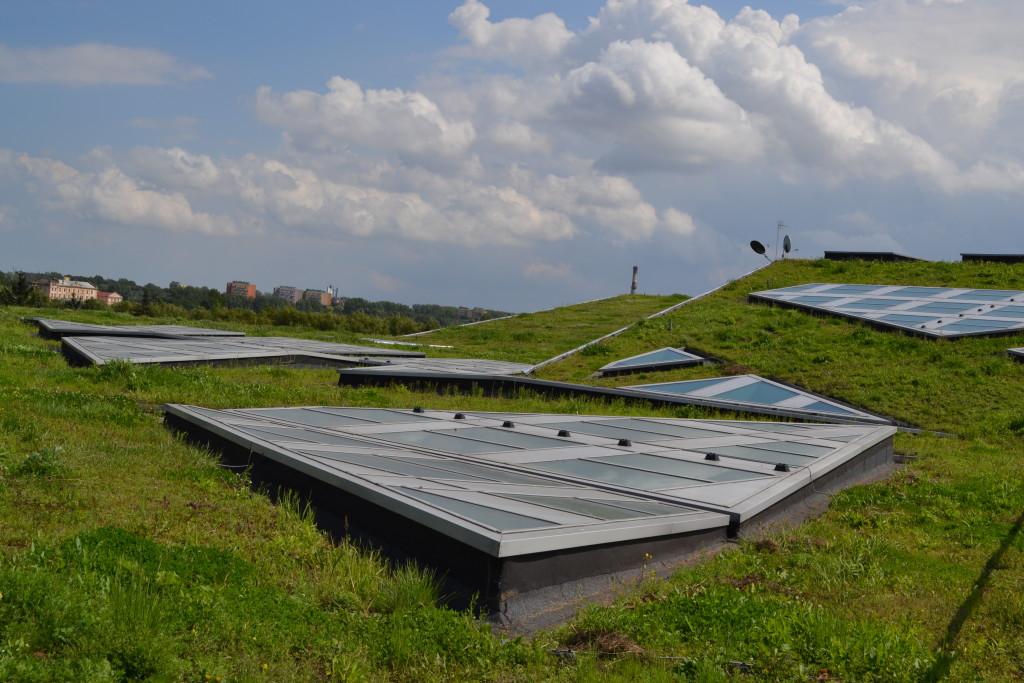
Green roof on the 'Castle Terraces' shopping mall
Source: http://zielonainfrastruktura.pl/tarasy-zamkowe-w-lublinie-ogolnodostepny-zielony-dach/
Overview
Nature-based solution
- Nature on buildings (external)
- Green roofs
- Parks and urban forests
- Pocket parks/neighbourhood green spaces
Key challenges
- Climate action for adaptation, resilience and mitigation (SDG 13)
- Climate change adaptation
- Water management (SDG 6)
- Stormwater and rainfall management and storage
- Green space, habitats and biodiversity (SDG 15)
- Green space creation and/or management
- Environmental quality
- Air quality improvement
- Health and well-being (SDG 3)
- Creation of opportunities for recreation
Focus
Creation of new green areas
Project objectives
The basic premise of the project was to create an open access, large, green space on the roof of the Castle Terraces, that would refer to the natural riverside landscape of the nearby Bystrzyca river valley and aid with the reduction of the heat island effect and help with water retention [1, 3, 8].
Implementation activities
The project introduced a green roof of the total area of 16,700 square meters – with around 5,000 square meters being accessible by the public and the other 10,000 square meters serving as an intensive cultivation area for the endemic greenery.
-The cultivation area to be established on the 15 cm thick soil substrate.
-The ‘garden parts’ of the roof to be planted on the 42cm thick soil substrate.
-The trees to be planted on the 80-140cm thick soil substrate [1,2,3].
Plants to be selected to create an endemic ecosystem of regional character.
The following Optigruen green roof products to be used for the construction of terraces:
- Optigreen Slip-Separation Foil PE 0,2mm
- Optigreen Drainage Mat FKD 10
- Optigreen Drainage Mat FKD 25
- Optigreen Filter Fibre Type 105
- Optigreen RMS 300 absorbent material
- Optigreen Kombi control boxes
- Optigreen Perforated angle type ZP 120 [1,2].
Climate-focused activities
Climate change adaptation:
- Increase or improve urban vegetation cover to help reduce outdoor temperature
- Implement green walls or roofs to lower indoor temperature and provide insulation
Main beneficiaries
- Citizens or community groups
Governance
Management set-up
- Led by non-government actors
Type of initiating organisation
- Private sector/corporate actor/company
Participatory approaches/ community involvement
- Unknown
Details on the roles of the organisations involved in the project
The IMMOFINANZ Group from Austria is the investor of the project. The author of the project's architectural design was the Polish company 'Stelmach i Partnerzy Sp. z o.o.' and the general contractor is 'Warbud SA' [5].
Project implemented in response to ...
... an EU policy or strategy?
Unknown
... a national policy or strategy?
Unknown
... a local policy or strategy?
Unknown
Financing
Total cost
More than €4,000,000
Source(s) of funding
- Corporate investment
Type of funding
- Unknown
Non-financial contribution
Unknown
Impacts and Monitoring
Environmental impacts
- Climate change
- Lowered local temperature
- Environmental quality
- Improved air quality
- Green space and habitat
- Promotion of naturalistic styles of landscape design for urban development
- Increased green space area
- Reduced biodiversity loss
Economic impacts
- Unknown
Socio-cultural impacts
- Social justice and cohesion
- Improved access to urban green space
- Health and wellbeing
- Gain in activities for recreation and exercise
- Cultural heritage and sense of place
- Increased appreciation for natural spaces
Type of reported impacts
Achieved impacts
Presence of formal monitoring system
Unknown
Presence of indicators used in reporting
No evidence in public records
Presence of monitoring/ evaluation reports
No evidence in public records
Availability of a web-based monitoring tool
No evidence in public records
References
1. Stankiewicz, M., 'Sample projects of green roofs and green walls in Polish municipalities. Overview of financing Source link realizacje zielonych dachów i żyjących ścian w polskich gminach. Przegląd źródeł Source link, DAFA, Source link (Accessed: 04 August 2020).
2. 'Castle Terraces in Lublin. Public green roof' ('Tarasy Zamkowe w Lublinie ogólnodostępny zielony dach'), Source link, Source link (Accessed: 04 August 2020).
3. 'Gallery Castle Terraces in Lublin' ('Galeria Zamek (Tarasy Zamkowe) w Lublinie'), Source link, Source link (Accessed: 04 August 2020).
4. 'Unique, green roof in the Castle Terraces' ('Unikatowy, zielony dach Tarasów Zamkowych'), Source link, Source link (Accessed 10 July 2017). Website not available in 2020.
5. 'Casle Terraces shopping Mall in Lublin' ('Centrum handlowe Tarasy Zamkowe w Lublinie'), Source link, Source link (Accessed: 04 August 2020).
6. 'The shopping mall Castle Terraces will be ready in Spring 2015' ('Centrum handlowe Tarasy Zamkowe w Lublinie będzie gotowe wiosną 2015 roku'), Source link, Source link (Accessed: 04 August 2020).
7. 'Shopping mall next to the monument' ('Centrum handlowe obok zabytku. Tarasy Zamkowe w Lublinie'), Source link, Source link (Accessed: 04 August 2020).
8. Mazus, A., (2015), 'Gardens on the roofs: non-expensive, effective and ecological' ('Ogrody na dachach: niedrogo, efektownie, ekologicznie') Source link, Source link (Accessed: 04 August 2020).
2. 'Castle Terraces in Lublin. Public green roof' ('Tarasy Zamkowe w Lublinie ogólnodostępny zielony dach'), Source link, Source link (Accessed: 04 August 2020).
3. 'Gallery Castle Terraces in Lublin' ('Galeria Zamek (Tarasy Zamkowe) w Lublinie'), Source link, Source link (Accessed: 04 August 2020).
4. 'Unique, green roof in the Castle Terraces' ('Unikatowy, zielony dach Tarasów Zamkowych'), Source link, Source link (Accessed 10 July 2017). Website not available in 2020.
5. 'Casle Terraces shopping Mall in Lublin' ('Centrum handlowe Tarasy Zamkowe w Lublinie'), Source link, Source link (Accessed: 04 August 2020).
6. 'The shopping mall Castle Terraces will be ready in Spring 2015' ('Centrum handlowe Tarasy Zamkowe w Lublinie będzie gotowe wiosną 2015 roku'), Source link, Source link (Accessed: 04 August 2020).
7. 'Shopping mall next to the monument' ('Centrum handlowe obok zabytku. Tarasy Zamkowe w Lublinie'), Source link, Source link (Accessed: 04 August 2020).
8. Mazus, A., (2015), 'Gardens on the roofs: non-expensive, effective and ecological' ('Ogrody na dachach: niedrogo, efektownie, ekologicznie') Source link, Source link (Accessed: 04 August 2020).