

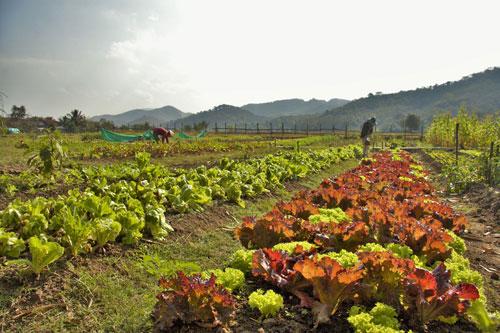
In 2005, local farmers in the sub-urban area of Luang Prabang combined their lands and founded The Living Land Farm, a rice farming community that runs an organic farm and an educational centre. The farm comprises of rice fields, vegetable gardens, homestay, and a restaurant. The aim of the farm is to preserve traditional rice-growing techniques, practice organic farming while also adopting new ways of grain selection and planting, and share rice farming knowledge with others. The products from the farm have been used in the local restaurant and are distributed to hotels and other restaurants in Luang Prabang city. The farm also serves as a training site for students of the Northern College of Agriculture and it offers ‘Rice Experience’ package for anyone who would like to learn about rice growing and the local Laos culture. The homestay and restaurant are run by local people of the village nearby and they are open to the public. The farm supports various community projects, such as village improvement and teaching English for local children. (Ref. 1,2,3)
Overview
Nature-based solution
- Community gardens and allotments
- Horticulture
Key challenges
- Environmental quality
- Soil quality improvement
- Water management (SDG 6)
- Flood protection
- Cultural heritage and cultural diversity
- Promotion of cultural diversity
- Preservation of historic traditions
- Health and well-being (SDG 3)
- Creation of opportunities for recreation
- Inclusive and effective governance (SDG 16)
- Effective management
- Social justice, cohesion and equity (SDG 10)
- Social cohesion
- Social interaction
- Environmental education
- Economic development and employment (SDG 8)
- Economic development: agriculture
- Tourism support
- Employment/job creation
Focus
Project objectives
Implementation activities
Main beneficiaries
- Citizens or community groups
- Marginalized groups: Elderly people, Socio-economically disadvantaged populations (e.g. low-income households, unemployed), People with functional diversities
- Food producers and cultivators (i.e. farmers, gardeners)
Governance
Management set-up
- Led by non-government actors
Type of initiating organisation
- Citizens or community group
Participatory approaches/ community involvement
- Dissemination of information and education
Details on the roles of the organisations involved in the project
Project implemented in response to ...
Financing
Total cost
Source(s) of funding
- Private funding by citizens
Type of funding
- Direct funding (grants, subsidies, or self-financed projects by private entities)
Non-financial contribution
Impacts and Monitoring
Environmental impacts
- Environmental quality
- Improved soil quality
- Water management and blue areas
- Increased protection against flooding
- Green space and habitat
- Increased number of species present
Economic impacts
- Increase of green jobs (e.g. paid employment positions)
- More sustainable tourism
- Stimulate development in deprived areas
- Increase in agricultural production (for profit or not)
- Generation of income from NBS
Socio-cultural impacts
- Social justice and cohesion
- Improved social cohesion
- Fair distribution of social, environmental and economic benefits of the NBS project
- Increased visibility and opportunity for marginalised groups or indigenous peoples
- Increased opportunities for social interaction
- Increased involvement of locals in the management of green spaces
- Increased access to healthy/affordable food
- Increased sustainability of agriculture practices
- Cultural heritage and sense of place
- Protection of historic and cultural landscape / infrastructure
- Education
- Increased support for education and scientific research
- Increased knowledge of locals about local nature
Type of reported impacts
Presence of formal monitoring system
Presence of indicators used in reporting
Presence of monitoring/ evaluation reports
Availability of a web-based monitoring tool
References
2. Experience Travel Group (No date), Living Land Companys Rice Farm Experience, Available at Source link (Accessed 27-03-2023)
3. Explore Laos (2013), The Living Land Farm a community Business in Luang Prabang, Available at Source link (Accessed 30-03-2023)
4. Travel Authentic Asia (No date), The Living Land Farm, Available at Source link (Accessed 31-03-2023)
5. Tripadvisor, The Living Land Farm (No date), Available at Source link (Accessed 01-014-2023)
6. Good Food Revolution (2014), Living Land in Laos, Available at Source link (Accessed 01-04-2023)
7. Career rappers (2020), How travel sparks curiosity: learning the 14-step rice farming process in Laos, Available at Source link (Accessed 10-04-2023)
8. British Embassy Vientiane (2013), Ambassador visits British-supported organic farm and community enterprise in Luang Prabang, Available at Source link (Accessed 10-04-2023)
9. Khiri Travel (2022), A Morning at Living Land Farm, Luang Prabang, Available at Source link (Accessed 10-04-2023)

