

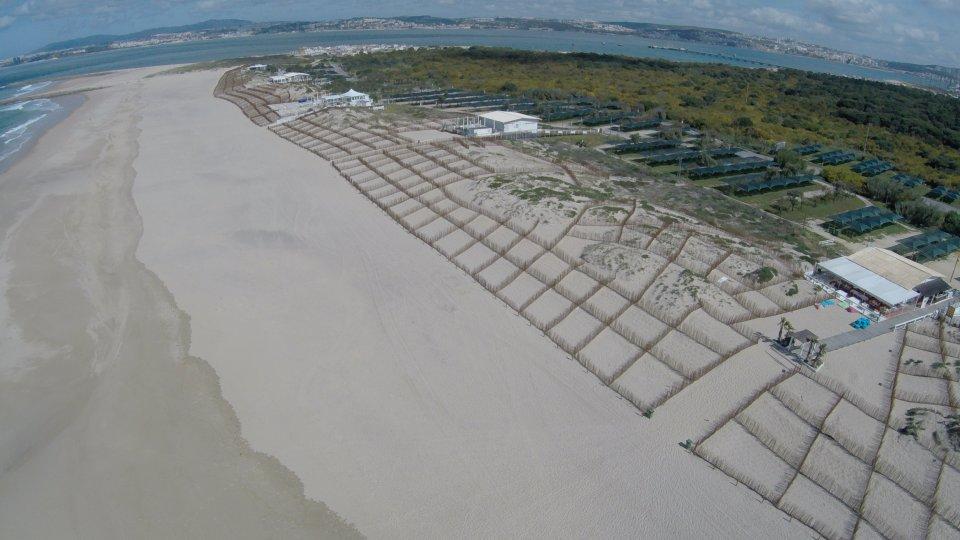
The ReDuna project, initiated in 2014, focuses on restoring the sand dune ecosystem in Costa da Caparica (Almada) in response to severe coastal erosion exacerbated by sea-level rise and winter storms. It aims to strengthen the resilience of dunes to environmental pressures while restoring ecological balance. Actions include sand nourishment, the installation of willow sand fences, and the planting of 100,000 native species. Community engagement was a key factor, involving local residents, NGOs, and schools in maintenance and replanting efforts. The project has been successful, with significant biodiversity recovery, establishing deep-rooted vegetation, and stabilising the dunes. Ongoing monitoring and adaptive management are central to its strategy, ensuring long-term sustainability. The ReDuna project serves as a replicable model for similar coastal protection initiatives globally (Ref 1).
Overview
Nature-based solution
- Blue infrastructure
- Coastlines
- Other
Key challenges
- Climate action for adaptation, resilience and mitigation (SDG 13)
- Climate change adaptation
- Coastal resilience and marine protection (SDG 14)
- Coastal protection / hazard mitigation
- Marine and coastal biodiversity protection
- Green space, habitats and biodiversity (SDG 15)
- Habitat and biodiversity restoration
Principal problems in Functional Urban Area (FUA)
- Climate-Related Hazards
- Coastal hazards (e.g. erosion, flooding)
- Sea level rise
Key priorities
Focus
Project objectives
Implementation activities
Climate-focused activities
Climate change adaptation:
- Restore mangroves, marshes, reefs and wetlands to dissipate the effects of storms and floodwaters
- Restore sediment supply to coastal zone
- Protect and restore coastal ecosystems, to address loss of land and livelihoods, due to rising sea levels
Biodiversity conservation or restoration-focused activities
Biodiversity restoration:
- Rehabilitate and restore damaged or destroyed ecosystems
- Restore species (native, endangered, or unspecified)
- Restore native species
- Clear and control invasive alien species
Main beneficiaries
- Citizens or community groups
- Coastal-dependent communities (e.g. small-scale fishers, coastal farmers, and indigenous peoples)
- Young people and children
Governance
Management set-up
- Co-governance with government and non-government actors
Type of initiating organisation
- Local government/municipality
- Researchers/university
Participatory approaches/ community involvement
- Deliberative decision-making processes (e.g., consensus building, deliberative polling)
- Dissemination of information and education
- Consultation (e.g. workshop, surveys, community meetings, town halls)
- Joint implementation (e.g. tree planting)
Details on the roles of the organisations involved in the project
Project implemented in response to ...
Type of enablers
Financing
Total cost
Source(s) of funding
- EU funds
- Multilateral funds/international funding
- Other
Type of funding
- Direct funding (grants, subsidies, or self-financed projects by private entities)
Non-financial contribution
- Provision of labour
- Provision of expertise
- Public authorities (e.g. land, utility services)
- Citizens (e.g. volunteering)
Impacts and Monitoring
Environmental impacts
- Climate change
- Increased protection against sea level rise
- Expected increased protection against sea level rise
- Water management and blue areas
- Increased protection against flooding
- Achieved increased protection against flooding
- Enhanced protection and restoration of coastal and marine ecosystems
- Achieved enhanced protection and restoration of coastal and marine ecosystems
- Green space and habitat
- Increased green space area
- Achieved increased green space area
- Increased number of species present
- Achieved increased number of species present
Economic impacts
- More sustainable tourism
- Achieved more sustainable tourism
Socio-cultural impacts
- Social justice and cohesion
- Improved access to urban green space
- Achieved improved access to urban green space
- Education
- Increased support for education and scientific research
- Achieved increased support for education and scientific research
- Increased knowledge of locals about local nature
- Expected increased knowledge of locals about local nature
Type of reported impacts
Presence of formal monitoring system
Presence of indicators used in reporting
Presence of monitoring/ evaluation reports
Availability of a web-based monitoring tool
Potential risks of implementation and trade-offs
References
 Information about this nature-based solution was collected as part of the Naturescapes project funded by the European Union under Grant Agreement No 101084341.