

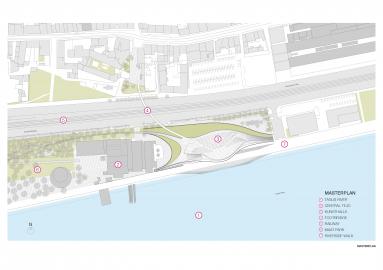
The Museum of Art, Architecture and Technology (MAAT) features a 2,920-square-meter green roof (Ref 8). Located on the riverfront of the historic Belém area in Lisbon, MAAT, inaugurated in 2017, comprises the repurposing of a thermoelectric power station built in 1908 (MAAT Central), a contemporary museum building (MAAT Gallery), connected by a garden that stretches along the Tagus River (MAAT Garden) (Ref. 3). Blending structure into landscape, MAAT was designed to allow visitors to walk over and under its building, in which "the roof becomes an outdoor room, a physical and conceptual reconnection of the river to the city’s heart – where visitors can turn away from the river and enjoy the vista of the cityscape, and at night, watch a film with Lisbon as a backdrop sitting on the bank of steps" (Ref. 1). This roof, part of AL_A’s (design company) architectural vision, offers panoramic views of Lisbon and the Tagus River (Ref 1), and complementing the green roof is a 225-meter-long garden designed by Vladimir Djurovic, which connects MAAT to the Central Tejo power station. This garden features diverse vegetation (Ref 2, Ref 3, Ref 4).

Overview
Nature-based solution
- Nature on buildings (external)
- Green roofs
- Parks and urban forests
- Pocket parks/neighbourhood green spaces
Key challenges
- Climate action for adaptation, resilience and mitigation (SDG 13)
- Climate change adaptation
- Green space, habitats and biodiversity (SDG 15)
- Green space creation and/or management
- Regeneration, land-use and urban development
- Promote natural styles of landscape design for urban development
- Cultural heritage and cultural diversity
- Protection of historic and cultural landscape/infrastructure
- Health and well-being (SDG 3)
- Creation of opportunities for recreation
Principal problems in Functional Urban Area (FUA)
- Land use and Socio-economic change
- Rapid urbanization
Key priorities
Focus
Project objectives
Implementation activities
Climate-focused activities
Climate change adaptation:
- Implement green walls or roofs to lower indoor temperature and provide insulation
Main beneficiaries
- Citizens or community groups
Governance
Management set-up
- Led by non-government actors
Type of initiating organisation
- Non-government organisation/civil society
Participatory approaches/ community involvement
- The project didn't involve any form of stakeholder participatory activities
Details on the roles of the organisations involved in the project
Project implemented in response to ...
Type of enablers
Financing
Total cost
Source(s) of funding
- Corporate investment
Type of funding
- Direct funding (grants, subsidies, or self-financed projects by private entities)
Non-financial contribution
Impacts and Monitoring
Environmental impacts
- Climate change
- Energy efficiency improvements
- Expected energy efficiency improvements
- Environmental quality
- Reduced noise exposure
- Expected reduced noise exposure
- Green space and habitat
- Increased green space area
- Achieved increased green space area
- Increased number of species present
- Achieved increased number of species present
Economic impacts
- Unknown
Socio-cultural impacts
- Health and wellbeing
- Gain in activities for recreation and exercise
- Achieved gain in activities for recreation and exercise
- Cultural heritage and sense of place
- Promotion of cultural diversity
- Expected promotion of cultural diversity
Type of reported impacts
Presence of formal monitoring system
Presence of indicators used in reporting
Presence of monitoring/ evaluation reports
Availability of a web-based monitoring tool
Potential risks of implementation and trade-offs
References

 Information about this nature-based solution was collected as part of the Naturescapes project funded by the European Union under Grant Agreement No 101084341.