

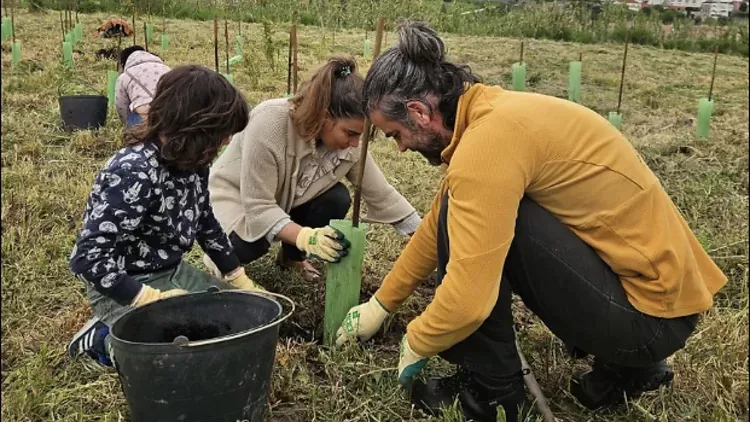
The Vale da Ameixoeira Urban Park is a key part of Lisbon's Peripheral Green Corridor, covering 20 hectares and aiming to enhance the city's ecological and social resilience. It includes pedestrian and cycling paths, rest areas, picnic spots, skate parks, and playgrounds, enabling recreational activities while providing scenic views (Ref 1). The park has undergone several requalification initiatives, including the tree planting project in 2018, which saw the community and municipal bodies plant over 130 native trees and shrubs, promoting biodiversity and environmental sustainability (Ref 3). Additionally, the park supports community-based vegetable gardens, integrating horticultural practices to promote local engagement and foster social inclusion (Ref 3). More recently, as part of the Life Lungs project, another 600 drought-resistant trees were planted to mitigate climate change impacts, such as urban heating and water scarcity (Ref 5). The Lisbon Participatory Budget funds the project and reflects the community’s demand for sustainable urban development (Ref 2).

Overview
Nature-based solution
- Community gardens and allotments
- Community gardens
- Parks and urban forests
- Large urban parks or forests
Key challenges
- Climate action for adaptation, resilience and mitigation (SDG 13)
- Climate change adaptation
- Environmental quality
- Air quality improvement
- Green space, habitats and biodiversity (SDG 15)
- Green space creation and/or management
- Habitat and biodiversity restoration
- Health and well-being (SDG 3)
- Creation of opportunities for recreation
- Social justice, cohesion and equity (SDG 10)
- Environmental and climate justice
- Sense of community and community engagement
- Sustainable consumption and production (SDG 12)
- Sustainable production
Principal problems in Functional Urban Area (FUA)
- Climate-Related Hazards
- Drought
- Heat stress & Extreme temperatures
- Environmental Degradation
- Deforestation and forest degradation
- Land use and Socio-economic change
- Rapid urbanization
Key priorities
Focus
Project objectives
Implementation activities
Climate-focused activities
Climate change adaptation:
- Increase urban vegetation cover to reduce urban heat island effect
- Increase the use of or more efficient agroforestry practices (e.g. soil moisture, reduce evaporation) or drought-resistant species for agriculture
- Improved agricultural practices for improved food security and prevention of food scarcity
- Other
Biodiversity conservation or restoration-focused activities
Biodiversity restoration:
- Restore species (native, endangered, or unspecified)
- Restore native species
- Restore valued species
Main beneficiaries
- Citizens or community groups
Governance
Management set-up
- Government-led
Type of initiating organisation
- Local government/municipality
- District/neighbourhood association
Participatory approaches/ community involvement
- Joint implementation (e.g. tree planting)
Details on the roles of the organisations involved in the project
Project implemented in response to ...
Type of enablers
Financing
Total cost
Source(s) of funding
- Public local authority budget
Type of funding
- Earmarked public budget
Non-financial contribution
- Provision of labour
- Citizens (e.g. volunteering)
Impacts and Monitoring
Environmental impacts
- Climate change
- Lowered local temperature
- Expected lowered local temperature
- Water management and blue areas
- Reduced risk of damages by drought
- Expected reduced risk of damages by drought
- Green space and habitat
- Reduced biodiversity loss
- Achieved reduced biodiversity loss
- Increased number of species present
- Achieved increased number of species present
Economic impacts
- Unknown
Socio-cultural impacts
- Health and wellbeing
- Gain in activities for recreation and exercise
- Expected gain in activities for recreation and exercise
- Cultural heritage and sense of place
- Improvement in people’s connection to nature
- Expected improvement in people’s connection to nature
Type of reported impacts
Presence of formal monitoring system
Presence of indicators used in reporting
Presence of monitoring/ evaluation reports
Availability of a web-based monitoring tool
Potential risks of implementation and trade-offs
References
 Information about this nature-based solution was collected as part of the Naturescapes project funded by the European Union under Grant Agreement No 101084341.