

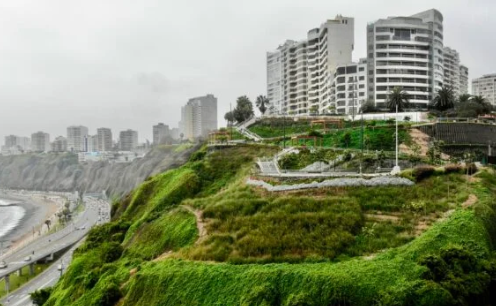
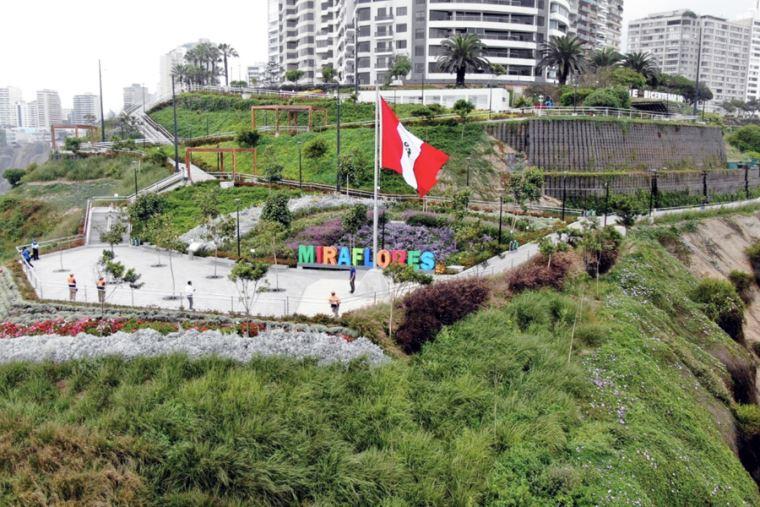
The Miraflores Bicentennial Park has been built on the Malecón de la Reserva and the Quebrada de Armendáriz. It was inaugurated in June 2022 as one of the created projects within the framework of the commemorations of the 200 years of Independence celebrations (1). It is considered a new green lung of Lima (2), as it has a green area of 30,400 square metres and stands on one of the cliffs of the Costa Verde (1). It has a system of terraces that replicates the construction model of the Incas, which has made it possible to additionally reinforce the soil and the slopes with the use of retaining walls up to 10 metres high, with horizontal geogrids and vertical geocells (1, 2). It was structured on a stabilised slope in order to mitigate the risk of landslides (4), and an irrigation system was implemented to stabilise the soil (4). This space was built as a biodiversity garden with more than 160,000 xerophilic coastal species with low water consumption, 300 trees and 80 palm trees. It also offers places for tourism, such as viewpoints and squares, where cultural events, open-air activities and rest areas are held (1). It also aims to connect aspects of landscape conservation, preservation of biodiversity in the city, and the construction of a cultural landscape in which human action is complementary and friendly to the natural environment (9). Finally, it seeks to contribute to the reduction of the municipality's carbon footprint by reducing the harmful effects of urban expansion on the Lima cliff ecosystem, such as deforestation, water pollution and loss of biodiversity (9).
Overview
Nature-based solution
- Blue infrastructure
- Coastlines
- Parks and urban forests
- Large urban parks or forests
Key challenges
- Climate action for adaptation, resilience and mitigation (SDG 13)
- Climate change adaptation
- Coastal resilience and marine protection (SDG 14)
- Coastal protection / hazard mitigation
- Environmental quality
- Air quality improvement
- Green space, habitats and biodiversity (SDG 15)
- Green space creation and/or management
- Habitat and biodiversity conservation
- Cultural heritage and cultural diversity
- Promotion of cultural diversity
- Health and well-being (SDG 3)
- Creation of opportunities for recreation
- Enabling opportunities for physical activity
- Improving physical health
- Social justice, cohesion and equity (SDG 10)
- Social interaction
- Sense of community and community engagement
- Economic development and employment (SDG 8)
- Tourism support
Principal problems in Functional Urban Area (FUA)
- Climate-Related Hazards
- Coastal hazards (e.g. erosion, flooding)
- Environmental Degradation
- Biodiversity loss
- Deforestation and forest degradation
- Poor water quality
- Health, Well-being and Social cohesion
- Disconnection from nature
Key priorities
Focus
Project objectives
Implementation activities
Climate-focused activities
Climate change adaptation:
- Restore and protect forests for soil stabilisation and prevention of landslides
Biodiversity conservation or restoration-focused activities
Biodiversity conservation:
- Protect and enhance urban habitats
- Create new habitats
- Preserve and strengthen habitat connectivity
- Protect species
- Undertake specific measures to protect species
- Undertake specific measures to protect native species
- Undertake specific measures to protect valued species
Main beneficiaries
- Local government/Municipality
- Citizens or community groups
- Marginalized groups: People with functional diversities
- Other
Governance
Management set-up
- Government-led
Type of initiating organisation
- National government
Participatory approaches/ community involvement
- Unknown
Details on the roles of the organisations involved in the project
Project implemented in response to ...
Type of enablers
Financing
Total cost
Source(s) of funding
- Public local authority budget
- Public national budget
Type of funding
- Earmarked public budget
- Direct funding (grants, subsidies, or self-financed projects by private entities)
Non-financial contribution
Impacts and Monitoring
Environmental impacts
- Climate change
- Improved resilience against landslides
- Expected improved resilience against landslides
- Water management and blue areas
- Enhanced protection and restoration of coastal and marine ecosystems
- Expected enhanced protection and restoration of coastal and marine ecosystems
- Green space and habitat
- Increased green space area
- Achieved increased green space area
- Reduced biodiversity loss
- Expected reduced biodiversity loss
- Increased number of species present
- Achieved increased number of species present
Economic impacts
- More sustainable tourism
- Achieved more sustainable tourism
- Other
Socio-cultural impacts
- Social justice and cohesion
- Improved access to urban green space
- Achieved improved access to urban green space
- Health and wellbeing
- Gain in activities for recreation and exercise
- Expected gain in activities for recreation and exercise
- Improved physical health
- Expected improved physical health
- Cultural heritage and sense of place
- Improvement in people’s connection to nature
- Expected improvement in people’s connection to nature
- Increased sense of place identity, memory and belonging
- Achieved increased sense of place identity, memory and belonging
- Increased appreciation for natural spaces
- Expected increased appreciation for natural spaces
Type of reported impacts
Presence of formal monitoring system
Presence of indicators used in reporting
Presence of monitoring/ evaluation reports
Availability of a web-based monitoring tool
Potential risks of implementation and trade-offs
References

 Information about this nature-based solution was collected as part of the Naturescapes project funded by the European Union under Grant Agreement No 101084341.