

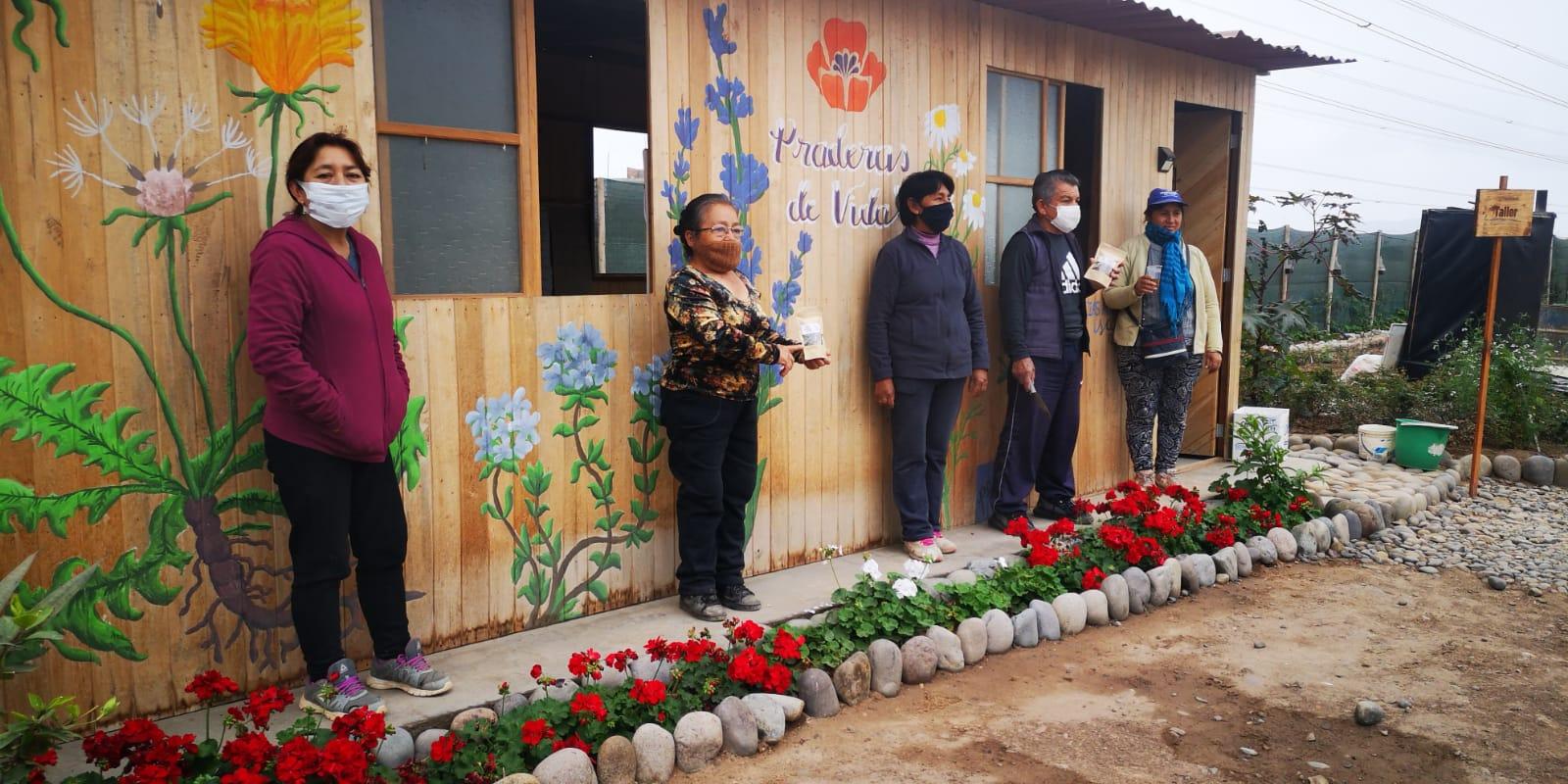
The Praderas de Vida garden is an initiative to transform a former rubbish dump into a source of employment and empowerment for the residents of the Praderas de San Juan de Miraflores Human Settlement (1). This agroecological community garden was developed as part of ISA REP's Sustainable Easements programme (13), located in the easement area of Peru's energy network, and it has collaboration efforts with KUNAN, Misha Rastrera, and La Muyita, brings together twelve female heads of households who cultivate, harvest, and process a variety of medicinal plants that have aromatic, antiseptic, and relaxing properties (2, 3). Beyond agricultural production, the garden has become a hub for emotional and economic support, fostering a connection with nature through plant care and interaction with the local ecosystem (3). It has also led to the establishment of a social enterprise, "Praderas de Vida," allowing women to participate in agroecological fairs to market the products derived from the medicinal plants grown in the garden (3). The garden has evolved into a space for learning and community collaboration, promoting the importance of sustainability and biodiversity conservation (6).
Overview
Nature-based solution
- Community gardens and allotments
- Community gardens
Key challenges
- Green space, habitats and biodiversity (SDG 15)
- Green space creation and/or management
- Regeneration, land-use and urban development
- Conversion of former industrial areas
- Promote natural styles of landscape design for urban development
- Inclusive and effective governance (SDG 16)
- Inclusive governance
- Social justice, cohesion and equity (SDG 10)
- Social justice and equity
- Social interaction
- Sense of community and community engagement
- Economic development and employment (SDG 8)
- Economic development: agriculture
- Sustainable consumption and production (SDG 12)
- Sustainable production
- Food scarcity / security
Principal problems in Functional Urban Area (FUA)
- Land use and Socio-economic change
- Limited economic opportunities and local livelihoods
- Health, Well-being and Social cohesion
- Insecurity in public spaces
- Resource Scarcity and Competition
- Food insecurity due to disruptions in food production and distribution
Key priorities
Focus
Project objectives
Implementation activities
Main beneficiaries
- Citizens or community groups
- Marginalized groups: Elderly people, Women, Socio-economically disadvantaged populations (e.g. low-income households, unemployed)
Governance
Management set-up
- Led by non-government actors
Type of initiating organisation
- Citizens or community group
- Private sector/corporate actor/company
Participatory approaches/ community involvement
- Dissemination of information and education
- Consultation (e.g. workshop, surveys, community meetings, town halls)
- Joint implementation (e.g. tree planting)
Details on the roles of the organisations involved in the project
Project implemented in response to ...
Type of enablers
Financing
Total cost
Source(s) of funding
- Corporate investment
Type of funding
- Direct funding (grants, subsidies, or self-financed projects by private entities)
- Donations
Non-financial contribution
- Provision of land
- Provision of goods
- Provision of labour
- Provision of expertise
- Citizens (e.g. volunteering)
- Private sector (businesses, financial institution)
Impacts and Monitoring
Environmental impacts
- Green space and habitat
- Increased green space area
- Achieved increased green space area
- Increased conversion of degraded land or soil
- Achieved increased conversion of degraded land or soil
- Enhanced support of pollination
- Achieved enhanced support of pollination
- Restoration of derelict areas
- Achieved restoration of derelict areas
Economic impacts
- Generation of other type of work opportunities (e.g. voluntary, work for rehabilitation)
- Achieved generation of other type of work opportunities (e.g. voluntary, work for rehabilitation)
- Increase in agricultural production (for profit or not)
- Achieved increase in agricultural production (for profit or not)
- Generation of income from NBS
- Achieved generation of income from NBS
Socio-cultural impacts
- Social justice and cohesion
- Increased involvement of locals in the management of green spaces
- Achieved increased involvement of locals in the management of green spaces
- Increased access to healthy/affordable food
- Achieved increased access to healthy/affordable food
- Increased sustainability of agriculture practices
- Achieved increased sustainability of agriculture practices
- Health and wellbeing
- Gain in activities for recreation and exercise
- Achieved gain in activities for recreation and exercise
- Improved mental health
- Achieved improved mental health
- Enhanced cognitive restoration, relaxation and stress relief
- Achieved enhanced cognitive restoration, relaxation and stress relief
- Cultural heritage and sense of place
- Improvement in people’s connection to nature
- Achieved improvement in people’s connection to nature
- Education
- Increased knowledge of locals about local nature
- Achieved increased knowledge of locals about local nature
- Increased awareness of NBS and their benefits
- Achieved increased awareness of NBS and their benefits
- Safety
- Decreased crime rates
- Achieved decreased crime rates
Type of reported impacts
Presence of formal monitoring system
Presence of indicators used in reporting
Presence of monitoring/ evaluation reports
Availability of a web-based monitoring tool
Potential risks of implementation and trade-offs
References
 Information about this nature-based solution was collected as part of the Naturescapes project funded by the European Union under Grant Agreement No 101084341.