

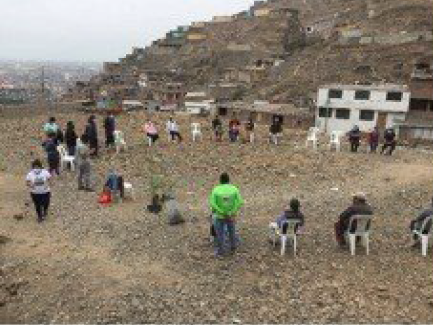
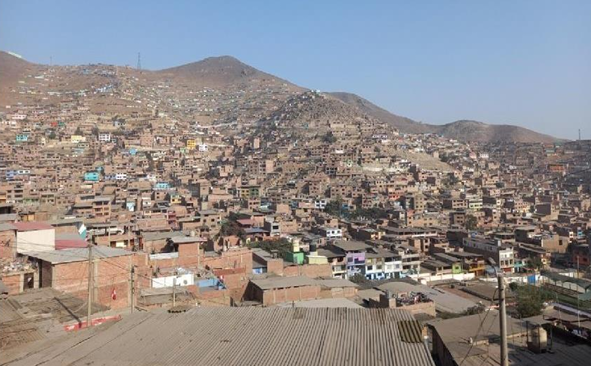
The Cinturón Verde de Independencia initiative is a pilot intervention that seeks to plant an urban forest in the lower middle-class district of Independencia (1) in the northern part of the urban territory (3). Here, 19% of the population lives in high-risk conditions, settled on steep slopes, and threatened by landslides (3). It is part of a broader planning strategy that involves proposals engaging different levels of government (4). This project seeks to afforest the district's hillsides to improve the environment, reduce air pollution, improve the quality of life of its inhabitants, manage waste, regulate shade, control erosion, increase wild biodiversity, and provide spaces for environmental education (2). The Independence Green Belt is linked to a wide range of plans, projects, and decrees that have been developed by actors at different levels of government since 2016 (4). It works hand in hand with the EBA Lomas programme and seeks to create a green belt along the Lomas-city interface, which acts as a buffer zone for this sensitive ecosystem and creates a protective boundary against the expansion of irregular human settlements while providing a space for environmental awareness (2). This program was developed by a consortium of multiple private, public, national, and international parties with strong community support (3). In two phases, an urban forest park of 4,800 of native trees irrigated with treated wastewater has been planted. During the first phase, PREDES planted 3,300 trees with USAID support in 2015, and another 1,500 were recently planted by PERIFERIA (consultants) (3). The Independencia Green Belt occupies the hill areas of the district of the same name and relates to a possible metropolitan-scale buffer belt. Its boundaries take advantage of the seven Sustainable Ecotourism Forest Parks (PFES) in the District Municipality of Independencia (MDI), as well as 115 hectares of the Amancaes Lomas (4). It aims to conserve 400 hectares (4).

Overview
Nature-based solution
- Grey infrastructure featuring greens
- House gardens
- Parks and urban forests
- Green corridors and green belts
Key challenges
- Climate action for adaptation, resilience and mitigation (SDG 13)
- Climate change adaptation
- Climate change mitigation
- Environmental quality
- Air quality improvement
- Green space, habitats and biodiversity (SDG 15)
- Green space creation and/or management
- Habitat and biodiversity restoration
- Regeneration, land-use and urban development
- Regulation of built environment
- Rewilding
- Landslides reduction
- Health and well-being (SDG 3)
- Creation of opportunities for recreation
- Inclusive and effective governance (SDG 16)
- Disaster-risk reduction
- Economic development and employment (SDG 8)
- Tourism support
- Sustainable consumption and production (SDG 12)
- Food scarcity / security
Principal problems in Functional Urban Area (FUA)
- Climate-Related Hazards
- Landslides & mudslides
- Environmental Degradation
- Deforestation and forest degradation
- Air pollution
- Land use and Socio-economic change
- Limited economic opportunities and local livelihoods
- Rapid urbanization
Key priorities
Focus
Project objectives
Implementation activities
Climate-focused activities
Climate change adaptation:
- Implement measures that prevent/manage desertification, soil erosion and landslides
- Restore and protect forests for soil stabilisation and prevention of landslides
Specification of climate or environmentally vulnerable communities
Biodiversity conservation or restoration-focused activities
Biodiversity restoration:
- Rehabilitate and restore damaged or destroyed ecosystems
- Restore species (native, endangered, or unspecified)
- Restore native species
- Restore ecological connectivity
Main beneficiaries
- Citizens or community groups
- Marginalized groups: Socio-economically disadvantaged populations (e.g. low-income households, unemployed), Homeless people & people living in informal settlements
Governance
Management set-up
- Government-led
Type of initiating organisation
- Local government/municipality
- Public sector institution
Participatory approaches/ community involvement
- Co-planning (e.g. stakeholder workshops, focus groups, participatory mapping)
- Dissemination of information and education
- Consultation (e.g. workshop, surveys, community meetings, town halls)
- Joint implementation (e.g. tree planting)
- Co-management/Joint management
- Citizen monitoring and review
Details on the roles of the organisations involved in the project
Project implemented in response to ...
Type of enablers
Financing
Total cost
Source(s) of funding
- Public regional budget
- Corporate investment
- EU funds
Type of funding
- Earmarked public budget
- Tax exemption
- Other funding types are unknown
Non-financial contribution
- Provision of goods
- Private sector (businesses, financial institution)
Impacts and Monitoring
Environmental impacts
- Climate change
- Lowered local temperature
- Expected lowered local temperature
- Enhanced carbon sequestration
- Expected enhanced carbon sequestration
- Improved resilience against landslides
- Expected improved resilience against landslides
- Environmental quality
- Improved air quality
- Expected improved air quality
- Green space and habitat
- Increased green space area
- Achieved increased green space area
- Expected increased green space area
- Increased conservation or restoration of ecosystems
- Expected increased conservation or restoration of ecosystems
- Increased ecological connectivity across regeneration sites and scales
- Expected increased ecological connectivity across regeneration sites and scales
- Reduced biodiversity loss
- Expected reduced biodiversity loss
- Increased presence and recovery of wild species
- Achieved increased presence and recovery of wild species
- Restoration of derelict areas
- Expected restoration of derelict areas
Economic impacts
- Generation of other type of work opportunities (e.g. voluntary, work for rehabilitation)
- Expected generation of other type of work opportunities (e.g. voluntary, work for rehabilitation)
- More sustainable tourism
- Expected more sustainable tourism
- Stimulate development in deprived areas
- Expected stimulate development in deprived areas
- Increase in agricultural production (for profit or not)
- Expected increase in agricultural production (for profit or not)
- Attraction of business and investment
- Expected attraction of business and investment
Socio-cultural impacts
- Social justice and cohesion
- Improved liveability
- Expected improved liveability
- Improved access to urban green space
- Expected improved access to urban green space
- Increased opportunities for social interaction
- Expected increased opportunities for social interaction
- Increased access to healthy/affordable food
- Expected increased access to healthy/affordable food
- Health and wellbeing
- Gain in activities for recreation and exercise
- Expected gain in activities for recreation and exercise
- Improved physical health
- Expected improved physical health
- Enhanced cognitive restoration, relaxation and stress relief
- Expected enhanced cognitive restoration, relaxation and stress relief
- Cultural heritage and sense of place
- Protection of natural heritage
- Expected protection of natural heritage
- Education
- Increased support for education and scientific research
- Expected increased support for education and scientific research
- Increased knowledge of locals about local nature
- Expected increased knowledge of locals about local nature
- Safety
- Improved community safety to climate-related hazards
- Expected improved community safety to climate-related hazards
Type of reported impacts
Presence of formal monitoring system
Presence of indicators used in reporting
Presence of monitoring/ evaluation reports
Availability of a web-based monitoring tool
Potential risks of implementation and trade-offs
References
 Information about this nature-based solution was collected as part of the Naturescapes project funded by the European Union under Grant Agreement No 101084341.