

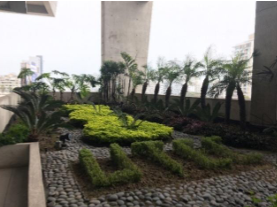
Barranco, the smallest district of Metropolitan Lima, is suffering from serious environmental problems that are affecting its inhabitants. Environmental degradation is a consequence of the increase in large buildings (real estate boom), which reduces green space areas and causes a deficit of vegetation in the district. Additionally, there are high levels of air pollution due to car traffic, which has been accentuated by the lack of green areas in the area, which affects the environmental quality and the population's quality of life (1). Additionally, the district doesn't have more free public areas where new green areas can be created. Due to these combined pressures, the local government has looked for alternatives, considering private areas, which have a high potential to implement green roofs and vertical gardens, which can contribute to face Climate Change as a mitigation strategy and improve the quality of life (1). The Green Roofs and Green Walls strategy is proposed to build citizen culture, nature appreciation, landscape, and ecosystems (2, 3). The aim is, therefore, to encourage the inhabitants of the district to progressively install green roofs and walls, employing an economic incentive in the taxes paid to maintain public green areas (4). The programme is oriented to generate environmental benefits such as the reduction of air pollution, acoustic insulation, thermal comfort, and increase of green areas (m2) per inhabitant, and social benefits such as the improvement of the living conditions and health of the inhabitants of the district (1, 3), the promotion of social relations (1), the aesthetic improvement of the city, and the possibility of producing food for self-consumption, as there is support in the implementation of hydroponic systems in the green walls and roofs (1, 3). Its implementation focuses on new, under construction or existing residential, commercial, office or lodging buildings (3).
Overview
Nature-based solution
- Nature on buildings (external)
- Green roofs
- Green walls or facades
Key challenges
- Climate action for adaptation, resilience and mitigation (SDG 13)
- Climate change mitigation
- Environmental quality
- Air quality improvement
- Noise reduction
- Green space, habitats and biodiversity (SDG 15)
- Green space creation and/or management
- Regeneration, land-use and urban development
- Promote natural styles of landscape design for urban development
- Health and well-being (SDG 3)
- Improving physical health
- Social justice, cohesion and equity (SDG 10)
- Social interaction
- Economic development and employment (SDG 8)
- Economic development: agriculture
Principal problems in Functional Urban Area (FUA)
- Climate-Related Hazards
- Heat stress & Extreme temperatures
- Environmental Degradation
- Air pollution
- Land use and Socio-economic change
- Rapid urbanization
- Unequal availability and access to public green spaces
Key priorities
Focus
Project objectives
Implementation activities
Climate-focused activities
Climate change adaptation:
- Implement green walls or roofs to lower indoor temperature and provide insulation
Climate change mitigation:
- Increase the availability of green urban space for carbon storage (street tree cover)
- Install vertical or horizontal artificial surfaces that help with carbon storage and cooling
Main beneficiaries
- Private sector/Corporate/Company
- Citizens or community groups
Governance
Management set-up
- Government-led
Type of initiating organisation
- Local government/municipality
Participatory approaches/ community involvement
- Joint implementation (e.g. tree planting)
Details on the roles of the organisations involved in the project
Project implemented in response to ...
Type of enablers
Financing
Total cost
Source(s) of funding
- Corporate investment
- Private funding by citizens
- Other funding sources are unclear
Type of funding
- Tax exemption
- Other funding types are unknown
Non-financial contribution
Impacts and Monitoring
Environmental impacts
- Climate change
- Lowered local temperature
- Expected lowered local temperature
- Environmental quality
- Improved air quality
- Expected improved air quality
- Reduced noise exposure
- Achieved reduced noise exposure
- Green space and habitat
- Increased green space area
- Expected increased green space area
Economic impacts
- Reduce financial cost for urban management
- Expected reduce financial cost for urban management
Socio-cultural impacts
- Social justice and cohesion
- Improved liveability
- Expected improved liveability
- Improved access to urban green space
- Expected improved access to urban green space
- Increased involvement of locals in the management of green spaces
- Expected increased involvement of locals in the management of green spaces
- Health and wellbeing
- Improved prevention of respiratory problems
- Expected improved prevention of respiratory problems
Type of reported impacts
Presence of formal monitoring system
Presence of indicators used in reporting
Presence of monitoring/ evaluation reports
Availability of a web-based monitoring tool
Potential risks of implementation and trade-offs
References
 Information about this nature-based solution was collected as part of the Naturescapes project funded by the European Union under Grant Agreement No 101084341.