

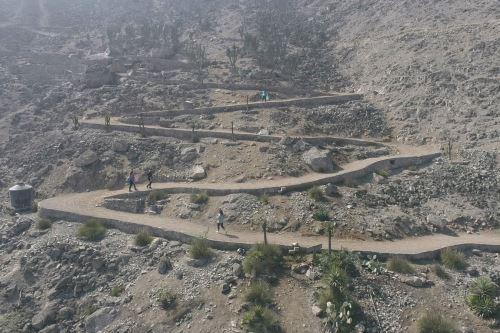
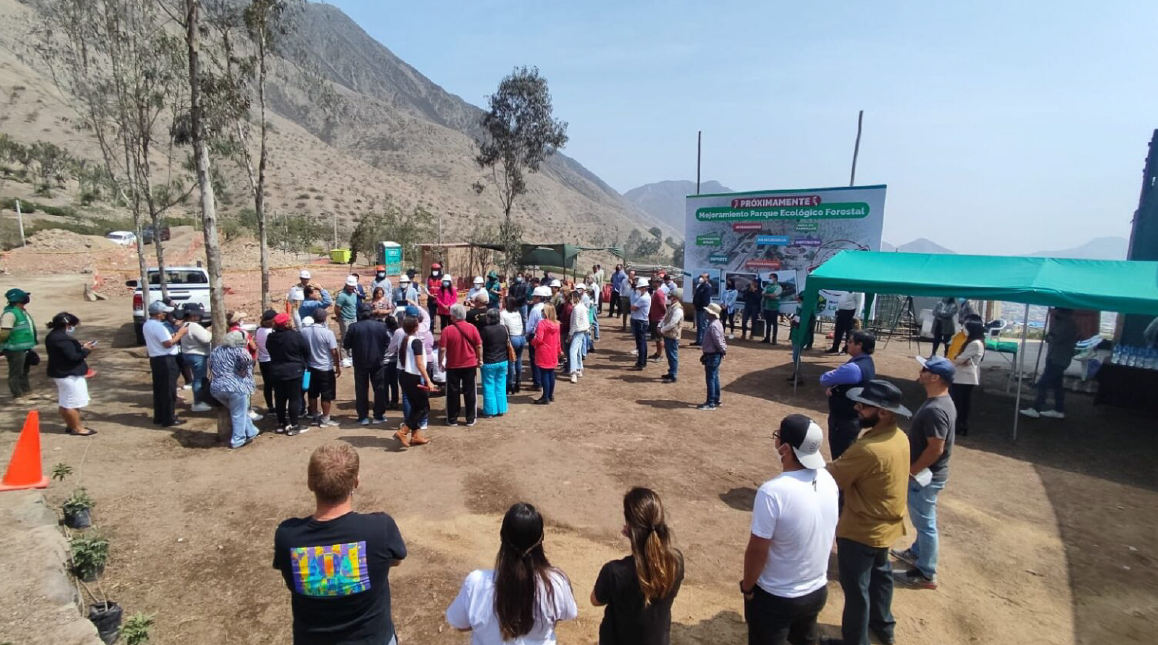
The intervention of the Ecological Park of La Molina is an urban-landscape design project developed between the San Martín de Porres University, through the IVUC, the Institute of Housing, Urban Planning and Construction, and the Municipality of La Molina (7). This is the first ecological park in the city of Lima, located in a characteristic ecosystem such as Las Lomas, between 600-1000 m.a.s.l. (1). It is a natural area that is part of the hill system of Villa María del Triunfo, located in the Subtropical Coastal Desert ecoregion, and is part of the Regional Conservation Area ‘Sistema de Lomas de Lima’ (7). The City Council decided to open this space in 2022 to the public, as a 200-hectare area, designed to bring people closer to nature, through outdoor activities and environmental education about its fauna, flora and microclimates (1). Thus, citizens can enjoy a recreational area with multi-purpose spaces and sports circuits; a cultural area where workshops and an open-air amphitheatre are held; an ecological interpretation area with exhibition galleries and an interpretative route; and an administrative and control area (1). The park also envisages reforestation efforts in areas that are currently arid and infertile to convert them into green areas for the enjoyment of citizens (1). In 2023, conservation efforts were reinforced for an additional 50 hectares, due to the danger posed by encroachment and land trafficking (4).
Overview
Nature-based solution
- Parks and urban forests
- Large urban parks or forests
Key challenges
- Green space, habitats and biodiversity (SDG 15)
- Green space creation and/or management
- Habitat and biodiversity restoration
- Regeneration, land-use and urban development
- Rewilding
- Health and well-being (SDG 3)
- Creation of opportunities for recreation
- Enabling opportunities for physical activity
- Social justice, cohesion and equity (SDG 10)
- Social interaction
- Environmental education
- Sense of community and community engagement
Principal problems in Functional Urban Area (FUA)
- Environmental Degradation
- Deforestation and forest degradation
- Soil degradation and loss
- Desertification
- Land use and Socio-economic change
- Rapid urbanization
- Resource Scarcity and Competition
- Land rights conflicts
Key priorities
Focus
Project objectives
Implementation activities
Biodiversity conservation or restoration-focused activities
Biodiversity restoration:
- Rehabilitate and restore damaged or destroyed ecosystems
- Restore species (native, endangered, or unspecified)
- Restore native species
- Public engagement
Main beneficiaries
- Citizens or community groups
Governance
Management set-up
- Government-led
Type of initiating organisation
- Regional government
- Local government/municipality
Participatory approaches/ community involvement
- Co-planning (e.g. stakeholder workshops, focus groups, participatory mapping)
- Dissemination of information and education
- Joint implementation (e.g. tree planting)
Details on the roles of the organisations involved in the project
Project implemented in response to ...
Type of enablers
Financing
Total cost
Source(s) of funding
- Public local authority budget
Type of funding
- Earmarked public budget
- Membership or entrance fees
Non-financial contribution
- Provision of goods
- Provision of labour
- Provision of expertise
- Public authorities (e.g. land, utility services)
- Citizens (e.g. volunteering)
Impacts and Monitoring
Environmental impacts
- Green space and habitat
- Increased conservation or restoration of ecosystems
- Achieved increased conservation or restoration of ecosystems
- Increased conversion of degraded land or soil
- Expected increased conversion of degraded land or soil
- Increased number of species present
- Achieved increased number of species present
- Increased presence and recovery of wild species
- Achieved increased presence and recovery of wild species
Economic impacts
- Generation of other type of work opportunities (e.g. voluntary, work for rehabilitation)
- Achieved generation of other type of work opportunities (e.g. voluntary, work for rehabilitation)
Socio-cultural impacts
- Social justice and cohesion
- Improved social cohesion
- Expected improved social cohesion
- Improved liveability
- Expected improved liveability
- Improved access to urban green space
- Achieved improved access to urban green space
- Increased involvement of locals in the management of green spaces
- Achieved increased involvement of locals in the management of green spaces
- Health and wellbeing
- Gain in activities for recreation and exercise
- Expected gain in activities for recreation and exercise
- Improved physical health
- Expected improved physical health
- Education
- Increased knowledge of locals about local nature
- Expected increased knowledge of locals about local nature
Type of reported impacts
Presence of formal monitoring system
Presence of indicators used in reporting
Presence of monitoring/ evaluation reports
Availability of a web-based monitoring tool
Potential risks of implementation and trade-offs
References

 Information about this nature-based solution was collected as part of the Naturescapes project funded by the European Union under Grant Agreement No 101084341.